

Highlights
- Bitcoin remained under pressure near the $63,000 mark amid cautious market sentiment.
- Expectations of higher U.S. interest rates continued to weigh on risk-sensitive assets.
- Spot Bitcoin ETF outflows extended for another week, reflecting weak institutional demand.
- Investors continued rotating capital toward sectors with stronger earnings visibility.
- Market participants awaited fresh inflation data for clues on future monetary policy.
Overview
Bitcoin traded below the $63,000 level as the cryptocurrency market struggled to regain momentum. Despite periods of stabilization, the broader sentiment remained cautious as investors continued to evaluate the implications of a higher-for-longer interest-rate environment. Weak institutional participation and ongoing capital outflows from Bitcoin-focused investment products also limited upside potential, keeping the world's largest cryptocurrency under pressure.
Higher Interest Rate Expectations Reduce Risk Appetite
One of the biggest headwinds for Bitcoin remains the outlook for U.S. monetary policy. Markets continue to price in the possibility that interest rates could stay elevated for longer than previously expected. Higher borrowing costs generally reduce demand for speculative assets, as investors shift toward safer investments offering more predictable returns. This environment has made it difficult for cryptocurrencies to attract sustained buying interest.
Institutional Demand Remains Soft
Investor participation through spot Bitcoin exchange-traded products has remained weak, with outflows continuing in recent weeks. Although the pace of withdrawals has slowed, inflows have yet to return in a meaningful way. Persistent outflows indicate that large investors remain cautious toward the asset class, reducing an important source of support for cryptocurrency prices.
Capital Rotation Continues Across Financial Markets
Financial markets have recently witnessed a shift in investor preferences, with capital moving toward sectors perceived to have stronger earnings visibility and clearer growth prospects. This trend has reduced demand for digital assets and other speculative investments. As a result, Bitcoin has struggled to benefit from broader market liquidity despite improvements in certain risk assets.
Inflation Data Remains the Next Major Catalyst
Market participants are closely monitoring upcoming economic data for clues about future monetary policy decisions. Inflation indicators remain particularly important because they influence interest-rate expectations. Any signs that inflation remains elevated could reinforce expectations of tighter financial conditions, while softer readings may provide temporary relief for risk assets, including cryptocurrencies.
Momentum Signals Suggest Consolidation Near Recent Lows
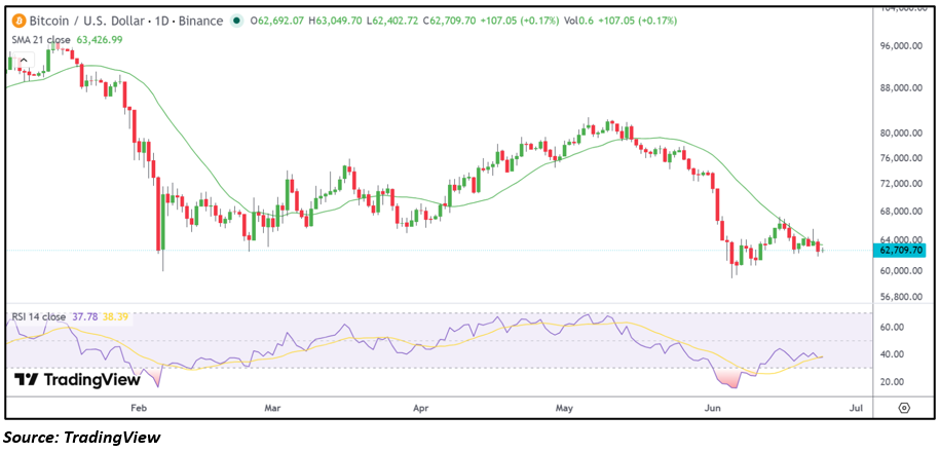
From a technical perspective, Bitcoin remains in a corrective phase following its sharp decline from higher levels earlier this year. The price continues to trade below a declining trend structure, indicating that bullish momentum remains limited. While recent sessions have shown some stabilization near the $62,000–$63,000 region, buyers have yet to generate enough strength to establish a meaningful recovery. The current price action reflects a market that is consolidating while awaiting fresh directional catalysts.
Key Price Zones Traders Are Monitoring
Bitcoin is currently trading near $62,700. Immediate support is visible around the recent swing low near $60,500, which has acted as an important short-term floor. A break below this area could expose the cryptocurrency to further weakness toward the $58,000 region. On the upside, resistance is located near $64,500, followed by a stronger hurdle around $67,000 where previous recovery attempts stalled. A sustained move above these resistance zones could improve sentiment and signal the beginning of a broader recovery phase.
What Could Shape Bitcoin's Next Move?
Bitcoin's near-term direction will likely depend on interest-rate expectations, institutional fund flows, inflation data, and overall risk sentiment across global financial markets. A return of ETF inflows and easing concerns over monetary policy could provide support for prices, while continued outflows and persistent rate fears may keep the cryptocurrency under pressure.
Risks to Watch
- Further ETF outflows from Bitcoin investment products.
- Stronger-than-expected inflation data.
- Additional increases in interest-rate expectations.
- Weak risk appetite across global markets.
- Increased volatility in cryptocurrency trading activity.
FAQ
Why is Bitcoin trading below $63,000?
Bitcoin remains under pressure due to concerns about higher interest rates, weak institutional demand, and continued ETF outflows.
How do interest rates affect Bitcoin?
Higher interest rates tend to reduce demand for speculative assets because investors can earn better returns from lower-risk investments.
Why are ETF outflows important?
ETF flows are closely watched because they provide insight into institutional investor sentiment and capital allocation trends.
What are traders watching now?
Investors are monitoring inflation data, interest-rate expectations, fund flows, and broader market sentiment for clues about Bitcoin's next move.
What are the key Bitcoin levels to watch?
Support is located near $60,500 and $58,000, while resistance is seen around $64,500 and $67,000.