

Highlights
- Bitcoin remains under pressure near the $63,000 mark after a sharp weekly decline.
- Persistent ETF outflows and institutional selling continue to weigh on market sentiment.
- Rising geopolitical tensions and higher interest-rate expectations have increased risk aversion across crypto markets.
Bitcoin Faces a Tough Recovery Attempt
Bitcoin has managed to stabilize near the $63,000 level after experiencing one of its sharpest weekly declines of the year. While the cryptocurrency has attempted a modest rebound, broader market sentiment remains fragile as investors continue reducing exposure to riskier assets.
The recent weakness comes amid a combination of sustained fund outflows, institutional profit-taking, and growing geopolitical uncertainty. These factors have overshadowed positive developments within the digital asset ecosystem and kept traders cautious despite Bitcoin's recovery efforts.
ETF Withdrawals Continue to Weigh on Sentiment
One of the biggest challenges for Bitcoin has been the continued withdrawal of capital from spot exchange-traded funds. Persistent outflows suggest institutional investors remain cautious about near-term cryptocurrency performance.
Large-scale withdrawals from crypto investment products often create additional selling pressure, reducing liquidity and limiting upside momentum. The trend has raised concerns that institutional demand, which helped fuel previous rallies, may remain subdued until market conditions improve.
Geopolitical Risks Add Another Layer of Uncertainty
Escalating tensions in the Middle East have also contributed to a risk-off environment across global financial markets. Investors have increasingly shifted toward defensive assets as concerns about broader economic and geopolitical instability intensify.
Higher oil prices resulting from regional tensions have renewed inflation concerns. If inflation remains elevated, central banks could maintain tighter monetary policies for longer than previously expected, reducing the appeal of speculative assets such as cryptocurrencies.
Interest Rate Expectations Remain a Headwind
Recent economic data has reinforced expectations that interest rates may stay elevated for an extended period. Strong labour market conditions and persistent inflation risks have lowered expectations for aggressive policy easing.
Higher interest rates typically increase the attractiveness of fixed-income investments while reducing investor appetite for non-yielding assets. This environment has created additional pressure on digital assets and contributed to Bitcoin's recent weakness.
Altcoins Also Feel the Impact
The broader cryptocurrency market has mirrored Bitcoin's struggles. Major alternative cryptocurrencies experienced significant volatility as traders reassessed risk exposure amid global uncertainty.
Although some digital assets staged short-term rebounds, overall market sentiment remains cautious. Investors continue monitoring capital flows, macroeconomic developments, and geopolitical events for signs of a more sustainable recovery.
Technical Picture Shows Weak Momentum
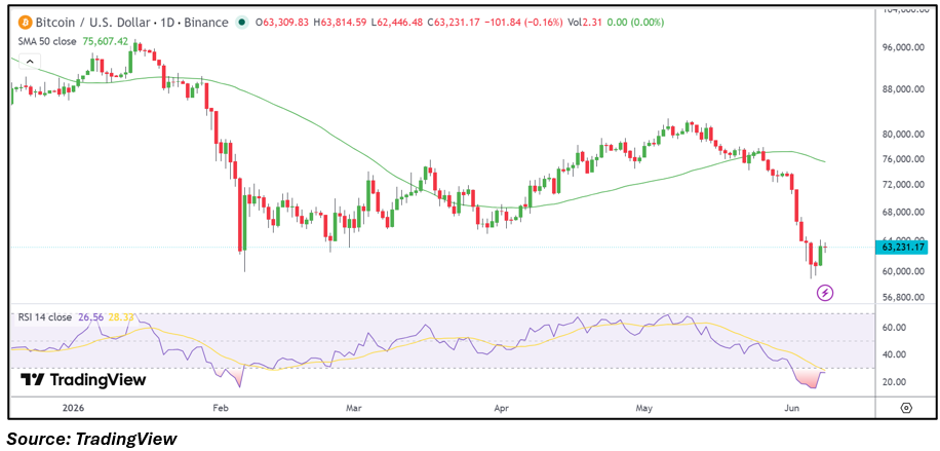
From a technical perspective, Bitcoin remains below its 50-day simple moving average of 75,607.42, indicating that the broader trend remains under pressure. The cryptocurrency is currently trading near 63,231.17, significantly below recent highs.
Momentum indicators also reflect weakness. The 14-day RSI has fallen to 26.56, placing Bitcoin in oversold territory. While oversold conditions can sometimes trigger short-term rebounds, they do not necessarily signal the end of a broader corrective phase.
Key Technical Levels
Bitcoin is currently trading around 63,231.17. Immediate downside levels are seen near 60,069.61 and 57,909.61, while recovery attempts could face hurdles near 66,392.73 and 69,552.73. A sustained move above resistance levels may improve sentiment, while a break below support could invite additional selling pressure.
Key Risks
- Continued ETF outflows reducing institutional demand.
- Escalating geopolitical tensions increasing market volatility.
- Higher-for-longer interest rate expectations.
- Further weakness in broader risk assets and equity markets.
Summary
Bitcoin remains under pressure near $63,000 as investors navigate a challenging mix of ETF outflows, institutional selling, geopolitical tensions, and elevated interest-rate expectations. While oversold technical conditions may support short-term stabilization, sentiment remains cautious. Market participants are likely to focus on capital flows, macroeconomic data, and geopolitical developments for clues regarding Bitcoin's next major move.
FAQs
Why is Bitcoin trading near $63,000?
Bitcoin has faced pressure from sustained ETF outflows, institutional selling, and increasing geopolitical uncertainty, which have weakened investor sentiment.
How do ETF outflows affect Bitcoin prices?
ETF outflows indicate investors are withdrawing capital from crypto-focused investment products, often increasing selling pressure and reducing liquidity.
What are the major factors to watch for Bitcoin?
Investors should monitor ETF flows, interest-rate expectations, inflation trends, and geopolitical developments that may influence overall risk appetite.