

Easing crude-linked input costs, volume recovery and management confidence are driving a broad-based re-rating across India's fast-moving consumer goods sector — and three names are leading the charge.
Key Highlights
- Godrej Consumer Products Limited (NSE: GODREJCP) surged +4.87% to ₹1,079.30 on 8 April, with the day's high touching ₹1,093.80, as double-digit consolidated volume growth in Q4 FY26 provisional results reinforced investor confidence.
- Dabur India Limited (NSE: DABUR) gained +3.02% to ₹426.75, with operating margin expansion supported by moderating input costs and approximately 5–6% YoY revenue growth in its latest quarterly results.
- Varun Beverages Limited (NSE: VBL) led the intraday momentum, rising +5.08% to ₹421.20, driven by capacity expansion and sustained international demand growth.
- All three stocks opened strongly and held gains through the afternoon session, signalling institutional conviction rather than speculative intraday activity.
- The rally reflects a broader sector rotation into consumer staples as crude-linked derivative prices ease, compressing raw material costs for FMCG producers across the board.
Market Context: Why FMCG Is Moving Now
India's FMCG sector has long been regarded as a defensive anchor within the NSE ecosystem — a place where institutional money parks capital during periods of macroeconomic uncertainty. In April 2026, however, the sector is attracting capital not merely for its defensive qualities, but for a more constructive reason: the simultaneous improvement of both volume growth and cost economics.
The catalyst is a meaningful decline in crude oil prices and, by extension, crude-linked derivatives — the petrochemical inputs that underpin packaging materials, surfactants, and a wide range of raw materials critical to FMCG manufacturing. When crude falls, FMCG margins typically expand with a lag of one to two quarters as lower-cost inventory flows through to the income statement. The market, forward-looking by nature, is pricing this dynamic in now.
Overlaid on this cost tailwind is evidence of genuine volume recovery in the India consumption story. Rural demand — which had been the sector's most persistent weak point through FY24 and into FY25 — is showing signs of stabilisation and, in some categories, recovery. This combination of improving margins and recovering volumes is a powerful earnings upgrade catalyst, and the market is responding accordingly.
The three companies examined in this article — Godrej Consumer Products, Dabur India, and Varun Beverages — each represent a distinct facet of the Indian FMCG opportunity, and each is benefiting from the current tailwind in meaningfully different ways.
Company Analysis
Godrej Consumer Products Limited (NSE: GODREJCP)
Price: ₹1,079.30 | Day's Change: +₹50.15 (+4.87%) | 8 April 2026, 2:26 PM IST
Company Overview
Godrej Consumer Products Limited (GCPL) is one of India's most geographically diversified FMCG companies, with a portfolio spanning home care, personal care, and hygiene categories. Its flagship brands — Godrej No.1, HIT, Good Knight, and Cinthol, among others — command strong category positions in the domestic market, while a deliberate international expansion strategy has built meaningful businesses across Africa, Indonesia, and Latin America.
GCPL's investment thesis rests on three pillars: category leadership in Home & Hygiene in India, profitable international market growth, and the operational leverage that comes from scaling a branded consumer business with strong distribution depth. The company has invested consistently in brand building and innovation, and its management team has demonstrated a willingness to exit underperforming geographies and redeploy capital toward higher-return opportunities.
Financial Update — Q4 FY26 Provisional Results
Based on GCPL's latest business update filed with exchanges for Q4 FY26 (provisional):
- Double-digit consolidated volume growth — the most significant data point from the provisional update, signalling that GCPL's India business is firing on all cylinders
- India business performance described as strong, with management commentary pointing to broad-based category gains rather than concentration in a single segment
- International market stabilisation — after a period of currency headwinds and macroeconomic volatility in key African and Indonesian markets, management has flagged improving conditions
- The provisional nature of Q4 FY26 results means full margin and profitability data are not yet available, but volume growth at double-digit levels — if sustained into the audited results — would represent a material positive surprise relative to consensus expectations
GCPL's market capitalisation stands at ₹1.10 lakh crore, reflecting its blue-chip status within the Indian consumer space. Its P/E ratio of 60.61 is at a premium to the broader market, justified by the quality of its brand portfolio and the earnings visibility that comes with category leadership. The dividend yield of 1.85% with a quarterly dividend amount of ₹4.99 reflects management's commitment to shareholder returns alongside reinvestment for growth.
Price Performance
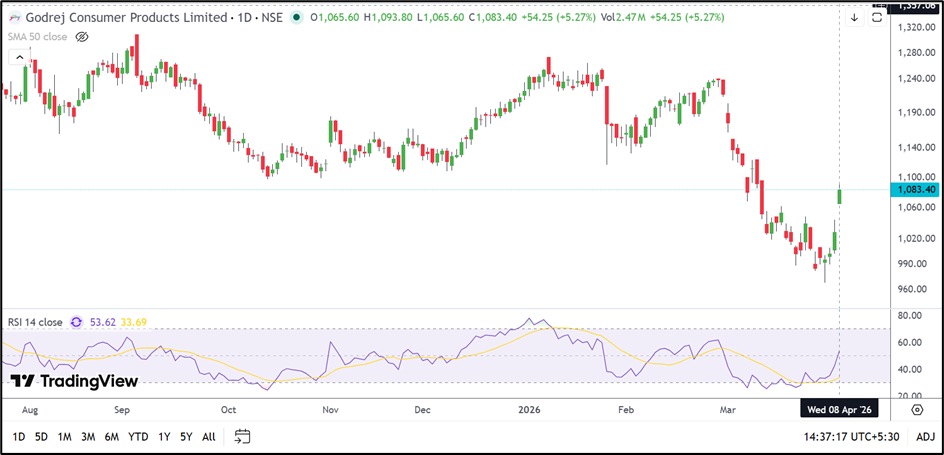
GCPL opened at ₹1,065.60 and reached a day's high of ₹1,093.80 before settling at ₹1,079.30 by mid-afternoon — a steady, orderly advance that speaks to institutional buying rather than retail-driven momentum. The previous close of ₹1,029.15 implies a gap-up open, suggesting overnight positioning ahead of the results-driven catalyst.
The 52-week range of ₹967.05 – ₹1,309.00 places the current price in the lower half of the annual range, which is significant. Despite today's strong move, GCPL remains materially below its 52-week high, suggesting that the re-rating still has meaningful headroom if volume growth translates into the margin expansion the market anticipates.
Technical Guidance
GCPL's intraday chart shows a strong opening gap followed by a push toward ₹1,093.80 — a level that acted as near-term resistance through the afternoon session. Key technical levels to monitor:
- Immediate resistance: ₹1,093.80 (intraday high) and ₹1,100 (psychological round number)
- Support: ₹1,065.60 (today's open) and ₹1,029.15 (previous close / gap fill level)
- A sustained close above ₹1,100 on volume would open the path toward the ₹1,150–₹1,200 range on a medium-term basis
- The gap between current price and the 52-week high of ₹1,309.00 represents approximately 21% upside — a recovery that would require sustained earnings delivery over the next two to three quarters
Source: TradingView
Management Outlook
GCPL's management has consistently articulated a strategy of premiumisation in India, deeper rural distribution penetration, and disciplined capital allocation in international markets. The Q4 FY26 provisional update reinforces this narrative. Looking ahead, investors will be focused on:
- Whether double-digit volume growth in Q4 FY26 can be sustained into FY27
- The trajectory of gross margin recovery as lower crude-linked input costs flow through
- International market performance, particularly in Africa, where currency stabilisation could provide an additional earnings tailwind
Dabur India Limited (NSE: DABUR)
Price: ₹426.75 | Day's Change: +₹12.50 (+3.02%) | 8 April 2026, 2:25 PM IST
Company Overview
Dabur India is one of the oldest and most trusted FMCG brands in India, with a heritage spanning more than 130 years. The company's portfolio is anchored in health and wellness — a strategic positioning that has become increasingly relevant as Indian consumers prioritise natural, Ayurvedic, and science-backed health products.
Key category positions include digestives (Hajmola), juices (Real), oral care (Dabur Red), hair care (Vatika), and a broad range of health supplements and OTC healthcare products. Dabur's rural distribution network is among the deepest in the Indian FMCG sector, making it particularly sensitive to — and a beneficiary of — rural demand recovery.
Financial Update — Latest Quarterly Results
Based on Dabur India's most recent company press release and quarterly results:
- Revenue growth of approximately 5–6% YoY — a moderate but consistent growth rate that reflects the company's large base and diversified category exposure
- Operating margins supported by moderating input costs — the easing of crude-linked raw material prices has provided direct relief to Dabur's cost of goods, with management commentary suggesting a favourable input cost environment through the near term
- No meaningful revenue concentration risk — Dabur's portfolio breadth across health, personal care, and food categories provides a natural hedge against category-specific demand volatility
Dabur's market capitalisation of ₹75,470 crore positions it as a large-cap FMCG name, though at a meaningful discount to peers like GCPL and Hindustan Unilever. Its P/E ratio of 41.08 is the most modest among the three stocks featured in this article, which may reflect the market's more cautious view on Dabur's near-term growth acceleration potential. The dividend yield of 1.87% with a quarterly dividend amount of ₹2.00 is consistent with the company's long-standing shareholder return policy.
Price Performance
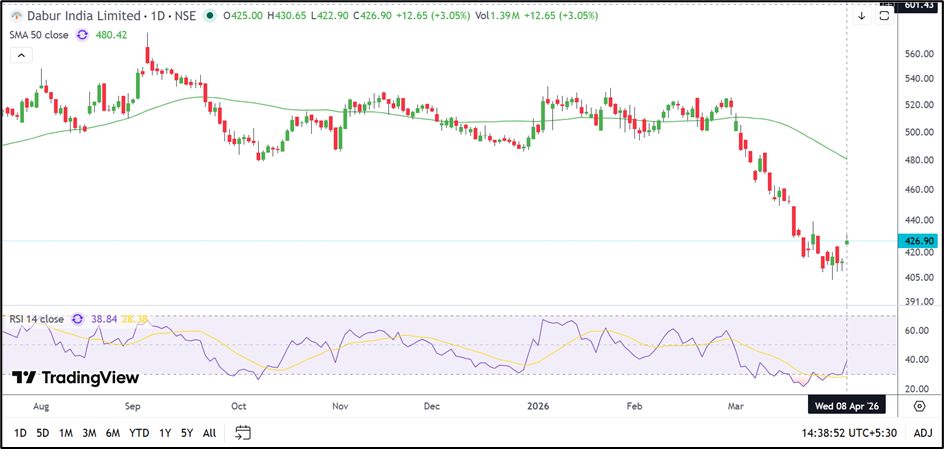
Dabur opened at ₹425.00, reached a high of ₹430.65, and traded at ₹426.75 in the mid-afternoon session. The previous close of ₹414.25 implies approximately 3% overnight appreciation — a move that reflects both the sector tailwind and stock-specific optimism around margin recovery.
The 52-week range of ₹403.35 – ₹577.00 tells a sobering story: at ₹426.75, Dabur remains close to its 52-week low and trades at a substantial discount — approximately 26% — to its 52-week high. This positioning makes Dabur arguably the most value-oriented name in this peer group for investors willing to take a medium to long-term view on earnings recovery.
Technical Guidance
Dabur's intraday chart shows a strong opening that held its gains through the session, with ₹430.65 acting as the first meaningful resistance level.
- Immediate resistance: ₹430.65 (intraday high) and ₹440 (next technical level)
- Support: ₹425.00 (today's open) and ₹414.25 (previous close)
- Medium-term watch: A sustained move above ₹440–₹450 would signal a technical base formation and could attract momentum-oriented institutional buyers
- The distance from current price to the 52-week high of ₹577.00 represents approximately 35% upside — the largest recovery potential among the three stocks, though also reflecting the greatest degree of earnings uncertainty
Source: TradingView
Management Outlook
Dabur's management has emphasised rural distribution expansion and portfolio premiumisation as the twin engines of its medium-term growth strategy. The current input cost environment is constructive, and management has flagged its intention to reinvest a portion of margin gains into brand investment — a strategy that typically supports long-term market share at the expense of near-term margin optically. Key priorities include accelerating the health supplements category and deepening international business performance, particularly in Middle Eastern and African markets.
Varun Beverages Limited (NSE: VBL)
Price: ₹421.20 | Day's Change: +₹20.35 (+5.08%) | 8 April 2026, 2:27 PM IST
Company Overview
Varun Beverages is one of PepsiCo's largest bottling franchises globally outside the United States, manufacturing and distributing PepsiCo's full portfolio of carbonated soft drinks, juices, and packaged water across India and a growing number of international markets including Sri Lanka, Nepal, Morocco, Zambia, and Zimbabwe.
VBL's investment case is built on the structural growth of India's organised beverage market, the company's aggressive capacity expansion program, and the compounding benefit of geographic diversification through international franchise agreements. The company has consistently delivered on its expansion commitments — a track record that has earned it a premium valuation among Indian consumer discretionary names.
Financial Update — Latest Investor Communication
Based on VBL's most recent investor communication and management commentary:
- Capacity expansion remains the central operational narrative, with new plants commissioned in India and internationally to support growing demand
- International market growth has been a standout performer, with management highlighting sustained volume momentum across African and South Asian territories
- Demand momentum sustained — management's characterisation of demand conditions as robust is particularly relevant heading into the peak summer season, which represents VBL's most critical revenue quarter
- Input cost dynamics are favourable: as a significant user of PET (polyethylene terephthalate) packaging — a crude-linked material — VBL benefits directly from the current decline in petrochemical prices
VBL's market capitalisation of ₹1.42 lakh crore makes it the largest company by market cap among the three featured in this article — a reflection of the market's confidence in the structural beverage consumption growth story in India. Its P/E ratio of 46.93 sits between GCPL and Dabur, reflecting growth premium without the extreme multiple that might invite valuation concern. The dividend yield of 0.36% with a quarterly dividend amount of ₹0.38 signals that VBL remains in active reinvestment mode, prioritising capacity and geographic expansion over near-term shareholder distributions.
Price Performance
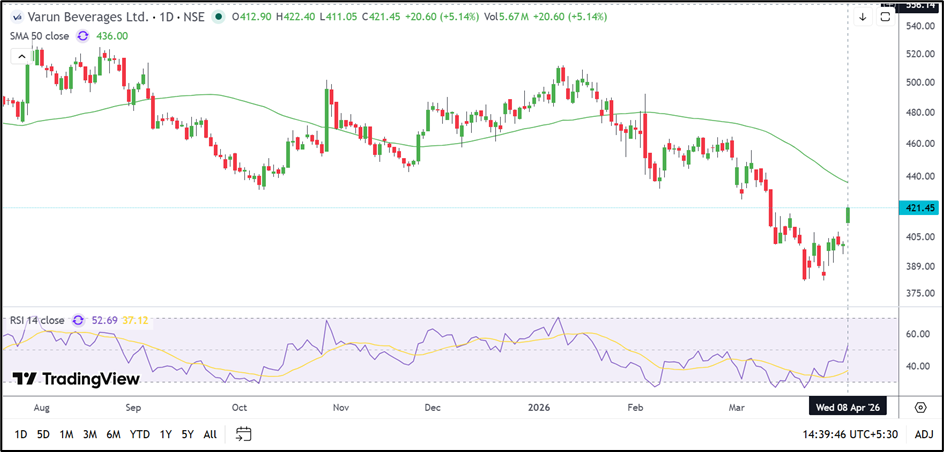
VBL delivered the strongest intraday performance of the three stocks, opening at ₹412.90 and reaching a high of ₹422.40 before settling at ₹421.20. The previous close of ₹400.85 makes today's gain the most significant in absolute terms across the peer group — a move of more than 5% on what appears to be meaningful volume participation.
The 52-week range of ₹381.00 – ₹568.50 places VBL, like its peers, in the lower half of its annual range. The current price represents approximately 26% discount to the 52-week high — meaningful recovery potential if the summer season delivers on management's demand outlook.
Technical Guidance
VBL's intraday chart is the most constructive of the three — a steady, ascending price action from open to close without significant intraday retracement, suggesting consistent buying interest through the session.
- Immediate resistance: ₹422.40 (intraday high) and ₹430 (next technical level)
- Support: ₹412.90 (today's open) and ₹400.85 (previous close)
- Medium-term watch: A sustained move above ₹430–₹440 ahead of the summer season results would be a technically significant breakout
- The proximity of the summer peak season — typically Q2 calendar year — makes the next 6–8 weeks a critical performance window for VBL investors
Source: TradingView
Management Outlook
VBL's management has been consistently bullish on both India's beverage consumption trajectory and the company's capacity to capture incremental market share through distribution expansion and new product introduction. Key themes for the year ahead include the rollout of energy drinks and functional beverages under the PepsiCo franchise umbrella, deeper penetration into tier-2 and tier-3 Indian cities, and continued geographic diversification through its African franchise operations.
Cross-Stock Insight: The Margin Recovery Trade
The simultaneous strength across GCPL, Dabur, and VBL on 8 April is not coincidental — it reflects a deliberate and rational investor response to a well-understood macroeconomic dynamic. When crude oil prices fall, FMCG input costs follow with a quarter or two of lag. Investors who understand this transmission mechanism position early, ahead of the reported margin improvement, and the current move is consistent with exactly that playbook.
What distinguishes the current rally from prior speculative episodes is the supporting evidence from company filings. GCPL's double-digit volume growth, Dabur's confirmed margin support from moderating costs, and VBL's capacity-driven demand capture are not narrative — they are data points from exchange filings and management communications. This gives the rally a fundamental foundation that short-term traders will respect and long-term investors will find reassuring.
Frequently Asked Questions (FAQs)
Q: Why are FMCG stocks rising today specifically?
The primary catalyst is the easing of crude oil and crude-linked derivative prices, which directly reduces input costs for FMCG manufacturers. Combined with company-specific positive developments — particularly GCPL's double-digit volume growth — the sector is attracting broad institutional interest.
Q: Which of the three stocks offers value at current prices?
This depends on investor preference. Dabur trades closest to its 52-week low and carries the lowest P/E among the three, making it the most value-oriented option. GCPL offers the strongest recent volume growth momentum. VBL provides the most direct leverage to India's beverage consumption growth story with peak summer season ahead.
Q: Is the FMCG rally sustainable or just a one-day move?
The sustainability of the rally depends on whether input cost relief persists and whether volume growth holds through Q1 FY27. If crude prices remain subdued and rural consumption continues to recover, FMCG earnings upgrades over the next two quarters could sustain and extend the re-rating.
Q: What are the key risks to this investment thesis?
The primary risks are a reversal in crude oil prices, a rural consumption slowdown driven by a weak monsoon or agrarian stress, and any company-specific execution misstep — particularly in international operations for GCPL and VBL.
Q: What should investors watch in the coming weeks?
Q4 FY26 audited results across all three companies will be the most important near-term catalyst. VBL's summer season volumes (April–June) will be particularly significant given the seasonal nature of its revenue profile. Any management commentary on FY27 guidance at results calls will be closely scrutinised.