

Highlights
- Grasim approved INR 3,094 crore capex for Lyocell capacity expansion.
- Total Lyocell capacity addition at Harihar will reach 165K TPA.
- The stock rose 1.65 percent to INR 3,104 following the announcement.
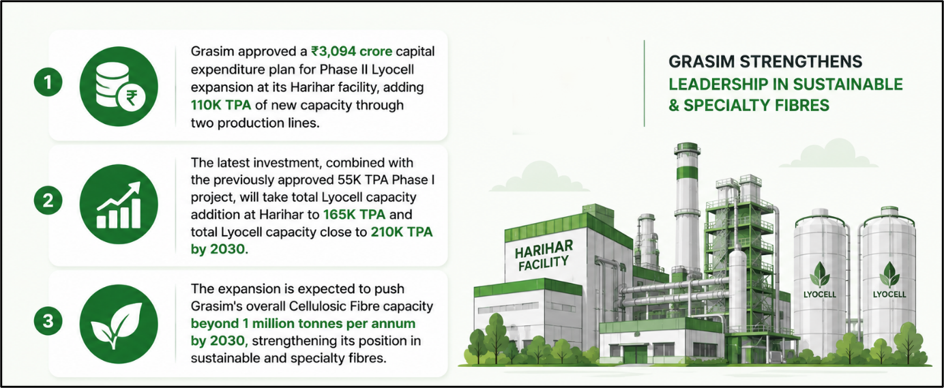
Grasim Industries Limited (NSE:GRASIM) announced that its Board of Directors has approved a capital expenditure of INR 3,094 crore for Phase II expansion of Lyocell capacity at its Harihar facility in Karnataka. The decision was taken at the board meeting held on June 8, 2026, and disclosed under SEBI Listing Regulations.
The investment is aimed at expanding the company's third-generation Cellulosic Staple Fibre (CSF) capabilities through additional Lyocell production lines. The announcement comes as Grasim continues to increase its presence in specialty fibre segments catering to global textile markets.
Capacity Expansion to Add 110K TPA in Phase II
According to the company, the approved Phase II project will add 110K tonnes per annum (TPA) of Lyocell capacity through two separate production lines of 55K TPA each. The first line is expected to be commissioned by mid-2028, while the second line is scheduled for commissioning by mid-2030. The latest approval follows an earlier decision taken in February 2025 to establish a 55K TPA Lyocell facility at the same location.
Once both phases are completed, the total capacity addition at Harihar will reach 165K TPA. The company currently operates 890K TPA of Cellulosic Staple Fibre capacity and reported capacity utilisation of 97 percent during FY2026.
Source: TradingView
Total CSF Capacity Expected to Cross One Million Tonnes
Grasim stated that the cumulative impact of the expansion projects will take its overall Cellulosic Fibre capacity beyond one million tonnes annually by 2030.
The company noted that once the Phase I and Phase II projects are operational, total Lyocell capacity will approach 210K TPA. This expansion is expected to increase the contribution of specialty fibre products within Grasim's portfolio.
The company indicated that specialty products, including Lyocell, Modal, Dope-dyed and Recycled Fibres, are expected to account for around 35 percent of its portfolio by 2030.
Management Highlights Long-Term Fibre Strategy
Commenting on the announcement, Mr. Kumar Mangalam Birla, Chairman, Aditya Birla Group, said:
“The Aditya Birla Group has always demonstrated the willingness to invest ahead of the curve in sectors that will define India’s future competitiveness and economic resilience. This investment carries forward that legacy. It is a vote of confidence in the scale and promise of the Indian market, aligns closely with the aspirations of Make in India, and will help position India as a more competitive and resilient force in the global textile industry.”
He further added:
“This investment also marks another significant step in Grasim’s strategic expansion of advanced fibre capabilities, catering to the growing global demand for sustainable and high-performance textile materials. This fresh expansion will catapult Grasim’s overall Cellulosic Fibres capacity beyond 1 million tonnes per annum, reinforcing its position as a global leader in sustainable Man-Made Cellulosic Fibres (MMCF).”
Mr. Vadiraj Kulkarni, Business Head, Grasim Pulp & Fibre, said:
“This expansion strengthens our position in the evolving MMCF landscape by scaling a high-value, future-ready fibre segment. By expanding Lyocell capacity, we are accelerating the shift towards high performance fibres with a lower environmental impact. Lyocell enhances our product mix, supports premium applications, and aligns with our focus on delivering differentiated, sustainable solutions to global markets.”
Focus on Lyocell and Specialty Fibres
Lyocell is used in apparel, home textiles and technical textile applications. The fibre is manufactured through a closed-loop production process and is known for characteristics such as durability, breathability and comfort.
Grasim stated that the expansion will support its specialty fibre portfolio and increase its participation in higher-value fibre categories. The project rationale, according to the company, is to support growing global demand for sustainable and high-performance textile materials.
The company plans to finance the investment through a combination of internal accruals and borrowed funds.
Key Risks to Monitor
- Project commissioning timelines may face execution-related delays.
- Borrowed funding could increase financing obligations.
- Demand fluctuations may affect specialty fibre utilisation.
- Raw material cost changes could influence profitability.
Today’s Share Performance
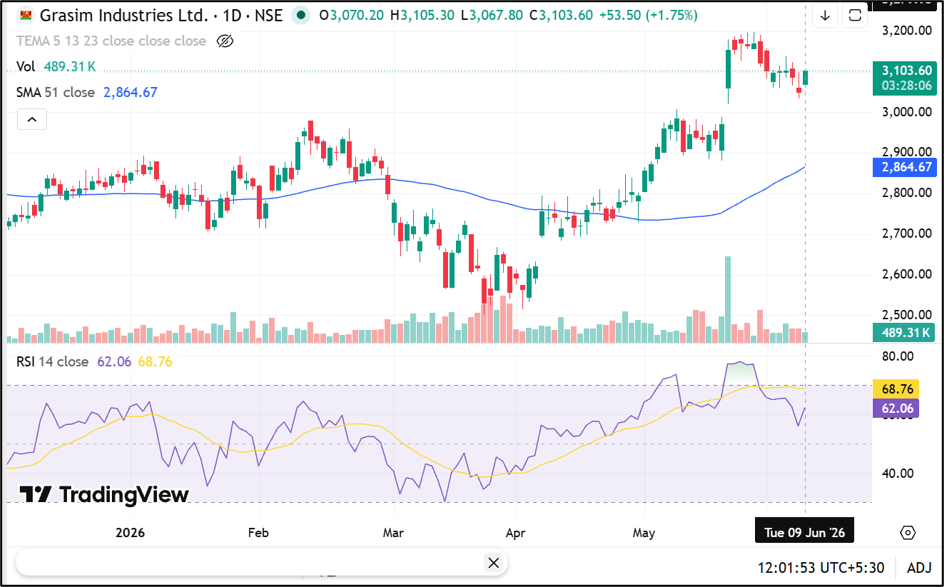
Grasim Industries shares traded higher on June 9, 2026, the stock was trading at INR 3,103.60, up 1.75 percent from the previous close of INR 3,050.10. The stock opened at INR 3,070.20 and touched an intraday high of INR 3,105.30, while the day's low stood at INR 3,067.80. The volume-weighted average price (VWAP) was INR 3,093.78.
Source: TradingView
Summary
Grasim Industries has approved an INR 3,094 crore investment to expand Lyocell manufacturing capacity at Harihar, Karnataka. The Phase II project will add 110K TPA, taking the combined capacity addition at the facility to 165K TPA alongside the previously approved Phase I expansion. The company expects total Cellulosic Fibre capacity to exceed one million tonnes annually by 2030, while shares gained 1.65 percent following the announcement.
FAQs
Q: What capex has Grasim Industries approved for Lyocell expansion?
A: The board approved INR 3,094 crore for Phase II Lyocell capacity expansion at Harihar, Karnataka.
Q: How much new capacity will the Phase II project add?
A: The project will add 110K TPA through two Lyocell production lines of 55K TPA each.
Q: When are the new Lyocell facilities expected to be commissioned?
A: The first line is expected by mid-2028 and the second line by mid-2030.