

D-Link India Ltd (NSE: DLINKIND) carries one of the highest payout ratios on this screen at 93.82%, translating into a 5.06% dividend yield at a CMP of Rs 516. The company is the Indian listed entity of the Taiwan-headquartered global networking products brand D-Link, and its capital-light distribution model makes it structurally suited to high shareholder payouts — though the near-zero profit growth (0.66% quarterly) raises a question about whether the current payout is a ceiling rather than a floor.
Key Highlights
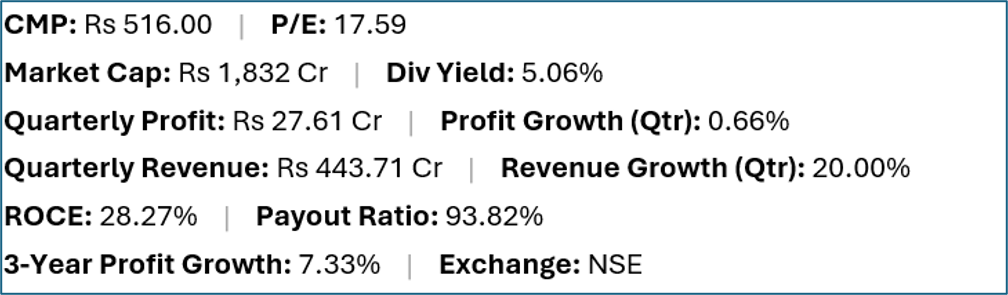
- D-Link India (NSE:DLINKIND) offers a trailing dividend yield of 5.06% at a current market price of Rs 516.00.
- Quarterly net profit stood at Rs 27.61 crore, representing a 0.66% change year-on-year on revenues of Rs 443.71 crore (20.00% change).
- Return on capital employed (ROCE) stands at 28.27%, with a dividend payout ratio of 93.82%.
- Market capitalisation is approximately Rs 1,832 crore. Three-year profit growth is 7.33%.
Financial Snapshot
Company Overview and Business Model
D-Link India is the exclusive distributor and local operating entity for D-Link Corporation's networking products in India. Its product portfolio spans consumer and business networking hardware: wireless routers and access points, network switches, network surveillance cameras, structured cabling and broadband modems. The company sells through a combination of retail channels, e-commerce platforms, and direct enterprise and government accounts.
The India networking products market has seen sustained volume growth driven by broadband expansion, enterprise network upgrades, and smart home adoption. D-Link India benefits from the parent brand's global R&D and product pipeline without carrying product development costs itself — the India entity is primarily a sales, marketing and distribution business. This asset-light model explains why ROCE of 28.27% is respectable despite the company not manufacturing anything domestically.
The company competes with TP-Link, Netgear, Cisco and domestic assemblers in a market where price competition has intensified, particularly in the consumer wireless segment.
Financial Review
Quarterly revenue of Rs 443.71 crore grew 20.00% year-on-year — a solid top-line performance — while net profit of Rs 27.61 crore grew just 0.66%. The sharp divergence between revenue growth and profit growth indicates margin compression, likely from product mix shift toward lower-margin consumer products, increased competition on pricing, or higher operating costs. A payout ratio of 93.82% means nearly all profits are being paid out as dividends, leaving very limited retained earnings for growth investment.
Dividend Profile and History
D-Link India has historically operated with a high payout policy, consistent with its role as a distribution subsidiary of a global parent company. The 5.06% yield is supported by the current profit level, but the 93.82% payout ratio provides minimal buffer if profits decline further. Revenue growth of 20% without commensurate profit growth is a yellow flag — if margin pressure persists, the dividend could face adjustment. That said, D-Link India's track record of consistent payouts reflects its parent-subsidiary dynamic where excess cash is typically remitted rather than accumulated.
Future Outlook
D-Link India's growth outlook is tied to broadband penetration rates in India — particularly in tier-2 and tier-3 cities — enterprise network modernisation, and government digitalisation programmes. The Wi-Fi 6 and Wi-Fi 7 upgrade cycle is a potential revenue driver as consumers and enterprises replace older access points. However, the company faces intensifying competition from Chinese networking brands and margin pressure from rupee depreciation (products are imported). Any sharp INR/USD movement affects product costs directly since D-Link India does not manufacture locally.
Investor Insights
- The 93.82% payout ratio is the highest on this list — income investors benefit, but there is virtually no earnings cushion; any profit decline will likely result in a dividend cut.
- Revenue growing at 20% while profit grew only 0.66% over the same period is a significant margin compression signal that warrants detailed examination of the cost structure.
- D-Link India does not manufacture; its profitability is determined by the spread between import prices (linked to USD and global component costs) and local selling prices — a margin that is competed away aggressively in networking hardware.
- At P/E 17.59 with near-zero profit growth, the valuation is not obviously cheap — investors are paying a premium for the reliable dividend payout, not earnings growth.
Frequently Asked Questions
Q: What products does D-Link India sell?
A: D-Link India distributes wireless routers, network switches, IP surveillance cameras, structured cabling solutions and broadband modems under the global D-Link brand. It sells through retail, e-commerce and enterprise channels across India.
Q: Why does D-Link India have such a high payout ratio?
A: As a distribution subsidiary of D-Link Corporation Taiwan, D-Link India's business model generates strong cash flows relative to the capital required to run it. Rather than accumulating cash, the company distributes most of its profits. The 93.82% payout reflects this structural preference for shareholder remittance.
Q: Is D-Link India's dividend at risk?
A: The near-zero profit growth (0.66%) despite 20% revenue growth is a margin-compression signal. If margins do not recover, the high payout ratio means the dividend could be reduced. Investors should monitor quarterly profit margins closely.
Q: Is D-Link India suitable for income investors?
A: This is general commentary only. The yield is real and backed by current profits, but the thin earnings coverage at 93.82% payout means the margin for safety is low. This is a name where profit trajectory monitoring is essential.
Conclusion
D-Link India delivers a 5.06% yield through one of the highest payout ratios on this screen, which makes it an attractive income stock in periods of stable profitability. The concern is that revenue growth of 20% is not converting to profit growth, which means the dividend is being maintained at the expense of earnings expansion rather than being funded by it. Income investors should track margin trends across the next two to three quarters to assess whether the 93.82% payout is sustainable at the current profit level.