

📌 Key Highlights
- Eight stocks approaching ex-dividend dates with aggregate dividend payout of Rs 36 per share
- Tata Technologies and HDB Financial Services among the prominent names
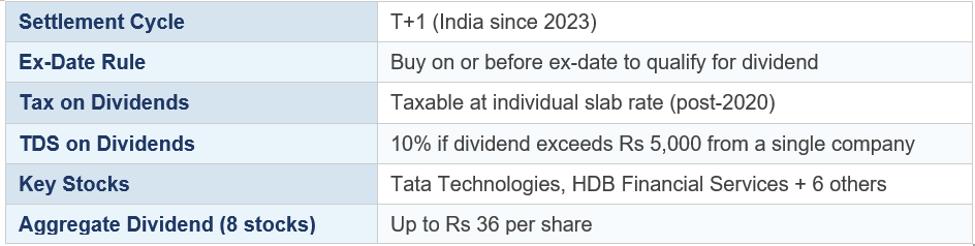
- Ex-dividend date rule: investors must buy shares at least one trading day before ex-date to receive dividend
- Dividend yield investing remains a core strategy in volatile market conditions
- HDB Financial Services is a recently listed NBFC — a subsidiary of HDFC Bank
- Dividends from domestic companies are taxable in the hands of investors at slab rate
- Record date and ex-date are typically the same under T+1 settlement in India
📋 Quick Facts
📰 The Story
With multiple companies approaching their ex-dividend dates, investors have a narrow window to acquire shares in eight companies — including Tata Technologies and the recently listed HDB Financial Services — and qualify for dividend payouts aggregating to approximately Rs 36 per share. The Economic Times has flagged these stocks as time-sensitive dividend opportunities ahead of their respective record dates.
Under India's T+1 settlement system (adopted since January 2023), shares purchased on a given day are credited to the buyer's demat account the following business day. This means investors must buy shares on or before the ex-dividend date to have their names appear on the company's register on the record date and qualify for the dividend.
Tata Technologies (NSE: TATATECH), a subsidiary of Tata Motors listed in November 2023, has been a high-profile name in the engineering R&D and IT services space. The company serves global automotive and aerospace OEMs and has been growing its digital engineering services portfolio. Its dividend declaration reflects confidence in current-year earnings and cash generation capability.
HDB Financial Services, the NBFC subsidiary of HDFC Bank, is a more recent entrant to the listed space following its long-awaited IPO. As an NBFC focused on retail and SME lending, HDB Financial's dividend policy post-listing will establish a baseline expectation for future payouts — making this first post-IPO dividend particularly watched by institutional investors.
Dividend investing has seen renewed interest in India as equity market volatility has increased in 2025-26. High-dividend yield stocks provide a partial buffer against capital loss — the dividend income acts as a return floor, reducing the effective break-even price for the investor. Sectors with historically high dividend yields include PSU banks, oil and gas companies, and established IT services firms.
Investors should note the tax implications: under the current regime (post-Finance Act 2020), dividends received by individuals are added to total income and taxed at the applicable slab rate. TDS at 10% is deducted by the company if the aggregate dividend from a single company exceeds Rs 5,000 in a financial year. For high-income investors, this makes dividend stocks less tax-efficient than capital gains from long-term equity holdings (taxed at a flat 12.5% for gains exceeding Rs 1.25 lakh).
📊 Financial Analysis
Dividend yield investing requires distinguishing between sustainable dividends (backed by strong free cash flow) and cyclical or one-time payouts. For a company like Tata Technologies — which operates in the engineering services space with a global client base — dividends should be evaluated against earnings per share, payout ratio, and cash conversion cycle. Companies with payout ratios below 50% and consistent FCF generation are generally preferred for income investors.
HDB Financial Services' dividend is notable as a signal of financial health and management confidence post-IPO. NBFCs with strong collections, adequate capital buffers, and improving return on equity typically initiate dividend policies that they can sustain — setting a template for future payouts.
From a market timing perspective, dividend-driven buying in the days before ex-dates often creates temporary price support — stocks may run up modestly ahead of the ex-date and then 'go ex' (price drops by approximately the dividend amount on ex-date). This pattern, well-documented in equity markets globally, means purely dividend-motivated buying near ex-dates may result in offsetting capital loss.
💹 Investor Insights
For income-seeking investors, the key metric is dividend yield — the annual dividend per share divided by the current share price. At prevailing market prices, high-yield stocks in the 3-5% range offer competitive returns versus fixed income alternatives at current interest rate levels. However, investors should verify sustainability by examining the dividend payout ratio (dividends as % of EPS) and the company's FCF coverage of dividends.
Tax-aware investors in high income brackets (above 30% slab) may find that dividend income is less tax-efficient than equivalent returns from growth equity or equity mutual funds — where long-term capital gains are taxed at 12.5% versus 30%+ on dividends.
Frequently Asked Questions (FAQs)
- How do I ensure I receive a dividend?
- You must own the shares in your demat account on the record date. Under T+1 settlement, you need to buy shares on or before the ex-dividend date (which is typically the same as the record date for most companies). Check the specific ex-date for each stock.
- What happens to the share price on ex-dividend date?
- On the ex-dividend date, the stock exchange theoretically adjusts the opening reference price downward by the dividend amount. In practice, market forces may result in a smaller or larger decline depending on investor sentiment and broader market conditions.
- Are dividends tax-free in India?
- No — since April 2020, dividends are taxable in the hands of investors at their applicable income tax slab rate. Prior to 2020, companies paid Dividend Distribution Tax (DDT) and dividends were tax-free for recipients up to Rs 10 lakh.
- What is the difference between ex-date and record date?
- The record date is the date on which the company checks its register to identify shareholders eligible for the dividend. The ex-date is the first date on which the stock trades without the right to the upcoming dividend. Under T+1 settlement, ex-date and record date are typically the same.