

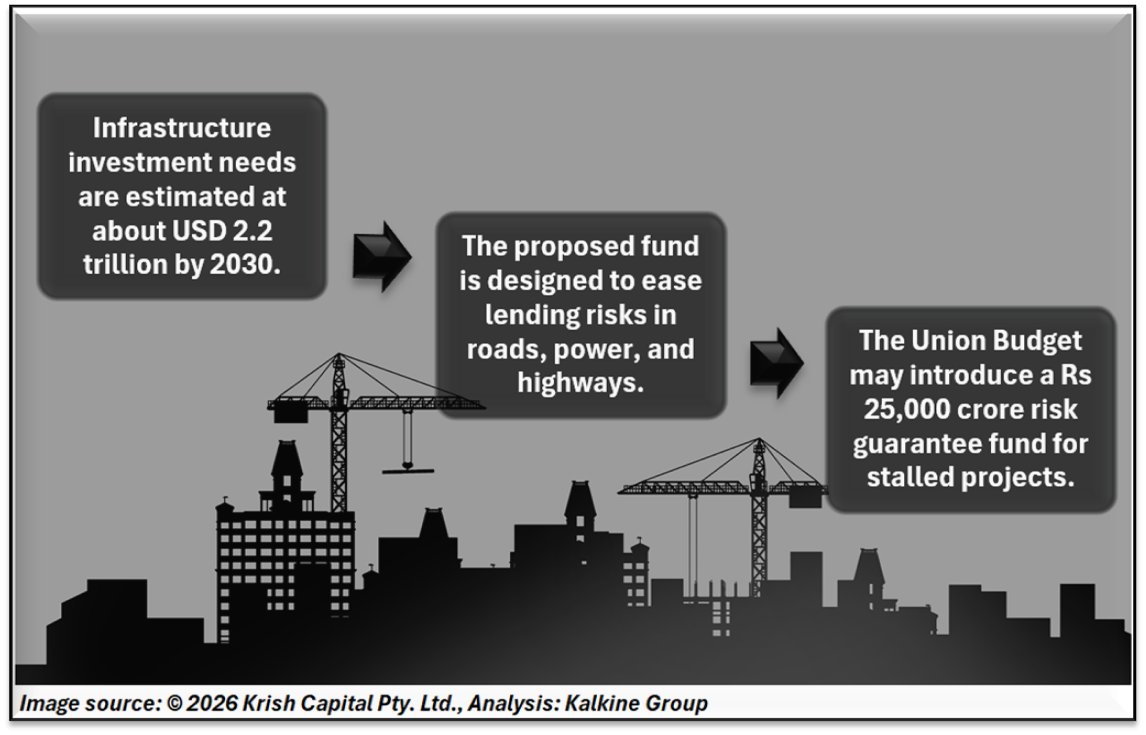
The Union government is considering the introduction of a ₹ 25,000 crore fund in the upcoming Union Budget to address delays in stalled infrastructure projects across India. The proposed fund is intended to support projects facing financial stress, particularly in sectors such as roads, highways, and power, where execution timelines have been affected by persistent funding constraints.
Reasons Behind Project Delays
Several infrastructure projects have experienced prolonged delays due to higher construction costs, land acquisition challenges, regulatory clearances, and elevated interest rates. These factors have increased perceived risk for banks and financial institutions, resulting in cautious lending behaviour. As a result, multiple projects have remained incomplete or have not progressed beyond initial stages.
Structure of the Risk Guarantee Fund
The proposed ₹25,000 crore fund is expected to function as a risk guarantee mechanism. Under this structure, the government would provide partial protection to lenders if projects encounter financial or execution difficulties. The concept was recommended by a committee under the National Bank for Financing Infrastructure and Development. The National Credit Guarantee Trustee Company is expected to manage the scheme, following credit guarantee frameworks already used in other segments.
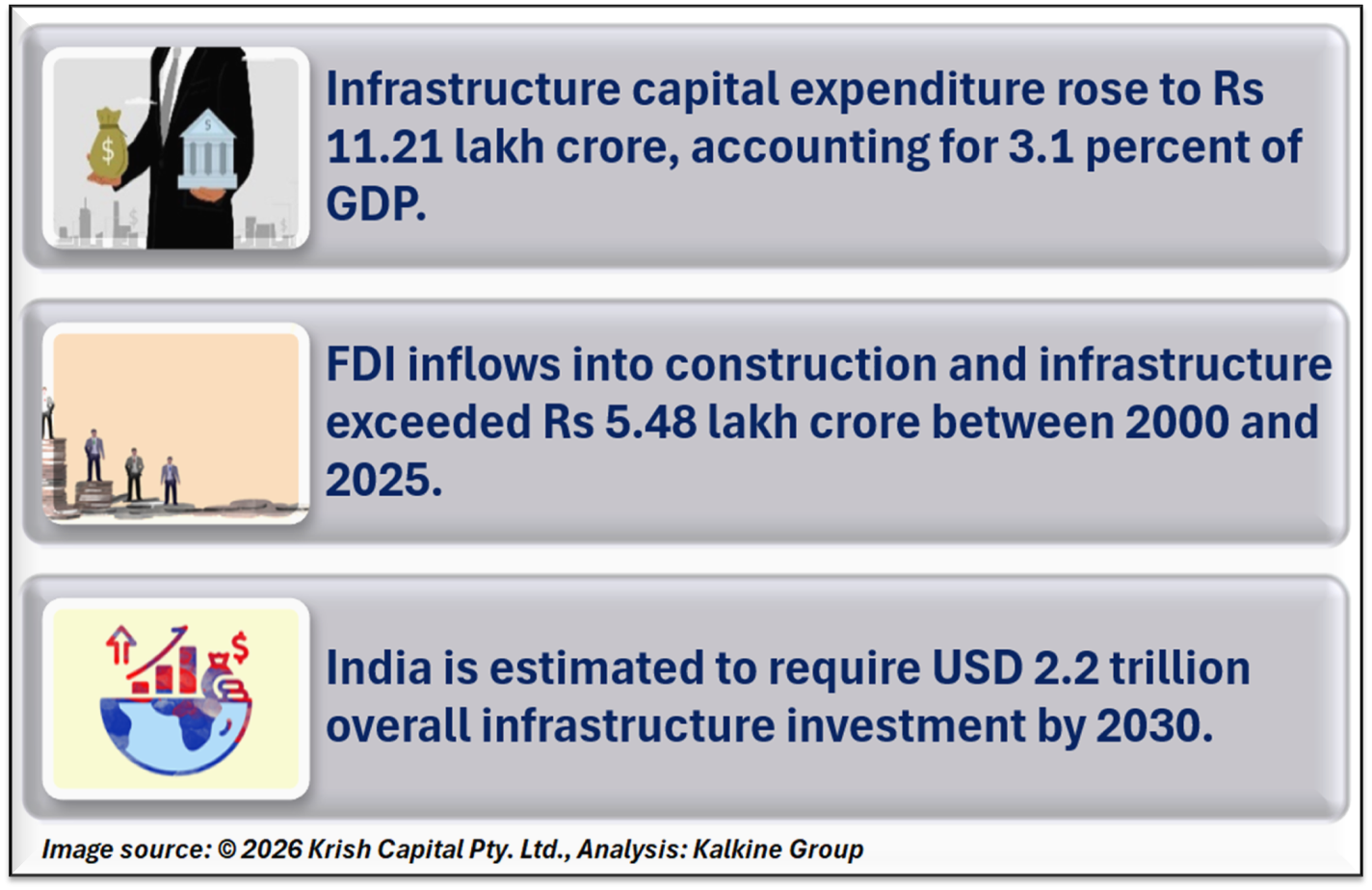
In the Union Budget 2025–26, infrastructure capital expenditure was raised to ₹11.21 lakh crore, equivalent to 3.1 percent of GDP. The government also extended the 50-year interest-free loan scheme for state capital expenditure to ₹1.5 lakh crore. Between April 2000 and June 2025, FDI into construction and infrastructure-related activities exceeded ₹ 5.48 lakh crore, reflecting continued investor participation.
Government estimates indicate that India will require infrastructure investment of around USD 2.2 trillion by 2030 to support its target of becoming a USD 7 trillion economy. While public capital expenditure has remained elevated, private investment has been limited due to project-level risks.
Broader Infrastructure Landscape
Cement consumption in India is projected to grow at a rate of 7–8 percent annually during FY25–FY27, supported by housing, roads, and urban development. The REIT market size stood at about ₹ 1.54 lakh crore as of August 2025 and is expected to expand to around ₹ 2.14 lakh crore by 2029, with yields ranging between 6–7.5 percent.
Conclusion
Overall, the proposed ₹ 25,000 crore risk guarantee fund reflects a policy effort to address credit constraints affecting stalled infrastructure projects. Against the backdrop of elevated public capital expenditure, sustained FDI inflows, and significant long-term investment requirements, the initiative seeks to mitigate project-level risks for lenders. However, the extent to which private investment responds will depend on the effectiveness of the fund’s design, implementation, and impact on project execution.