

Highlights
- RBI Bulletin says an adverse monsoon could affect growth prospects.
- Global economic risks remain elevated despite the temporary West Asia truce.
- India's economic fundamentals continue to provide resilience against external shocks.
India's economic outlook remains supported by relatively strong domestic fundamentals, but a weaker-than-expected south-west monsoon could create challenges for growth and inflation in the months ahead, according to an article on the State of the Economy published in the June edition of the RBI Bulletin. The assessment comes at a time when policymakers are closely monitoring weather conditions, global geopolitical developments and commodity price movements.
The bulletin noted that while India's economy has entered the current period of global uncertainty with stronger macroeconomic conditions than many countries, risks linked to rainfall patterns could influence agricultural production, food prices and overall economic activity.
Source: Analysis by Kalkine
Monsoon Emerges As A Key Domestic Risk
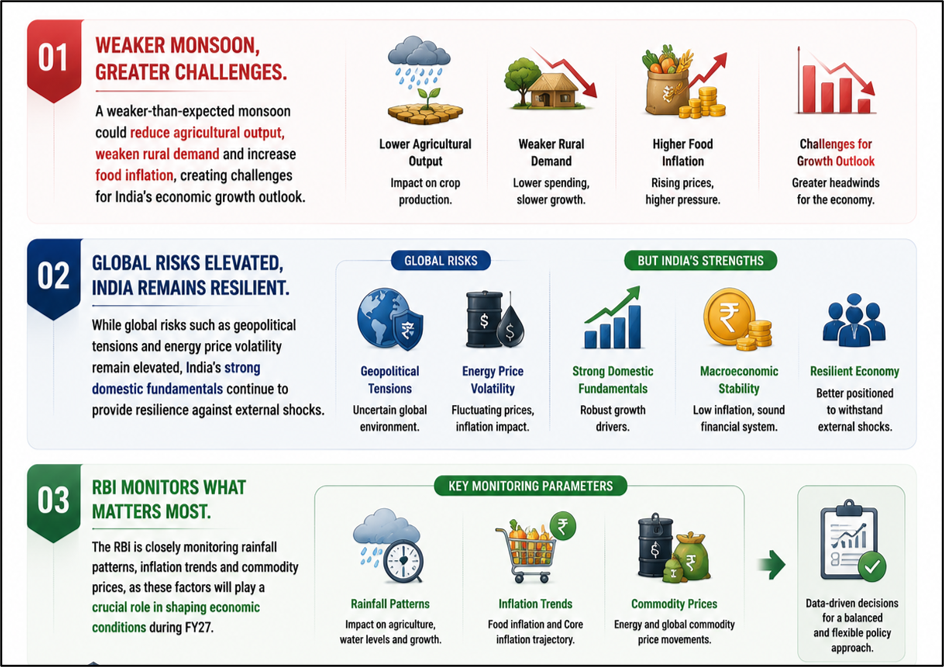
The south-west monsoon plays a crucial role in India's economy, supporting agriculture, rural incomes and consumer demand. Any significant shortfall in rainfall can affect crop yields, reduce farm output and place upward pressure on food prices. These developments can subsequently influence inflation and economic growth.
The RBI Bulletin highlighted that an adverse monsoon could weigh on both growth and inflation, making weather conditions one of the most closely watched domestic variables in the current economic environment. The concern comes amid forecasts that suggest rainfall this year may be below historical averages.
Global Uncertainty Continues Despite Temporary Relief
Beyond domestic factors, the RBI Bulletin pointed to continuing uncertainty in the global economy. Although the interim peace agreement between the United States and Iran has provided some relief to financial markets, policymakers believe global risks remain elevated. Geopolitical tensions, supply-chain disruptions and trade-related uncertainties continue to influence economic activity worldwide.
According to the bulletin, any deterioration in the geopolitical situation could lead to higher inflation expectations, disruptions to critical energy infrastructure, delayed investment decisions and increased financial market volatility. Such developments could affect economies across the world, including India.
Strong Domestic Fundamentals Offer Support
Despite these concerns, the RBI noted that India's economy remains relatively well positioned to absorb external shocks. The bulletin stated that the country entered the current period of uncertainty with stronger economic fundamentals compared with many other economies.
India's economic performance has been supported by domestic consumption, investment activity and resilience across several sectors. High-frequency indicators during the initial months of FY27 have also pointed to continued economic momentum despite external challenges.
The RBI has previously indicated that while risks remain, the economy continues to demonstrate resilience amid global turbulence. Policymakers are expected to closely monitor developments related to weather conditions, inflation and commodity prices over the coming months.
Inflation Risks Remain Under Watch
Food inflation remains one of the key concerns associated with a weaker monsoon. Lower rainfall can affect agricultural output and create supply shortages for certain crops, potentially leading to higher food prices. Rising food inflation can have broader implications for household spending and monetary policy decisions.
The RBI has already flagged monsoon performance as an important factor in determining future inflation trends. Combined with energy price volatility and geopolitical developments, weather-related disruptions remain a major area of focus for policymakers.
Economic Outlook Depends On Multiple Variables
While monsoon performance is important, it represents only one element of the broader economic picture. Global oil prices, geopolitical developments, trade conditions and domestic demand trends will also play a significant role in shaping India's growth trajectory during FY27.
The RBI Bulletin suggests that maintaining economic stability will require continuous monitoring of both domestic and international developments. Although risks have increased, India's economic buffers and underlying fundamentals continue to provide a degree of protection against external shocks.
Key Risks
- Weak monsoon may reduce agricultural output and rural incomes.
- Food inflation could rise due to lower crop production.
- Higher oil prices may increase inflationary pressures.
- Geopolitical tensions could disrupt global trade and investment.
Summary
The RBI Bulletin has warned that an adverse south-west monsoon could affect India's growth and inflation outlook despite the country's relatively strong economic fundamentals. While domestic demand and investment continue to support economic activity, policymakers remain cautious about risks arising from weather conditions, food inflation, geopolitical tensions and commodity price volatility. The bulletin indicates that India's economy remains resilient, but continued monitoring of both domestic and global developments will be important in the months ahead.
FAQs
Q: Why is the RBI concerned about the monsoon?
A: A weak monsoon can affect crop production, rural incomes and food inflation.
Q: What global risks did the RBI Bulletin highlight?
A: Geopolitical tensions, trade disruptions and energy-related uncertainties remain significant concerns.
Q: Does the RBI believe India's economy remains resilient?
A: Yes, the bulletin noted that India has relatively strong economic fundamentals.