

Highlights
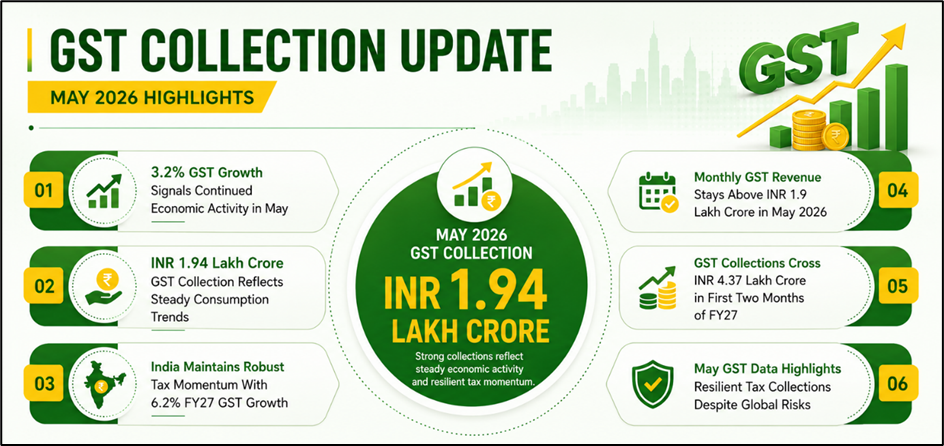
- India's gross GST collections rose 3.2% year-on-year in May 2026.
- Total GST revenue for May stood at INR 1.94 lakh crore.
- April-May FY27 GST collections increased 6.2% to INR 4.37 lakh crore.
India's gross Goods and Services Tax (GST) collections stood at INR 1,94,184 crore in May 2026, registering a 3.2% increase compared with the corresponding month last year.
The latest figures indicate continued growth in indirect tax collections, although the pace was slower than some of the higher growth rates recorded in previous periods. The collections for May reflect economic activity and transactions undertaken during April 2026.
May marks the second consecutive month after the beginning of the conflict in West Asia, a development that has been closely monitored due to its potential impact on global trade, commodity prices, and economic activity.
 Source: Analysis by Kalkine
FY27 Begins With Higher GST Revenue
For the first two months of FY27, gross GST collections totaled INR 4.37 lakh crore, reflecting a 6.2% year-on-year increase compared with the corresponding period of the previous financial year.
The cumulative growth suggests that tax collections have continued to expand despite a mixed global economic backdrop. GST collections are often viewed as a broad indicator of consumption, business activity, and economic momentum across sectors.
The April-May figures provide an early snapshot of revenue trends for the current financial year and will be closely watched by policymakers and market participants in the coming months.
GST Remains a Key Economic Indicator
GST collections are among the most closely followed economic indicators in India because they provide insight into consumption patterns, manufacturing activity, services demand, and compliance levels.
Higher collections can be influenced by factors such as increased economic activity, inflation, improved tax compliance, and growth in formal sector transactions. Conversely, slower growth in collections may reflect moderation in demand or changes in business conditions.
The May data indicates that collections remained near the INR 2 lakh crore mark, continuing a trend of elevated monthly GST revenues seen in recent years.
Why Markets Track GST Data
Investors, economists, and policymakers monitor GST collections as they offer an indication of economic activity across multiple sectors. Strong tax collections can support government revenues and fiscal planning, while also providing clues about consumption trends and business sentiment.
The April-May FY27 growth of 6.2% will likely be assessed alongside other economic indicators such as industrial production, retail inflation, exports, and corporate earnings to gauge the broader trajectory of the economy.
Key Risks
- Slower consumer spending could affect future GST growth.
- Global economic uncertainty may impact business activity.
- Commodity price volatility could influence consumption patterns.
- Geopolitical developments may affect trade and economic sentiment.
Summary
India's gross GST collections rose 3.2% year-on-year to INR 1,94,184 crore in May 2026. For the first two months of FY27, cumulative GST collections reached INR 4.37 lakh crore, reflecting growth of 6.2% compared with the same period last year. The figures indicate continued expansion in tax revenues and remain an important indicator of economic activity and consumption trends.
FAQs
Q: What was India's GST collection in May 2026?
A: India's gross GST collection stood at INR 1,94,184 crore in May 2026.
Q: How much did GST collections grow in May 2026?
A: Gross GST collections increased 3.2% year-on-year compared with May 2025.
Q: What were the GST collections during April-May FY27?
A: Gross GST collections totaled INR 4.37 lakh crore, up 6.2% year-on-year.