

The Indian Rupee has recently experienced notable depreciation, dipping to a new low of 85.93 per U.S. Dollar on Thursday. This marks a continued decline from the previous day’s close of 85.87, with the currency standing at 85.878 as of 2:13 PM IST on January 9, 2025. The ongoing weakening of the Rupee has drawn significant attention, with market experts attributing the decline to a combination of both domestic and global factors influencing the currency's performance.
Key Global Factors Contributing to the Weakening of the Rupee
A prominent reason for the Indian Rupee's fall is the strengthening of the U.S. Dollar. The Dollar Index, which measures the U.S. Dollar’s performance against a basket of global currencies, surged to 109.07 by 4:21 a.m. EST. This uptick in the Dollar has increased its appeal among investors, putting pressure on emerging market currencies, including the Indian Rupee.
In addition to this, the U.S. 10-year Treasury yield saw a sharp rise, reaching 4.677% at 4:29 AM EST. This increase in bond yields makes U.S. assets more attractive, boosting demand for the Dollar. Consequently, this has led to the depreciation of other currencies, including the Rupee, as investors shift their attention toward U.S. assets.
U.S. Policies and Federal Reserve Impact
The ongoing uncertainty regarding U.S. President Donald Trump’s policies has contributed to heightened market volatility. Expected inflationary pressures tied to Trump’s economic proposals have raised concerns, influencing the strength of the U.S. Dollar. Investors are also anticipating measured rate cuts by the Federal Reserve, further boosting the appeal of the Dollar. As a result, these combined factors have contributed to a stronger Dollar, which continues to apply downward pressure on the Indian Rupee.
The Influence of the Non-Deliverable Forwards (NDF) Market and RBI's Response
The Non-Deliverable Forwards (NDF) market has significantly contributed to the weakening of the Indian Rupee due to strong demand for the U.S. Dollar. This demand has increased pressure on the Rupee, driving further declines. In response, the Reserve Bank of India (RBI) has likely intervened, using its foreign exchange reserves to stabilize the currency and mitigate excessive volatility.
What Lies Ahead for the Indian Rupee?
The Indian Rupee’s outlook remains uncertain, influenced heavily by global factors such as the continued strength of the U.S. Dollar and the upward movement in bond yields. The ongoing volatility in U.S. policies and global markets will continue to impact the Rupee in the short term. However, the RBI’s active involvement in the currency market, along with its management of foreign reserves, will play a pivotal role in controlling the extent of the Rupee’s depreciation.
Despite these pressures, India’s robust economic growth and strong foreign investment inflows may help provide some stability to the currency over time. The RBI’s cautious approach to monetary policy and effective forex management will be key in navigating future challenges and stabilizing the Rupee.
Technical Summary
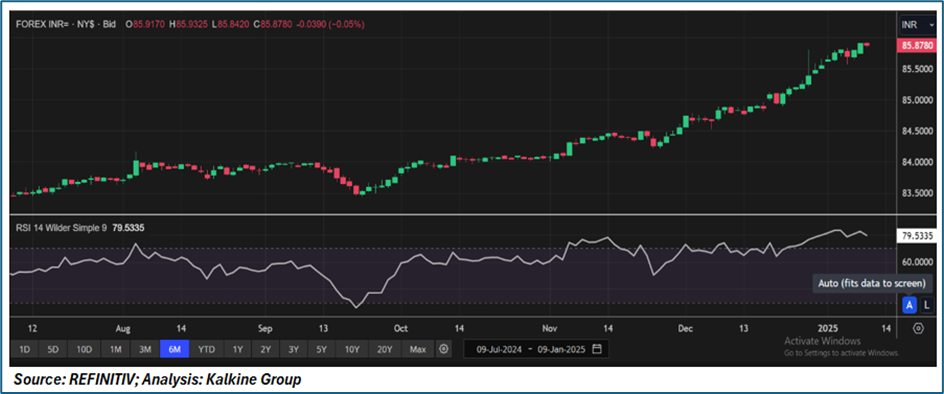
The USD/INR was trading at 85.8780 (as of 9 January 2025, 2:13 PM IST), with a marginal decline of 0.05% for the day. While the trend remains bullish, supported by higher highs and lows since mid-October, the RSI of 79.53 signals overbought conditions, raising the possibility of a price correction or consolidation. Key support lies at 85.5 and 84.5, while resistance is near 86.0. Though the upward momentum persists, overbought conditions may lead to a temporary slowdown or pullback, adding short-term volatility to the pair's movement.
Conclusion
The Indian Rupee’s recent decline to 85.93 against the U.S. Dollar is primarily attributed to a combination of a stronger Dollar, rising U.S. bond yields, and uncertainty surrounding U.S. policies. While the RBI's intervention likely helped limit further depreciation, the outlook for the Rupee remains tied to global economic trends. The central bank’s continued vigilance and strategic management of both monetary policy and forex reserves will be essential in ensuring the stability and strength of the Indian Rupee in the future.