

RBI Adopts a Measured Approach as Inflation Remains Benign and Growth Risks Persist
The Reserve Bank of India (RBI) maintained the benchmark repo rate at 5.25% during its June 2026 Monetary Policy Committee (MPC) meeting, while retaining its 'Neutral' policy stance, reflecting a balanced approach toward supporting economic growth without compromising price stability.
The decision comes at a crucial juncture for the Indian economy, where moderating inflation, resilient domestic demand, and ongoing geopolitical uncertainties continue to shape the macroeconomic landscape. By opting for a pause after recent policy easing measures, the central bank has signaled confidence in the current monetary settings while preserving flexibility to respond to emerging risks.
Policy Pause Reflects Balance Between Growth and Inflation
The RBI's latest decision underscores its commitment to maintaining macroeconomic stability amid an increasingly complex global environment.
While headline inflation remains within the central bank's comfort zone, policymakers highlighted that food price volatility, commodity market fluctuations, and geopolitical developments could create upside risks going forward. At the same time, softer global growth conditions and trade-related uncertainties warrant continued support for economic activity.
The central bank emphasized that underlying inflationary pressures remain contained, although second-round effects from price shocks require close monitoring.
Key Policy Announcements
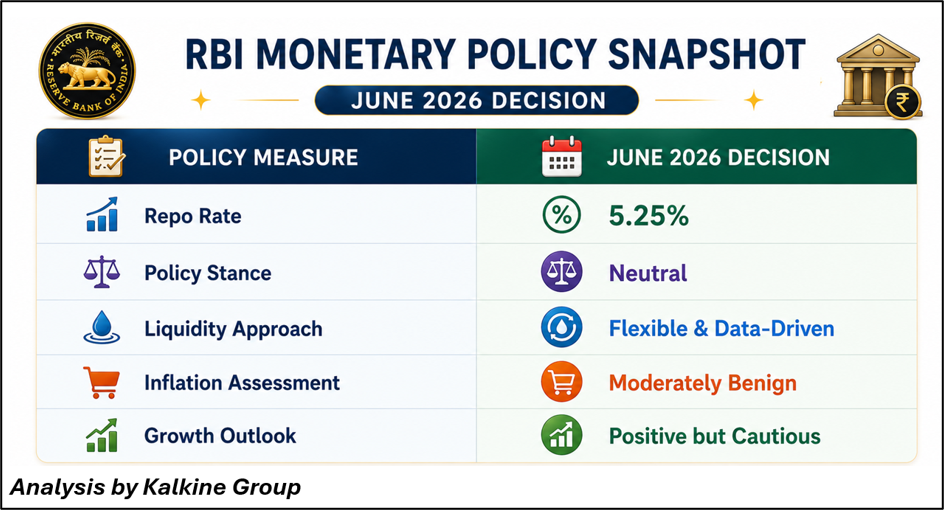
The neutral stance indicates that future policy actions will remain data-dependent, allowing the RBI to respond effectively to evolving inflation and growth dynamics.
Growth Outlook Remains Resilient
Despite external headwinds, India's economic fundamentals continue to remain robust relative to most major economies.
Key growth drivers include:
- Strong domestic consumption trends
- Continued public infrastructure spending
- Expanding manufacturing activity
- Healthy corporate balance sheets
- Rising formalisation of the economy
However, the RBI acknowledged that slowing global demand, geopolitical tensions, and trade disruptions could moderate the pace of economic expansion in FY27.
For investors, the policy statement reinforces confidence that India's long-term growth story remains intact despite near-term global challenges.
Inflation Remains Under Control, But Risks Persist
One of the most encouraging aspects of the policy review was the RBI's assessment that core inflation remains broadly benign.
Nevertheless, policymakers remain watchful of:
- Rising food prices
- Weather-related supply disruptions
- Crude oil volatility
- Imported inflation risks
- Global commodity price movements
The central bank's cautious tone suggests that maintaining price stability remains a key priority even as growth-supportive measures continue.
What the Decision Means for Investors
Equity Markets- The status quo policy is generally viewed as supportive for equities, particularly interest-rate-sensitive sectors such as:
- Banking
- Financial Services
- Real Estate
- Automobiles
- Consumer Discretionary
Stable rates improve earnings visibility and support investment sentiment across corporate India.
Fixed Income Markets- Bond investors are likely to view the policy positively as the RBI's measured stance reduces uncertainty regarding near-term interest rate movements. The pause could help maintain stability in sovereign bond yields while supporting fixed-income asset classes.
Banking Sector- For banks, unchanged rates provide greater balance sheet stability, supporting credit growth while preserving net interest margins.
Why the Neutral Stance Matters
The RBI's decision to maintain a neutral stance may be the most important takeaway for financial markets.
Unlike a hawkish stance, which prioritizes inflation control through tighter policy, or a dovish stance, which focuses on stimulating growth, a neutral approach provides policymakers with maximum flexibility.
This allows the central bank to:
- Respond swiftly to inflation shocks
- Support growth if economic momentum weakens
- Manage liquidity efficiently
- Maintain financial market stability
For investors, policy flexibility reduces the risk of abrupt monetary tightening while preserving confidence in the RBI's inflation-fighting credibility.
Investment Perspective
The latest policy review reinforces India's position as one of the most stable macroeconomic stories among emerging markets.
A combination of:
- Controlled inflation
- Stable interest rates
- Strong domestic demand
- Healthy banking system
- Continued structural reforms
creates a favorable backdrop for long-term capital formation and investment.
While global uncertainties remain elevated, the RBI's measured approach suggests confidence in the economy's underlying resilience and its ability to navigate external shocks.
Conclusion
By keeping the repo rate unchanged at 5.25% and maintaining a neutral policy stance, the RBI has chosen prudence over aggressive action. The move reflects confidence that inflation remains manageable while acknowledging the need to support growth amid an uncertain global backdrop.
For investors, the policy signals continuity, stability, and flexibility—three factors that remain critical for sustaining economic momentum and market confidence in the months ahead.
As inflation trends, global commodity prices, and economic growth evolve, the RBI retains sufficient room to adjust policy if required. Until then, the central bank appears comfortable staying on the sidelines while carefully monitoring incoming data.
Frequently Asked Questions (FAQs)
- Why did the RBI keep the repo rate unchanged?
The RBI believes current monetary conditions are appropriate to balance economic growth and inflation management while preserving policy flexibility.
- What is the current repo rate?
The benchmark repo rate remains unchanged at 5.25%.
- What does a neutral stance mean?
A neutral stance means the RBI is not committed to either raising or lowering interest rates and will make future decisions based on economic data.
- Is the RBI concerned about inflation?
While inflation remains relatively benign, the central bank continues to monitor food prices, commodity costs, and potential second-round inflationary effects.
- Which sectors may benefit from stable interest rates?
Banking, financial services, real estate, automobiles, and consumer-oriented sectors typically benefit from a stable interest-rate environment.
- What should investors watch next?
Investors should monitor inflation data, GDP growth trends, crude oil prices, global economic developments, and future RBI policy guidance.