

RBI Intervenes as Geopolitical Risks Shake Indian Financial Markets
Indian financial markets witnessed heightened volatility on Monday after escalating tensions between the United States and Iran triggered a sharp jump in global crude oil prices, leading to renewed pressure on the Indian rupee, equities, and bond markets.
The Indian rupee weakened beyond the psychological 95-per-dollar mark, reflecting growing investor concerns over rising import costs, inflationary pressures, and potential stress on India’s external balances. Market participants indicated that the Reserve Bank of India (RBI) likely stepped into the foreign exchange market through state-owned banks to curb excessive currency depreciation.
The domestic currency declined nearly 0.75% during the session, while benchmark equity indices also faced selling pressure. The Nifty 50 index slipped over 1%, and yields on India’s benchmark 10-year government bond moved higher, indicating caution among investors amid rising geopolitical uncertainty.
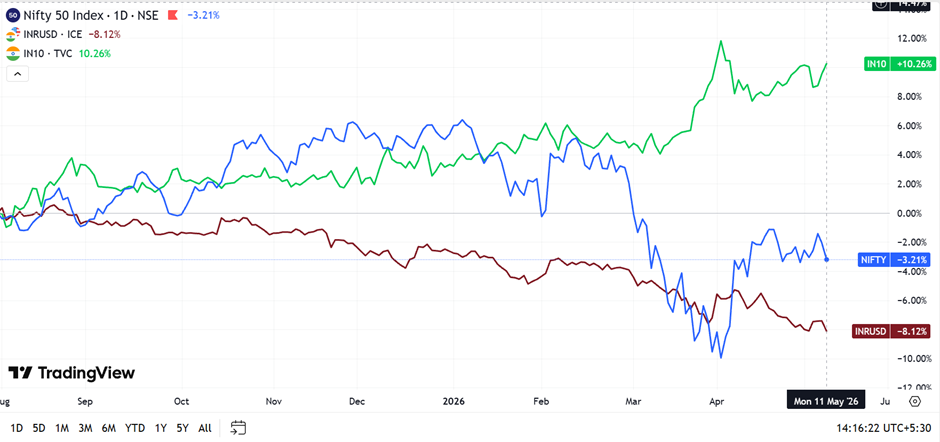
Chart by TradingView
Crude Oil Spike Intensifies Concerns
The latest market reaction followed reports that discussions aimed at easing tensions between the United States and Iran had reached a deadlock. Statements from U.S. leadership rejecting Iran’s proposals reignited fears of prolonged geopolitical instability in the Middle East, a region critical to global energy supplies.
Brent crude prices surged nearly 4% in Asian trading, crossing the USD 105 per barrel level. For India, which remains heavily dependent on imported crude oil, sustained higher energy prices could significantly impact macroeconomic stability.
A sharp increase in oil prices tends to widen India’s current account deficit, increase imported inflation, and elevate fiscal pressures. Higher fuel costs also reduce consumer purchasing power and may slow overall economic activity if maintained over a prolonged period.
Modi’s Remarks Add to Market Nervousness
Investor sentiment was further impacted after Prime Minister Narendra Modi reportedly urged citizens and businesses to adopt measures aimed at conserving foreign exchange reserves. Suggestions included fuel conservation, reduced imports, and limiting unnecessary overseas expenditure.
While the comments were viewed as precautionary, traders interpreted them as an indication that authorities are preparing for a potentially prolonged period of elevated energy prices and external sector pressure.
The remarks contributed to concerns over India’s vulnerability to global commodity shocks, particularly as geopolitical tensions continue to disrupt energy markets.
RBI Seen Supporting the Currency
Currency traders observed dollar-selling activity from major state-run banks, which market participants believe was conducted on behalf of the RBI. Such intervention is typically aimed at smoothing excessive volatility and preventing disorderly market movements rather than defending a specific exchange rate level.
Analysts noted that although intervention activity was visible, it appeared measured rather than aggressive. This suggests the central bank may prefer allowing market-driven adjustments while intervening selectively to prevent abrupt currency swings.
Since tensions in the Middle East intensified earlier this year, the rupee has remained under pressure alongside broader weakness in Indian financial assets. Rising crude prices and global risk aversion have also pushed sovereign bond yields higher as investors reassess inflation and interest-rate expectations.
Broader Impact Across Emerging Markets
The pressure was not limited to India alone. Several Asian currencies weakened during the session as investors moved toward safer assets amid geopolitical uncertainty and elevated oil prices.
Economists highlighted that emerging economies with relatively lower crude inventory buffers and high dependence on imported energy could remain particularly vulnerable if supply disruptions persist. Alongside India, countries such as the Philippines, Vietnam, and Indonesia may also face pressure from prolonged energy market instability.
Market participants are expected to closely monitor future developments surrounding U.S.-Iran relations, movements in crude oil prices, and potential policy responses from central banks and governments globally.
Conclusion
Rising geopolitical tensions and surging crude oil prices have renewed pressure on Indian financial markets, with the rupee weakening sharply and investor sentiment turning cautious. RBI intervention may help limit volatility in the near term, but sustained energy price increases could continue influencing inflation, external balances, and overall market stability.
FAQs
- Why did the Indian rupee weaken sharply?
The rupee weakened mainly due to rising crude oil prices and escalating geopolitical tensions between the U.S. and Iran, which increased concerns over India’s import bill and economic stability.
- Why is high crude oil a concern for India?
India imports a large portion of its crude oil requirements. Higher oil prices increase import costs, widen the current account deficit, fuel inflation, and can slow economic growth.
- Did the RBI officially intervene in the forex market?
While the RBI did not officially confirm intervention, traders observed state-run banks selling dollars in the market, which is commonly interpreted as central bank support for the