

Escalating Geopolitical Risks Prompt RBI to Reassess Inflation Outlook
The Reserve Bank of India (RBI) has raised its FY27 consumer inflation forecast by 50 basis points to 5.1%, reflecting mounting concerns over global energy prices and supply-chain disruptions stemming from the ongoing conflict in West Asia. The upward revision marks a significant shift in the central bank's inflation outlook and highlights the growing impact of geopolitical developments on India's macroeconomic environment.
The revised projection was announced alongside the RBI's decision to keep the benchmark repo rate unchanged at 5.25% and maintain a neutral monetary policy stance, underscoring the central bank's preference for caution amid heightened uncertainty.
Inflation Risks Return to the Forefront
After several quarters of easing price pressures, inflation has once again emerged as a key concern for policymakers.
According to RBI Governor Sanjay Malhotra, the increase in the inflation forecast primarily reflects the risk of higher imported inflation arising from elevated crude oil prices and broader geopolitical disruptions. While the central bank acknowledged that underlying inflation remains relatively contained, external shocks have materially altered the inflation trajectory for the current fiscal year.
Notably, the Monetary Policy Committee (MPC) retained its projection for core inflation at 4.7%, indicating that domestic demand-driven inflation remains manageable despite rising external pressures.
Key Policy Highlights
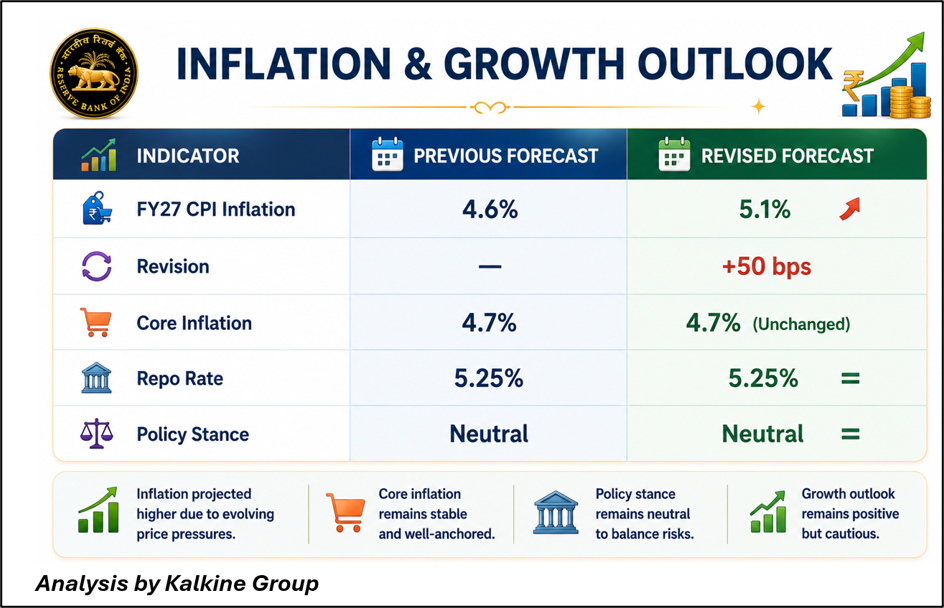
The inflation forecast remains within the RBI's tolerance band of 2%-6%, but the revision signals a more challenging operating environment for policymakers in the months ahead.
Why the Inflation Forecast Was Raised
Several factors contributed to the upward revision:
- Rising Crude Oil Prices- India remains heavily dependent on imported crude oil. Any sustained increase in energy prices directly impacts transportation, manufacturing, logistics, and household expenses. The ongoing West Asia conflict has heightened concerns about supply disruptions and elevated global oil prices.
- Geopolitical Uncertainty- Escalating tensions in the Middle East have increased volatility across commodity markets, creating inflationary risks for import-dependent economies such as India.
- Food Inflation Risks- The RBI also remains watchful of weather-related disruptions and agricultural output risks, which could add further pressure to food prices during FY27.
Market Implications
For Equity Markets- The inflation revision may temper expectations of future rate cuts and could increase market sensitivity toward:
- Banking stocks
- Rate-sensitive sectors
- Consumer discretionary companies
- Interest-rate-dependent businesses
However, the RBI's decision to maintain the repo rate suggests that monetary conditions remain supportive for economic activity.
For Bond Markets- Higher inflation expectations could place upward pressure on government bond yields as investors adjust return expectations. Nevertheless, the RBI's neutral stance provides reassurance that policymakers are not yet preparing for aggressive monetary tightening.
For the Indian Rupee- The inflation outlook comes at a time when the rupee faces pressure from higher oil imports and global capital flows. The RBI has simultaneously announced measures to attract foreign capital and support currency stability.
Investor Perspective
While the upward revision in inflation is noteworthy, the broader message from the RBI remains one of measured confidence.
The central bank continues to view domestic inflation dynamics as broadly manageable, with most of the current risks originating from external factors rather than excessive domestic demand. The decision to keep rates unchanged indicates that policymakers believe the economy can absorb these shocks without requiring immediate monetary tightening.
For investors, the key variables to monitor over the coming quarters will be:
- Crude oil prices
- Developments in West Asia
- Food inflation trends
- Rupee stability
- Future RBI policy guidance
Conclusion
The RBI's decision to raise its FY27 inflation forecast to 5.1% reflects a more challenging global environment shaped by geopolitical tensions and rising energy costs. While inflation risks have increased, the central bank's unchanged core inflation outlook and neutral policy stance suggest confidence that underlying domestic price pressures remain contained.
As geopolitical developments continue to influence commodity markets and global capital flows, investors should prepare for a period of heightened macroeconomic sensitivity while remaining focused on India's long-term structural growth story.
Frequently Asked Questions (FAQs)
- Why did the RBI raise its inflation forecast for FY27?
The RBI cited rising crude oil prices, global supply disruptions, and inflationary pressures linked to the ongoing West Asia conflict.
- What is the RBI's new inflation forecast?
The central bank has revised its FY27 CPI inflation estimate to 5.1%, up from 4.6%.
- Has the RBI changed its core inflation outlook?
No. The RBI retained its core inflation projection at 4.7%, indicating that underlying domestic inflation pressures remain relatively benign.
- Did the RBI change interest rates?
No. The repo rate remains unchanged at 5.25%, and the monetary policy stance remains neutral.
- How could higher inflation impact investors?
Higher inflation may influence bond yields, interest-rate expectations, currency movements, and sector-specific market performance.
- What should investors watch next?
Investors should monitor crude oil prices, geopolitical developments, inflation data, rupee movements, and future RBI policy actions.