

RBI Deploys Capital Inflow Package Amid Global Volatility
In a significant policy initiative alongside its June monetary policy announcement, the Reserve Bank of India (RBI) unveiled a six-point package aimed at attracting foreign capital, strengthening the rupee, and enhancing liquidity in domestic financial markets.
The measures come at a time when India faces heightened external challenges, including rising crude oil prices, geopolitical tensions in West Asia, and persistent foreign portfolio outflows. While the Monetary Policy Committee retained the repo rate at 5.25%, the central bank simultaneously launched targeted reforms designed to improve India's attractiveness as an investment destination.
Why RBI Announced These Measures
The Indian rupee has come under pressure in 2026 due to elevated oil prices and sizeable foreign capital outflows. To counter these pressures, the RBI has focused on expanding investment avenues for global investors while facilitating greater foreign currency inflows into the country. Analysts estimate the package could potentially attract billions of dollars into Indian financial markets over time.
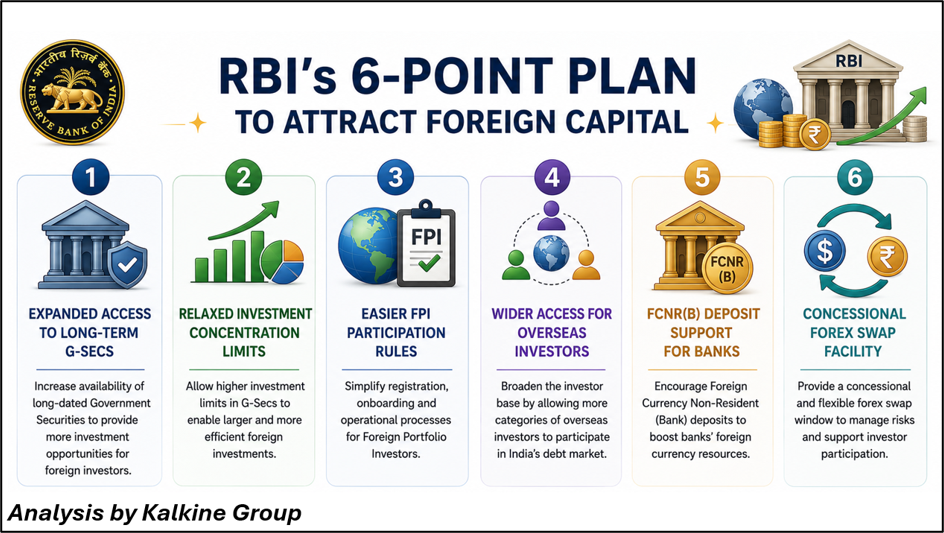
The Six Key Measures Announced by RBI
- Expanded Access to Government Securities
The RBI widened the Fully Accessible Route (FAR) framework by allowing foreign investors broader access to long-duration government securities, including new 15-year, 30-year, and 40-year sovereign bonds. This move significantly expands investment opportunities in India's debt market.
- Removal of Investment Concentration Limits
Foreign investors will benefit from relaxed investment concentration norms in eligible government securities, making it easier for large global funds to increase allocations to Indian bonds.
- Liberalisation of FPI Investment Rules
The central bank announced measures to simplify and broaden foreign portfolio investment participation, improving market accessibility and facilitating larger capital inflows into Indian financial assets.
- Enhanced Access for Overseas Individuals
Investment access has been expanded to include a wider category of individuals residing outside India, further broadening the potential investor base for Indian securities.
- FCNR(B) Deposit Support
To encourage foreign currency deposits from non-resident Indians (NRIs), the RBI announced support mechanisms for banks raising Foreign Currency Non-Resident (Bank) [FCNR(B)] deposits, including assistance in managing hedging costs.
- Concessional Forex Swap Facility
The RBI introduced a concessional foreign exchange swap arrangement aimed at facilitating foreign currency mobilization and improving liquidity conditions in the banking system.
Potential Impact on Financial Markets
- Stronger Capital Inflows- The measures are expected to improve India's appeal among global investors seeking exposure to emerging-market debt and equity opportunities.
- Support for the Rupee- Higher foreign capital inflows can help offset external pressures arising from elevated crude oil imports and portfolio outflows, potentially supporting rupee stability.
- Improved Bond Market Liquidity- Expanding foreign participation in government securities could deepen the bond market and improve price discovery across maturities.
- Positive for Banking Sector Liquidity- FCNR(B) deposit incentives and forex swap facilities may help banks access additional foreign currency funding at competitive costs.
Investor Takeaway
The RBI's six-point capital inflow package signals a proactive approach toward safeguarding macroeconomic stability amid a challenging global backdrop. Rather than relying solely on interest-rate adjustments, the central bank has chosen targeted market reforms to attract foreign capital and support financial stability.
For investors, the measures reinforce confidence in India's policy framework and its commitment to maintaining adequate foreign exchange liquidity while preserving growth momentum. If successfully implemented, these reforms could strengthen India's position as a preferred destination for global capital in both debt and equity markets.
Conclusion
By combining a stable interest-rate environment with targeted capital-market reforms, the RBI has adopted a balanced strategy to address external vulnerabilities. The six measures announced on June 5 are designed to improve foreign investor participation, enhance market liquidity, support the rupee, and strengthen India's external sector resilience.
As global uncertainty remains elevated, the effectiveness of these initiatives will be closely monitored by investors, policymakers, and financial markets in the months ahead.
Frequently Asked Questions (FAQs)
- Why did the RBI announce these six measures?
The measures are intended to attract foreign capital, strengthen the rupee, improve liquidity, and support India's external sector amid global uncertainty.
- Did the RBI change the repo rate?
No. The RBI kept the repo rate unchanged at 5.25% and retained its neutral policy stance.
- What is the Fully Accessible Route (FAR)?
FAR allows eligible foreign investors to invest in specified Government Securities without investment restrictions. The RBI has expanded this framework to cover additional long-term bonds.
- How do FCNR(B) deposits help India?
FCNR(B) deposits bring foreign currency into the banking system, helping strengthen forex reserves and external liquidity.
- Will these measures support the rupee?
Higher foreign capital inflows can improve foreign exchange availability and help reduce pressure on the rupee.
- Which sectors could benefit the most?
Government securities, banking, financial services, and capital-market-related businesses are likely to benefit from improved foreign participation and liquidity.