

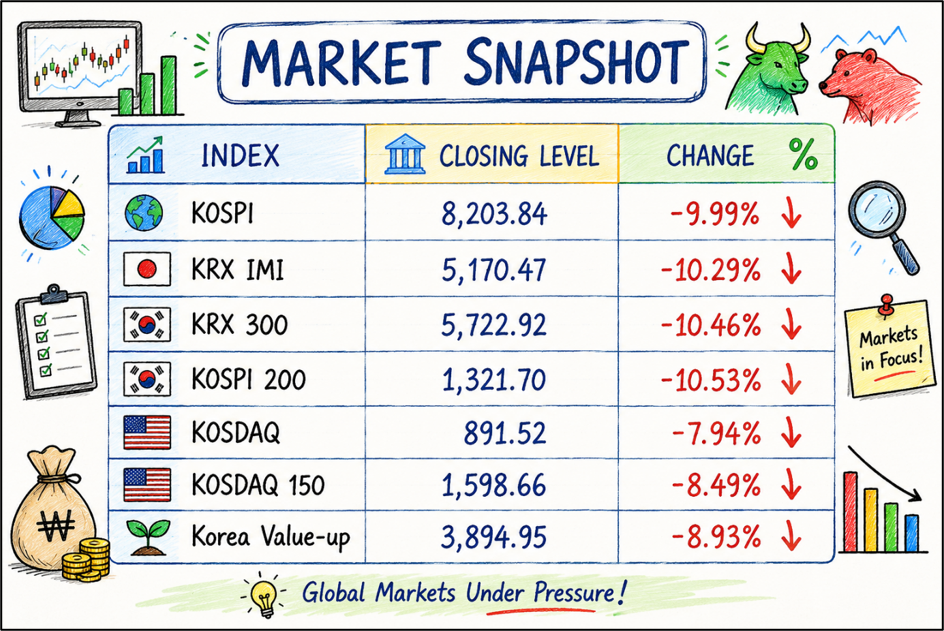
South Korean equities came under significant pressure on Tuesday, with the benchmark KOSPI Index declining 9.99% to 8,203.84, marking one of its sharpest single-session declines in recent months. The selloff reflected a combination of global risk aversion, profit booking in technology stocks, and concerns surrounding stretched valuations across key market segments.
The weakness was not limited to the headline index. Broader market benchmarks also recorded steep losses, highlighting widespread selling activity across sectors. The KRX TMI Index fell 10.29% to 5,170.47, while the KRX 300 Index dropped 10.46% to 5,722.92. The KOSPI 200 Index declined 10.53% to 1,321.70, underscoring heavy pressure on large-cap stocks. Meanwhile, the KOSDAQ Index slipped 7.94% to 891.52, and the KOSDAQ 150 Index lost 8.49% to 1,598.66. The Korea Value-up Index also retreated 8.93% to 3,894.95, reflecting weakness across companies that had previously benefited from shareholder-return and governance-improvement themes.
Technology Stocks Lead the Decline
The technology sector remained at the center of the market correction, mirroring weakness in global semiconductor and artificial intelligence-related stocks. Investor sentiment was affected by concerns over lofty valuations following a prolonged rally in chipmakers and AI-linked companies.
Among the major decliners, SK Hynix recorded a double-digit fall as investors locked in gains after the stock's recent outperformance. Samsung Electronics also witnessed heavy selling pressure, contributing significantly to the benchmark's decline. Weakness extended across the broader technology ecosystem, weighing on market confidence.
Foreign Selling Adds Pressure
Foreign institutional investors remained net sellers throughout the session, amplifying downside momentum. Persistent capital outflows from overseas investors added pressure to large-cap stocks, particularly in export-oriented sectors such as semiconductors, automobiles, and industrials.
Market participants also remained cautious amid increasing regulatory attention on leveraged investment products linked to South Korea's semiconductor industry, a factor that further dampened risk appetite.
Auto and Industrial Stocks Under Pressure
Selling activity extended beyond technology shares. Major automobile manufacturers and industrial companies experienced notable declines as investors reassessed growth expectations against a backdrop of heightened market volatility.
The broad-based nature of the correction indicated a shift toward risk reduction rather than company-specific concerns, with investors opting to trim exposure across multiple sectors.
Focus Remains on AI Semiconductor Developments
Despite the sharp market decline, investors continue to closely monitor developments within South Korea's AI semiconductor industry. Recent industry milestones, including SK Hynix's emergence as the country's most valuable listed company and strong demand for next-generation high-bandwidth memory (HBM) products, have reinforced the long-term growth narrative for the sector.
However, Tuesday's trading session highlighted the market's sensitivity to valuation concerns and shifts in global technology sentiment. While structural demand drivers for advanced semiconductors remain intact, near-term volatility may persist as investors evaluate earnings expectations, regulatory developments, and broader global market conditions.
Outlook
The sharp correction reflects a combination of global technology-sector weakness, valuation concerns, and foreign investor selling. Market direction in the coming sessions is likely to depend on global risk sentiment, semiconductor industry developments, and the pace of institutional and foreign fund flows into South Korean equities.