

Upward Revision: A Vote of Confidence in India's Economy
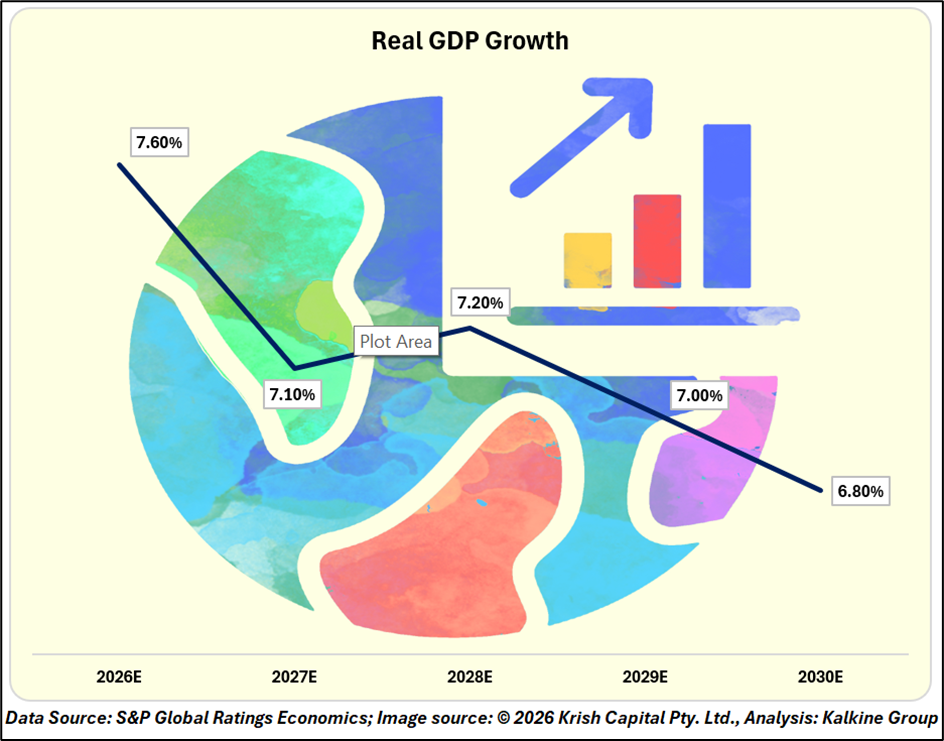
S&P Global Ratings has revised upward its outlook for India’s economy, projecting GDP growth of 7.1% for FY27, reflecting sustained confidence in the country’s structural growth drivers. The agency also raised its FY26 estimate to 7.6%, suggesting that the current fiscal year has exceeded earlier expectations. These revisions were published in the Economic Outlook Asia-Pacific Q2 2026 report, highlighting India’s continued position among the fastest-growing major economies globally.
Growth Engines: Consumption, Investment, and Exports
India’s growth momentum is expected to be supported by three key pillars: private consumption, investment recovery, and export performance. Private consumption remains the backbone of economic expansion, supported by improving rural income conditions, stable urban demand, and government-led income-support programs. These measures have helped maintain consumer spending even amid global uncertainties.
On the investment side, S&P anticipates a gradual recovery in private capital expenditure. Corporate investments had remained cautious due to global volatility, but improving capacity utilization, stronger corporate balance sheets, and continued public infrastructure spending are expected to encourage businesses to expand. Meanwhile, exports particularly services exports such as IT and business process outsourcing are projected to remain resilient, generating stable foreign exchange earnings and supporting overall economic stability.
The Energy Risk: Middle East Conflict Casts a Long Shadow
Despite the optimistic outlook, S&P highlighted energy price volatility as a major downside risk, particularly due to ongoing tensions in the Middle East. India’s heavy dependence on imported crude oil makes it vulnerable to supply disruptions.
Under the baseline scenario, Brent crude prices are expected to average USD 92 per barrel in the June 2026 quarter, gradually easing to around USD 80 per barrel later in the year. However, in an adverse scenario involving prolonged disruptions, crude prices could surge to USD 185 per barrel in the June quarter and average USD 130 per barrel for 2026, significantly impacting growth.
Higher oil prices typically weaken economic activity by reducing household purchasing power, increasing industrial costs, and raising government subsidy burdens. These pressures could strain fiscal balances and slow economic momentum if sustained for longer periods.
Inflation and Monetary Policy: RBI Walks a Tightrope
S&P expects India’s inflation to rise to 4.3% in FY27, remaining within the Reserve Bank of India’s tolerance band of 2–6%. Under normal conditions, the RBI is likely to maintain a neutral policy stance, keeping interest rates stable.

However, if oil prices rise sharply and inflation exceeds expectations, the RBI may be forced to tighten monetary policy. In such a case, S&P anticipates a 25-basis-point rate hike in the second half of FY28, which could modestly weigh on growth. Partial adjustments in domestic fuel prices are also expected, although full pass-through of crude price increases is unlikely due to fiscal considerations.

External Sector and Regional Context
Higher crude import costs are expected to widen India’s merchandise trade deficit. However, a strong services trade surplus, driven by software exports and remittances, is likely to keep the current account deficit manageable.
Within the broader Asia-Pacific region, many economies face similar vulnerabilities due to dependence on imported energy. However, India’s large domestic market, resilient consumer base, and expanding services sector provide stronger buffers than many smaller regional economies. These advantages support S&P’s view that India’s growth trajectory remains comparatively robust despite global headwinds.
Conclusion
Overall, S&P’s revised outlook reflects cautious optimism for India’s economy. While strong domestic demand, improving investment trends, and resilient services exports support steady growth, geopolitical risks particularly energy price volatility remain key uncertainties. Policymakers will need to closely monitor global oil markets and inflation trends to ensure that India’s FY27 growth path remains aligned with the baseline scenario rather than shifting toward a more challenging outcome.