

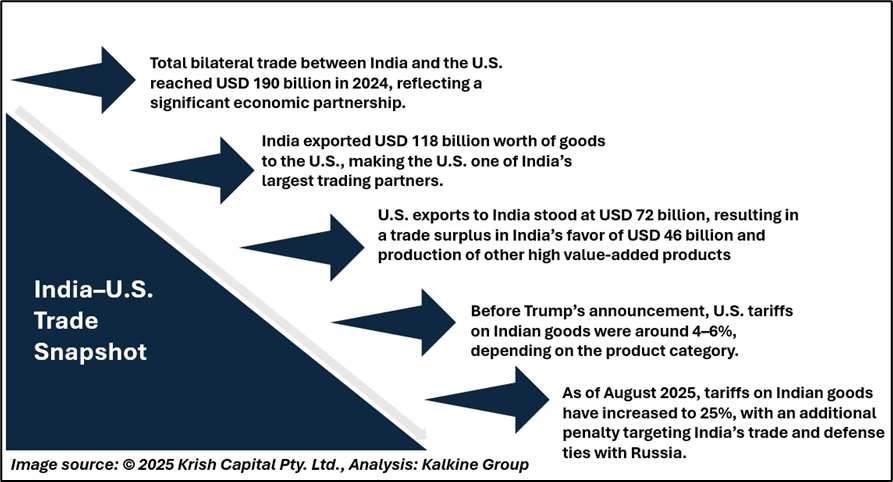
On July 30, 2025, former U.S. President Donald Trump made a major trade policy announcement, declaring a 25% tariff on all Indian goods exported to the United States, effective from August 1. Alongside this, Trump warned of an additional penalty targeting India’s economic and defense engagement with Russia including crude oil imports and weapons procurement. While the specific penalty amount is yet to be finalized, the move signals a significant escalation in U.S.-India trade tensions under Trump’s policy framework.
Tariff Tensions
Trump pointed to ongoing trade deficits and what he described as unfair protective policies by other nations as primary reasons for imposing the tariffs. The U.S. trade deficit with India stood at USD 45.7 billion in 2024, a figure the former president deems “unfair” due to what he described as high tariff and non-tariff barriers on U.S. goods. These include restrictions on automobiles, dairy products, agricultural commodities, pharmaceuticals, and technology exports. According to Trump, such barriers disadvantage American producers while India enjoys broad market access in the U.S.
Additionally, U.S. negotiators have long pushed for greater access to India’s dairy and agriculture sectors, which remain highly protected. American dairy products, for example, often do not align with India’s domestic standards due to the use of non-vegetarian feed additives, making market access a point of cultural as well as regulatory contention.
India-Russia Strain
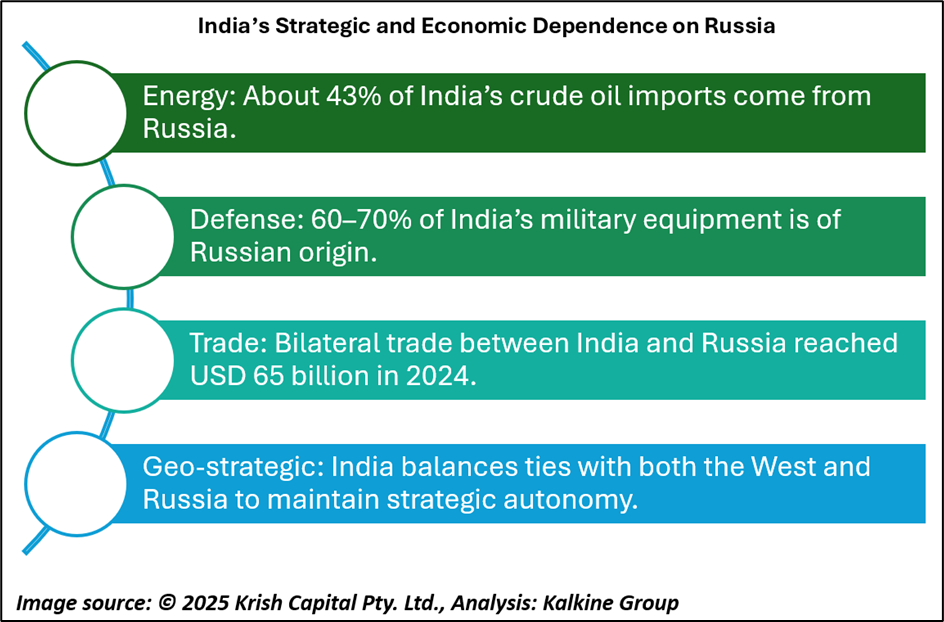
A key component of Trump’s new policy is a punitive measure for India’s ongoing trade and defense cooperation with Russia. Since the Ukraine war began in 2022, India has emerged as a leading buyer of Russian crude, with total imports surpassing USD 124 billion. India also maintains long-standing military agreements with Moscow, including procurement of S-400 missile systems, submarines, tanks, and fighter aircraft.
The proposed penalty draws from the “Sanctioning Russia Act of 2025,” under discussion in the U.S. Congress. It targets non-NATO and non-EU countries importing Russian energy and weapons, allowing for tariffs of up to 500%. Trump argued that India’s continued engagement with Russia supports a geopolitical rival of the West and must carry economic consequences.
India’s Strategic Response
The announcement presents India with a challenging diplomatic and strategic scenario. While India is a member of U.S.-aligned groups like the Quad (alongside Japan and Australia) and has expanded defense ties with Washington, it has avoided criticizing Russia over Ukraine. India continues to prioritize strategic autonomy a balancing act that is increasingly difficult under rising external pressure.
India’s initial response has been firm. Unlike allies such as Japan and several EU countries that quickly aligned with U.S. policy, India has held its position. Officials have reiterated the country’s refusal to compromise on agricultural access, dairy standards, data localization rules, and medical price controls. These policies are seen as non-negotiable components of domestic economic stability and sovereignty.
Conclusion
Trump’s decision to impose sweeping tariffs and penalties marks a pivotal moment in U.S.-India relations. It exposes the growing friction between India’s strategic independence and its deepening economic ties with the United States. The coming weeks will test New Delhi’s ability to navigate this complex challenge whether through countermeasures, negotiation, or continued resistance as it strives to protect its economic goals and diplomatic flexibility.