

Highlights
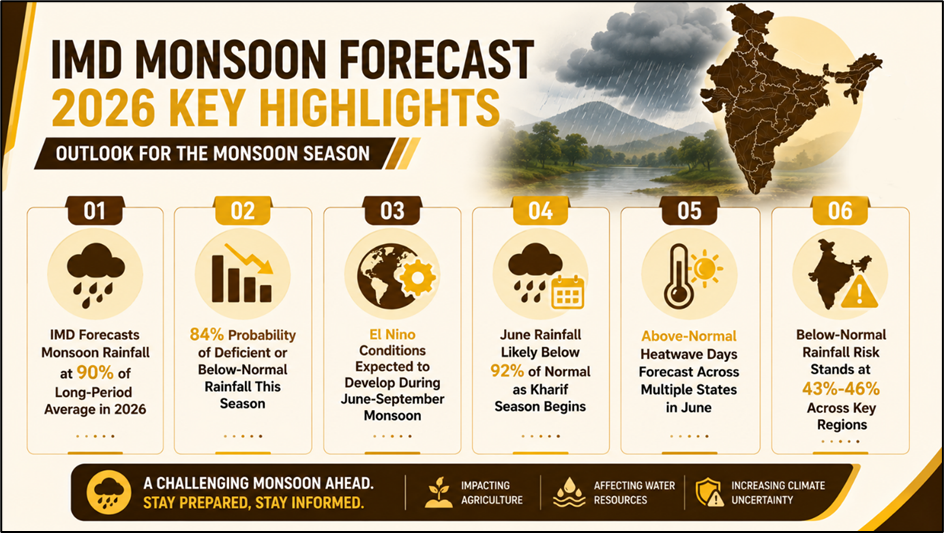
- IMD projects 2026 monsoon rainfall at 90% of the long-period average.
- El Nino conditions are likely to develop during the monsoon season.
- Above-normal heatwave days are expected across several Indian states in June.
The India Meteorological Department (IMD) has revised its outlook for the 2026 southwest monsoon season, forecasting rainfall at 90% of the Long Period Average (LPA) during the June-September period, with a model error margin of ±4%. Based on the 1971-2020 average, the seasonal LPA stands at 87 cm.
The latest forecast indicates an 84% probability that rainfall will be either deficient or below normal, including a 60% chance of deficient rainfall and a 24% chance of below-normal rainfall. The outlook suggests a weaker-than-average monsoon season, a key development for agriculture, water management, and sectors dependent on rural demand.
Source: Analysis by Kalkine
El Nino Development Remains a Key Factor
According to IMD, neutral El Nino-Southern Oscillation (ENSO) conditions are currently transitioning toward El Nino conditions in the equatorial Pacific Ocean. Climate model guidance, including forecasts from the Monsoon Mission Climate Forecasting System (MMCFS), indicates that El Nino conditions are likely to emerge during the southwest monsoon season.
At the same time, neutral Indian Ocean Dipole (IOD) conditions are prevailing over the Indian Ocean and are expected to continue through the monsoon period. The combination of a developing El Nino and neutral IOD has influenced the current rainfall outlook.
Regional Rainfall Distribution Signals Variability
The spatial distribution forecast indicates that below-normal rainfall is likely across most parts of the country during the monsoon season. However, some regions, including parts of Northwest India, Northeast India, eastern Peninsular India, adjoining east-central areas, and isolated pockets of East India, are expected to receive normal to above-normal rainfall.
Among the homogeneous regions, the probability of below-normal rainfall stands at 46% for Northwest India, 43% for Central India, 45% for the South Peninsula, and 43% for the Monsoon Core Zone. Northeast India presents a relatively balanced outlook with nearly equal probabilities across rainfall categories.
June Rainfall Expected Below Average
For June 2026, IMD expects rainfall over the country as a whole to remain below normal, defined as less than 92% of the monthly Long Period Average. The June LPA is 165.4 mm.
Most regions are likely to record below-normal rainfall during the month, although parts of Northwest India, Northeast India, the South Peninsula, and isolated areas of Central India may receive normal to above-normal precipitation. The June rainfall outlook is particularly important as it coincides with the beginning of the kharif sowing season and influences water storage levels across reservoirs.
Temperature Outlook Points to Warmer Conditions
IMD forecasts above-normal maximum temperatures across most parts of India during June 2026. Minimum temperatures are also expected to remain above normal in large parts of the country.
However, some areas in Northwest, Central, and adjoining southern Peninsular regions may experience normal to below-normal temperature conditions. Elevated temperatures during the early monsoon period could increase cooling demand and place additional pressure on water resources.
Heatwave Activity Likely to Intensify
The weather agency expects above-normal heatwave days across many parts of Uttar Pradesh, Haryana, Punjab, Bihar, Odisha, Chhattisgarh, Gujarat, and Andhra Pradesh during June. Isolated regions of Maharashtra, Telangana, Himachal Pradesh, and Tamil Nadu are also likely to witness higher-than-normal heatwave activity.
In contrast, Rajasthan and Jharkhand are expected to record below-normal heatwave days. IMD noted that prolonged heat conditions could affect public health, water availability, energy consumption, and essential services, particularly for vulnerable populations.
Preparedness Measures Gain Importance
Given the possibility of below-normal rainfall and elevated heatwave activity, IMD has emphasized the importance of preparedness measures, including water conservation, drought monitoring, agricultural contingency planning, and public health readiness.
State governments and local administrations have been advised to ensure the availability of safe drinking water, operational cooling facilities, and emergency response mechanisms. The department will continue issuing extended-range forecasts, early warnings, and impact-based forecasts throughout the season to support planning and response efforts.
Key Risks
- Deficient rainfall may affect agricultural output and crop yields.
- Lower precipitation could pressure reservoir and water storage levels.
- Heatwaves may increase electricity demand and energy consumption.
- Water scarcity risks could rise in rainfall-deficit regions.
Summary
IMD's updated forecast indicates that India's 2026 southwest monsoon is likely to remain below normal, with seasonal rainfall estimated at 90% of the Long Period Average. The outlook is influenced by the expected emergence of El Nino conditions during the monsoon season.
June rainfall is also projected to remain below average, while above-normal temperatures and increased heatwave activity are expected across several states, highlighting risks for agriculture, water resources, and public health.
FAQs
Q: What is IMD's rainfall forecast for the 2026 monsoon season?
A: IMD expects seasonal rainfall at 90% of the Long Period Average, indicating below-normal monsoon conditions.
Q: What role is El Nino expected to play in 2026?
A: Climate models indicate El Nino conditions may develop during the monsoon season, influencing rainfall patterns.
Q: Which states are expected to face higher heatwave activity?
A: Uttar Pradesh, Haryana, Punjab, Bihar, Odisha, Gujarat, Andhra Pradesh, and some other regions may see more heatwaves.