

Highlights
- NITI Aayog has proposed a dedicated pharmaceutical chapter in future FTAs.
- The recommendation aims to address regulatory barriers affecting pharma exports.
- India is being encouraged to expand into higher-value pharmaceutical segments.
India's pharmaceutical industry could see a shift in trade strategy after NITI Aayog proposed a dedicated pharmaceutical chapter in future free trade agreements (FTAs). The recommendation is aimed at improving regulatory predictability, reducing non-tariff barriers and helping Indian pharmaceutical companies expand their presence in global markets. The think tank has also called for a greater focus on innovation-led, high-value pharmaceutical products as India seeks to strengthen its position in the global healthcare industry.
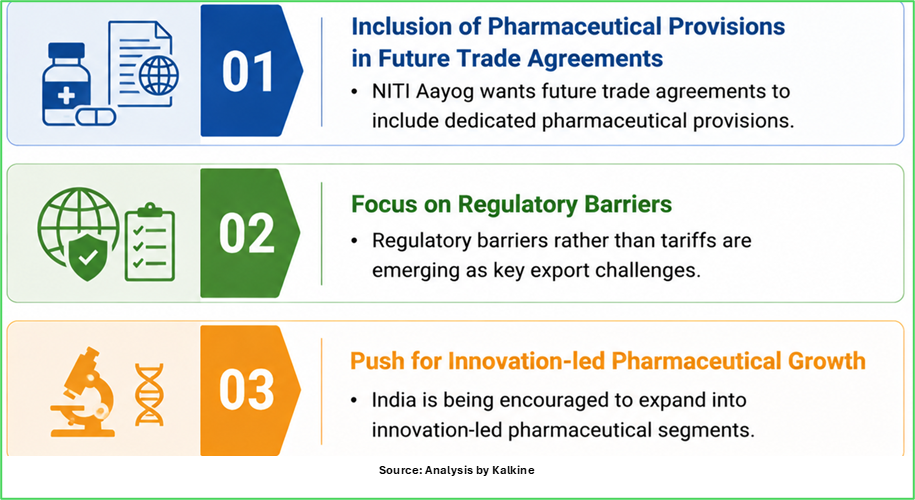
Why NITI Aayog Wants A Pharma-Specific FTA Chapter
According to NITI Aayog, traditional trade agreements often focus heavily on tariffs while giving limited attention to sector-specific regulatory challenges. In pharmaceuticals, market access is frequently influenced by quality standards, certification requirements, regulatory approvals and compliance procedures rather than import duties alone.
The proposed pharma chapter would serve as a framework for future trade negotiations and could help create more predictable rules for pharmaceutical exports. The objective is to reduce uncertainties faced by exporters while improving access to overseas markets.
The Growing Importance Of Non-Tariff Barriers
Industry reports indicate that regulatory requirements and technical barriers have become among the most significant challenges for pharmaceutical exporters, particularly in developed markets.
NITI Aayog has noted that non-tariff measures such as quality-control regulations, testing requirements and certification procedures account for a substantial share of obstacles affecting pharmaceutical exports. Addressing these barriers through trade agreements could potentially improve market access opportunities for Indian manufacturers.
As global pharmaceutical regulations become increasingly complex, companies often face higher compliance costs and longer approval timelines when entering international markets.
Moving Beyond Volume To Value
India is widely recognised as one of the world's leading suppliers of generic medicines and has earned the reputation of being the "pharmacy of the world." However, policymakers believe the next phase of growth will require greater participation in higher-value segments of the pharmaceutical industry.
NITI Aayog has emphasized the need for India to diversify into advanced pharmaceutical products, deep-tech innovation, specialty medicines, biologics and research-driven healthcare solutions. Such a transition could help improve value addition and strengthen India's role in global pharmaceutical innovation.
The think tank has also highlighted the importance of stronger collaboration between industry and academic institutions to support patent commercialisation, research development and startup incubation.
Addressing Supply Chain Vulnerabilities
The recommendations come at a time when India's pharmaceutical supply chain continues to rely heavily on imported raw materials.
According to NITI Aayog, nearly 65 percent of India's requirements for active pharmaceutical ingredients (APIs), key starting materials (KSMs) and intermediates are sourced from China. This dependence has raised concerns regarding supply-chain resilience and strategic vulnerabilities.
Reducing import dependence while expanding domestic capabilities in critical pharmaceutical inputs remains an important policy objective for the sector.
Why FTAs Matter For Pharma Exports
India has been actively pursuing trade agreements with several countries and economic blocs to improve export competitiveness.
A dedicated pharmaceutical chapter could provide mechanisms for regulatory cooperation, mutual recognition processes, dispute resolution and transparency in approval procedures. These provisions may help companies navigate international regulatory systems more efficiently while improving certainty for exporters.
As global pharmaceutical demand continues to expand, easier access to regulated markets could create opportunities for Indian manufacturers seeking international growth.
What Industry Will Watch Next
Industry participants are expected to closely monitor how future trade negotiations incorporate pharmaceutical-specific provisions. Stakeholders will also assess whether proposed measures translate into easier market access and reduced compliance challenges.
The broader objective remains to strengthen India's position not only as a large-volume medicine supplier but also as a participant in higher-value pharmaceutical innovation and research-driven manufacturing.
Key Risks
- Regulatory harmonisation may require lengthy negotiations.
- Compliance costs could remain high despite trade agreements.
- Dependence on imported pharmaceutical inputs remains significant.
- Innovation-led growth requires sustained R&D investment.
Summary
NITI Aayog has proposed a dedicated pharmaceutical chapter in future free trade agreements to address regulatory barriers and improve export competitiveness. The recommendation reflects a broader strategy to help India move beyond traditional generic drug manufacturing and expand into higher-value pharmaceutical segments. Success will depend on regulatory cooperation, innovation capabilities, supply-chain resilience and effective implementation of future trade agreements.
FAQs
Q: Why has NITI Aayog proposed a pharma chapter in FTAs?
A: The proposal aims to address regulatory barriers and improve market access for pharmaceutical exports.
Q: What does moving up the value chain mean for pharma companies?
A: It involves expanding into innovative, research-driven and higher-value pharmaceutical products and technologies.
Q: Why is supply-chain dependence a concern for the sector?
A: India continues to import a significant share of pharmaceutical raw materials and critical inputs.