

Highlights
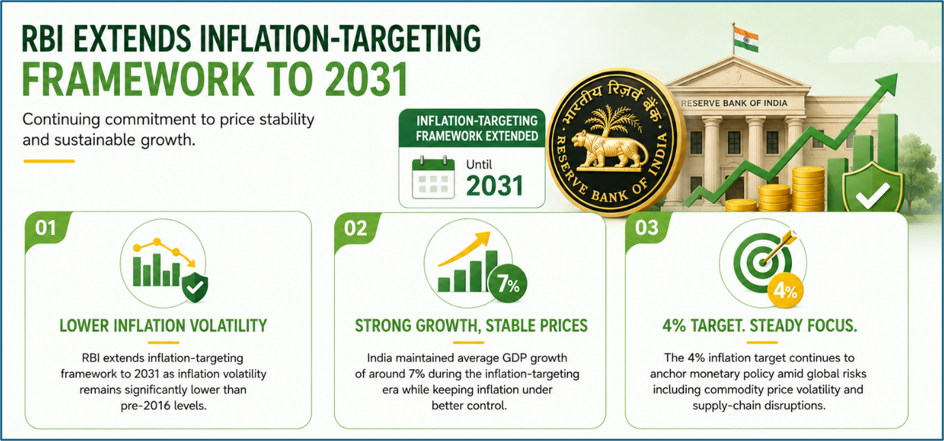
- India has retained the 4% inflation target with a ±2% tolerance band until March 2031.
- RBI data indicates inflation moderated significantly during the inflation-targeting era.
- Most respondents in the RBI consultation supported maintaining the existing framework.
Banking and financial sector stocks may remain on investors' radar after the Reserve Bank of India (RBI) reaffirmed the country's inflation-targeting framework for another five years. The Government of India has retained the inflation target of 4%, with a tolerance band of 2 percentage points on either side, through March 31, 2031.
The announcement follows a comprehensive review of India's monetary policy framework and reflects continued policy emphasis on maintaining price stability while supporting economic growth.
 Source: Analysis by Kalkine
Inflation Targeting Delivers Lower and More Stable Inflation
According to the RBI, India's inflation-targeting framework has contributed to a significant improvement in inflation outcomes since its formal adoption in 2016.
Average headline Consumer Price Index (CPI) inflation declined to 4.6% during 2016-26 from 8.1% recorded during the decade preceding the framework. Inflation volatility also moderated considerably, indicating greater price stability across the economy. The RBI noted that inflation variability narrowed substantially after the introduction of inflation targeting, helping households and businesses operate in a more predictable economic environment.
Economic Growth Remained Resilient
The central bank's assessment suggests that lower inflation has not come at the cost of economic growth. Average GDP growth during the inflation-targeting period stood at around 7%, excluding pandemic-related disruptions, compared with 6.8% during the preceding decade. The RBI highlighted that stable prices and economic growth have complemented each other over the last ten years.
The findings support the view that credible monetary policy can contribute to macroeconomic stability without constraining long-term growth prospects.
Consultation Process Supports Existing Framework
Ahead of the review, the RBI conducted a public consultation covering key aspects of the inflation-targeting framework, including the inflation measure, target level, tolerance band, and overall structure.
The majority of participants favoured retaining the existing framework. More than 90% of respondents supported continuing with headline CPI inflation as the primary policy target, while a similar proportion endorsed maintaining the current 4% target rate.
Most respondents also supported retaining the existing tolerance band of ±2%, reflecting broad confidence in the framework's effectiveness.
Why the 4% Inflation Target Was Retained
The RBI cited several factors supporting the continuation of the current target.
The 4% inflation objective was originally recommended by an expert committee and remains consistent with India's economic development requirements. The central bank also noted that India's target aligns with practices followed by many emerging market economies.
In addition, the RBI highlighted that India's inflation performance has compared favourably with several peer economies in recent years, reinforcing confidence in the existing framework.
Global Challenges Continue to Influence Policy
While inflation outcomes have improved, policymakers continue to face a challenging global environment. Geopolitical tensions, supply-chain disruptions, commodity price fluctuations, and climate-related risks remain potential sources of inflationary pressure. The RBI indicated that maintaining a clear and credible inflation target provides an important anchor for monetary policy amid evolving global uncertainties.
The continuation of the framework is expected to provide policy continuity and predictability for financial markets, businesses, and consumers over the next five years.
Key Risks to Monitor
- Commodity price volatility could influence inflation trends.
- Geopolitical developments may disrupt global supply chains.
- Food inflation remains vulnerable to weather-related shocks.
- External economic weakness could affect domestic growth momentum.
Summary
The Government of India has extended the RBI's inflation-targeting framework until March 2031, retaining the 4% CPI inflation target and ±2% tolerance band. RBI data indicates that inflation has moderated significantly since the framework's introduction in 2016, while economic growth has remained resilient. Public consultation findings also showed broad support for maintaining the current monetary policy structure.
FAQs
Q: What inflation target has India retained until 2031?
A: India has retained a CPI inflation target of 4% with a tolerance band of ±2%.
Q: How has inflation performed under the inflation-targeting framework?
A: Average inflation declined to 4.6% during 2016-26 from 8.1% in the previous decade.
Q: Why did the RBI continue with the existing framework?
A: The RBI cited improved inflation outcomes, policy credibility, and strong stakeholder support for retaining the framework.