

Highlights
- India–Oman CEPA provides duty-free access for 99.38% of Indian exports.
- Services commitments cover 127 sub-sectors with expanded professional mobility.
- Pharmaceuticals, engineering goods, textiles and marine products gain tariff benefits.
India and Oman have operationalized the Comprehensive Economic Partnership Agreement (CEPA), marking a significant development in bilateral economic relations. The agreement entered into force on June 1, 2026, following its signing in Muscat on December 18, 2025, in the presence of Prime Minister Narendra Modi and Sultan Haitham bin Tarik Al Said.
The agreement is expected to influence several export-oriented sectors listed on Indian stock exchanges, including information technology, pharmaceuticals, engineering goods, textiles, automobiles and food processing. Companies with exposure to Gulf markets may closely track the implementation of the agreement and its impact on trade flows.
Source: Analysis by Kalkine
A New Trade Gateway for Indian Exporters
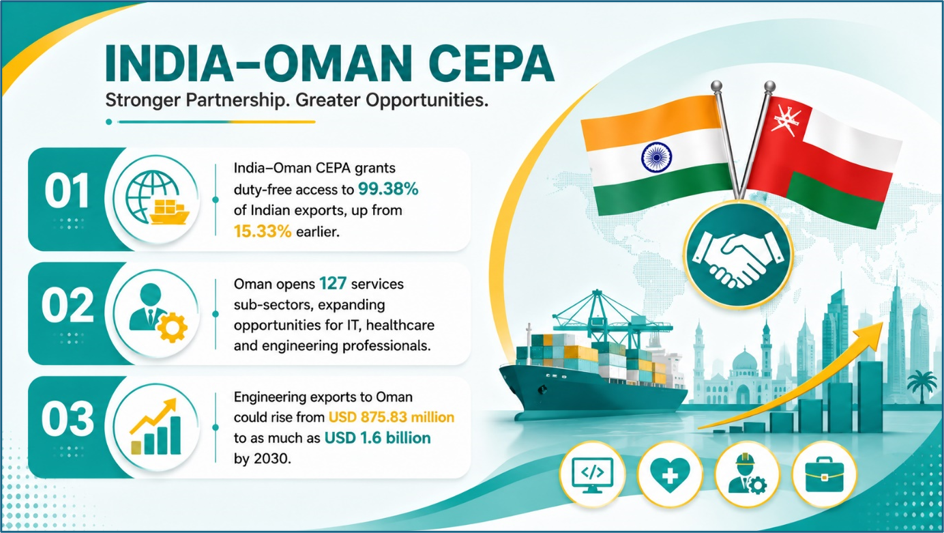
Under the CEPA, 99.38% of India's exports by value will receive duty-free access to Oman, covering 98.08% of Oman's tariff lines. Prior to the agreement, only 15.33% of India's exports entered Oman duty-free under the Most Favoured Nation (MFN) regime.
The new framework provides immediate tariff elimination across a wide range of sectors, creating a larger opportunity for Indian exporters in Oman's import market. Bilateral trade between India and Oman reached USD 11.18 billion during FY2025-26, compared with USD 10.61 billion in FY2024-25.
Sector Watch: Pharmaceuticals Gain Regulatory Advantage
One of the notable provisions of the CEPA relates to pharmaceuticals. The agreement grants zero-duty access for medicines, vaccines and pharmaceutical ingredients. It also introduces accelerated approval mechanisms, allowing products approved by regulators such as the USFDA, EMA, UK MHRA and TGA to receive marketing authorization within 90 days under specified conditions.
Engineering and Electronics Exports in Focus
The CEPA eliminates import duties of up to 5% on engineering products. The coverage includes machinery, automobiles, electrical equipment, iron and steel products, industrial machinery and electronics.
India's engineering exports to Oman stood at USD 875.83 million in FY2025-26. According to official estimates, engineering exports could increase to between USD 1.3 billion and USD 1.6 billion by 2030. Companies operating in engineering, electrical equipment and manufacturing segments may evaluate potential opportunities emerging from the agreement.
Services Commitments Expand Professional Access
A key component of the CEPA is Oman's services package covering 127 sub-sectors. The commitments span information technology, engineering, healthcare, education, financial services, telecommunications, construction, tourism and research services. The agreement also introduces commitments for specific professional categories, including engineers, doctors, IT professionals, teachers and consultants.
Business visitors may stay in Oman for up to 90 days, independent professionals for up to 180 days and intra-corporate transferees for up to four years. Technology companies such as NSE: TCS, NSE: INFY, NSE: HCLTECH and NSE: WIPRO may track implementation of these provisions due to their relevance for cross-border services.
Logistics and Regional Connectivity Advantage
Oman's logistics hubs at Sohar, Duqm and Salalah are expected to support wider access to Gulf Cooperation Council (GCC) and East African markets.
The agreement also introduces trade facilitation measures, including acceptance of certificates issued by India's Export Inspection Council (EIC), recognition of India's organic certification system and streamlined procedures for perishable goods.
These measures are intended to reduce compliance requirements and improve cargo movement efficiency.
Sensitive Sectors Remain Protected
India has maintained safeguards for several sensitive sectors while extending tariff concessions.
Products under the exclusion list include dairy products, cereals, fruits, vegetables, edible oils, oilseeds, rubber, leather, spices and certain agricultural products.
The agreement also incorporates tariff rate quotas and minimum import price mechanisms for selected products to address domestic industry concerns.
What Commerce Ministry Officials Said
Commerce and Industry Minister Piyush Goyal stated:
“The India–Oman CEPA marks a defining milestone in India’s engagement with Oman and reflects Hon’ble Prime Minister Shri Narendra Modi’s vision of forging trade partnerships that deliver gains for farmers, fishermen, youth, women, entrepreneurs and MSMEs."
Commerce Secretary Rajesh Agrawal said:
“At a time when global trade patterns are being reconfigured by supply-chain diversification, shifting production networks and the emergence of new economic corridors, the CEPA positions India and Oman to leverage these structural changes."
Key Risks to Watch
- Export growth may depend on actual demand conditions in Oman.
- Global trade disruptions could affect projected bilateral trade expansion.
- Regulatory implementation timelines may vary across sectors.
- GCC economic slowdowns could influence export performance.
Summary
The India–Oman CEPA has entered into force with extensive tariff concessions, services commitments and trade facilitation measures. The agreement grants duty-free access to 99.38% of Indian exports and covers sectors including pharmaceuticals, engineering goods, marine products, agriculture and information technology services. Export-oriented listed companies may monitor the implementation of the agreement as bilateral trade and investment relations evolve.
FAQs
Q: What is the India–Oman CEPA?
A: It is a bilateral trade agreement covering goods, services, investment and regulatory cooperation between India and Oman.
Q: Which sectors may benefit from the CEPA?
A: Pharmaceuticals, engineering goods, marine products, agriculture, textiles, information technology and professional services gain market access advantages.
Q: When did the India–Oman CEPA come into force?
A: The agreement officially entered into force on June 1, 2026, after completion of internal approval processes.