

Highlights
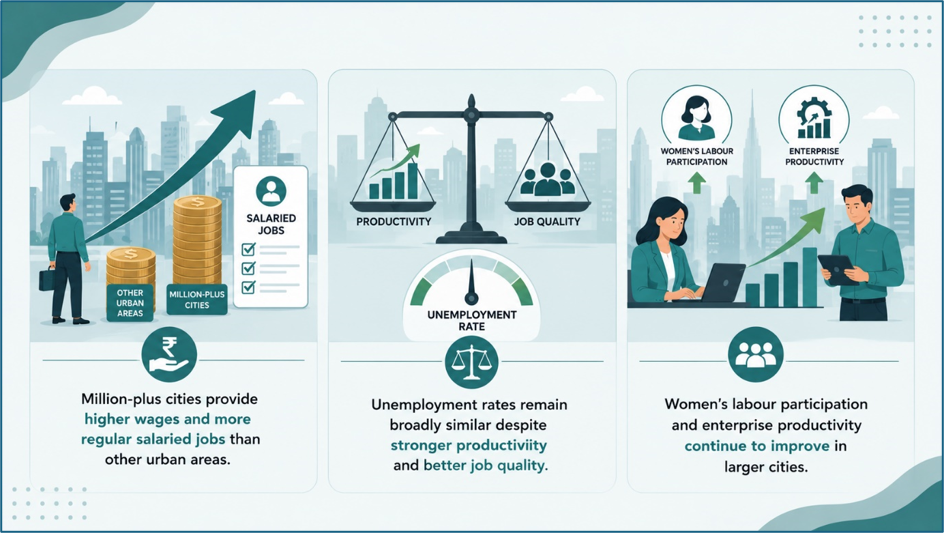
- Million-plus cities offer higher wages and more regular salaried jobs than other urban areas.
- Unemployment rates remain broadly similar despite better productivity and employment quality.
- Higher labour participation and women-led enterprises reflect changing urban employment trends.
India's million-plus cities continue to provide better-paying jobs and higher productivity than other urban centres, but they have not significantly reduced unemployment, according to the latest data released by the National Statistical Office (NSO). The findings indicate that while larger cities generate better employment opportunities and higher incomes, job availability relative to the labour force remains comparable with the rest of urban India.
Source: Analysis by Kalkine
Better Job Quality Than Other Urban Areas
The NSO data show that employment quality is considerably better in India's 46 million-plus cities. Around 58.5% of workers in these cities are employed in regular wage or salaried jobs compared with 42.9% in other urban areas. At the same time, dependence on casual labour is much lower, with only 6.3% of workers engaged in casual employment against 14.4% elsewhere in urban India. These figures suggest that larger cities provide more stable employment opportunities even though unemployment levels remain similar.
Unemployment Gap Remains Narrow
Despite stronger economic activity, unemployment has not declined substantially in larger cities. The unemployment rate in million-plus cities stood at 4.9% in 2025 compared with 4.7% in other urban areas. This indicates that while large urban centres generate higher-value jobs, they are not absorbing job seekers at a significantly faster pace than smaller cities. The data highlight that economic expansion alone may not be sufficient to reduce unemployment without corresponding employment creation.
Higher Earnings Across Employment Categories
Workers in million-plus cities earn more irrespective of their employment category. Self-employed individuals reported average monthly earnings of Rs 30,858 compared with Rs 23,013 in other urban areas. Regular salaried employees earned an average of Rs 28,808 per month versus Rs 26,258 elsewhere, while casual workers received Rs 624 per day compared with Rs 550 in the rest of urban India. Higher productivity and greater concentration of formal economic activity contribute to these income differences.
Labour Participation and Women's Employment Improve
Labour force participation has steadily increased in million-plus cities over recent years. The labour force participation rate rose to 52.4% in 2025 from 47.7% in 2017-18. Female participation also improved, with the labour force participation rate increasing to 27.2% from 19.8% during the same period. Similarly, the worker population ratio for women increased to 25.5% from 17.9%, indicating a gradual rise in women's participation in urban labour markets.
Enterprise Productivity Remains Higher
The report also highlights the economic contribution of India's largest cities. Although the 46 million-plus cities account for only about 13% of establishments in the unincorporated non-agricultural sector, they contribute 16% of employment and 21% of gross value added (GVA). Productivity is also higher, with GVA per worker reaching Rs 2.11 lakh compared with Rs 1.80 lakh in other urban areas. GVA per establishment stood at Rs 4.17 lakh versus Rs 3.24 lakh elsewhere. Around 24.3% of establishments in these cities employ at least one hired worker, compared with 19% in other urban centres.
What the Findings Indicate
The NSO findings suggest that India's largest cities continue to generate higher-value economic activity and offer better employment quality. However, similar unemployment rates indicate that labour supply remains strong and job creation has not kept pace with the number of people seeking employment. As urbanisation continues, employment generation alongside productivity improvements may remain an important area for policymakers.
Risks
- Higher wages do not necessarily translate into lower unemployment.
- Urban migration may increase competition for available jobs.
- Informal employment remains significant across urban centres.
- Productivity gains may not benefit all sectors equally.
Summary
India's million-plus cities provide higher salaries, better-quality jobs and stronger enterprise productivity than other urban areas, according to the NSO. However, unemployment remains broadly similar, indicating that while these cities create higher-value employment, they have not significantly improved job absorption. The findings highlight the need for continued employment generation alongside urban economic growth.
FAQs
Q: Why do million-plus cities offer better jobs?
A: Larger cities have higher productivity, greater formal employment, and more regular salaried jobs across multiple economic sectors.
Q: Is unemployment lower in India's biggest cities?
A: No. The unemployment rate remains broadly similar despite higher wages and better employment quality in larger cities.
Q: What does the NSO report reveal about women workers?
A: Female labour force participation and employment have improved steadily in million-plus cities over recent years.