

Highlights
- CII has urged policymakers to focus on the speed of doing business.
- Faster dispute resolution is seen as critical for attracting investments.
- Infrastructure, land and power-related bottlenecks remain key concerns.
Private investment is widely regarded as a crucial driver of long-term economic growth, employment generation and industrial expansion. While India remains one of the world's fastest-growing major economies, industry leaders believe that additional reforms are needed to accelerate investment activity and improve competitiveness.
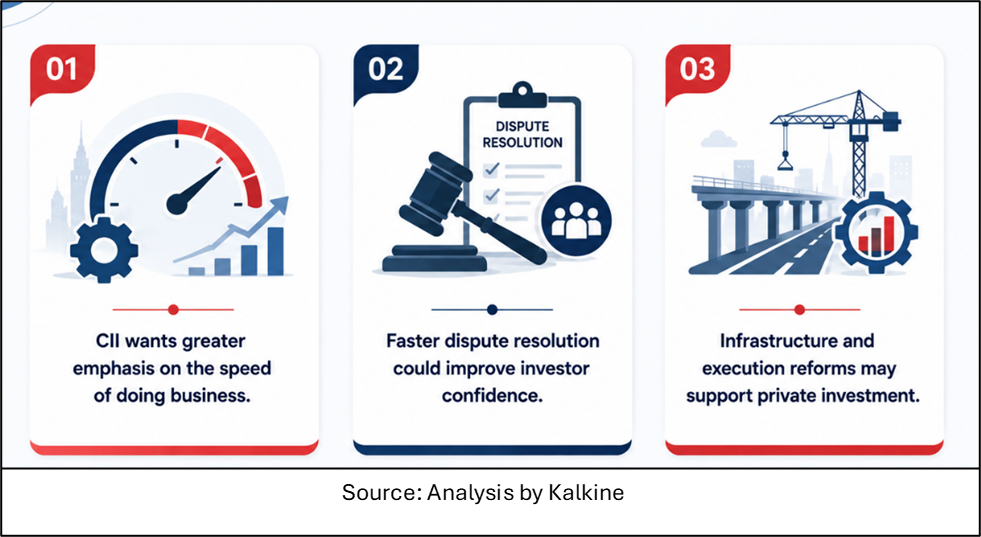
Confederation of Indian Industry (CII) President R. Mukundan has called for a greater focus on improving the “speed of doing business,” arguing that faster execution, quicker approvals and efficient dispute resolution could help attract more domestic and foreign investment. He has suggested that India should move beyond ease of doing business and focus on reducing delays that affect investment decisions.
Why Speed Matters For Investors
Businesses often evaluate investment destinations based on factors such as regulatory certainty, infrastructure availability, project approvals and dispute resolution mechanisms.
According to Mukundan, delays in areas such as land allocation, project approvals, utility connections and legal processes can increase project costs and reduce investment attractiveness. Faster implementation of projects could improve efficiency and encourage greater private-sector participation.
Industry representatives argue that execution speed is becoming increasingly important as countries compete globally for capital, manufacturing investments and supply-chain opportunities.
Focus Shifts Beyond Ease Of Doing Business
From Ease To Speed
India has implemented multiple reforms over the past decade aimed at improving the business environment, including tax reforms, digitalisation initiatives and insolvency frameworks.
However, industry leaders believe that the next phase of reforms should focus on reducing the time required for approvals, clearances and project implementation. Mukundan has highlighted the need to improve the speed of land allotment, project execution and infrastructure delivery.
Lowering The Cost Of Doing Business
Apart from execution delays, CII has also pointed to concerns regarding logistics costs, power expenses and infrastructure bottlenecks.
Reducing these costs could improve competitiveness for businesses operating in India and make the country more attractive as an investment destination. Industry stakeholders believe that addressing these challenges can support industrial growth and export competitiveness.
Faster Dispute Resolution Gains Importance
One of the major issues highlighted by Mukundan is the need for quicker resolution of investor disputes.
He has argued that arbitration and dispute-settlement mechanisms should conclude within months rather than taking several years. According to industry representatives, prolonged legal uncertainty can discourage investment and increase business risks.
Mukundan also suggested that India should strengthen its dispute-resolution capabilities to match leading global jurisdictions. Faster resolution mechanisms could improve investor confidence and support long-term capital inflows.
Private Investment And Economic Growth
Higher Growth Requires More Investment
Industry leaders believe that achieving higher economic growth rates will require stronger private-sector participation.
Mukundan has stated that while investment will continue to come into India, achieving sustained growth rates of 8% to 10% may require deeper reforms aimed at improving competitiveness, infrastructure efficiency and investor confidence.
Infrastructure Remains A Key Factor
Reliable infrastructure continues to be one of the most important considerations for investors. Areas such as logistics, transportation networks, power availability and industrial land access influence investment decisions across sectors.
Industry bodies have argued that faster execution of infrastructure projects can improve productivity and reduce business costs.
Global Competition For Capital
India is competing with several emerging economies for foreign direct investment and manufacturing opportunities.
Industry leaders have pointed out that improving investment conditions and reducing administrative delays can strengthen India's position in the global investment landscape. Reforms aimed at improving speed, efficiency and predictability may help attract larger investment commitments over time.
As businesses increasingly seek reliable and efficient investment destinations, policymakers may face growing pressure to ensure that regulatory processes keep pace with economic ambitions.
Key Risks
- Delayed approvals may discourage new investments.
- Infrastructure bottlenecks can increase project costs.
- Slow dispute resolution may affect investor confidence.
- Higher operating costs can reduce competitiveness.
Summary
CII President R. Mukundan has urged policymakers to prioritise the “speed of doing business” as a way to encourage private investment and support higher economic growth. Industry concerns include delays in project approvals, land allocation, infrastructure execution and dispute resolution. According to CII, faster implementation, lower business costs and improved investor confidence could help India attract greater domestic and foreign investment while strengthening its competitiveness in the global economy.
FAQs
Q: What does CII mean by ‘speed of doing business’?
A: It refers to reducing delays in approvals, project execution, dispute resolution and other business-related processes.
Q: Why is faster dispute resolution important for investors?
A: Quicker settlements reduce uncertainty, improve confidence and lower investment-related risks.
Q: How can faster execution support private investment growth?
A: Timely approvals and infrastructure delivery can reduce costs and improve project viability.