

Highlights
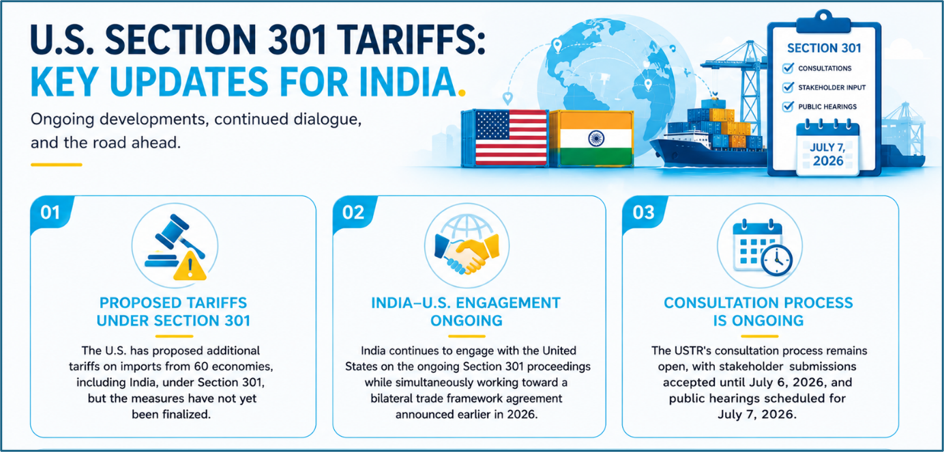
- The U.S. has proposed additional tariffs on imports from 60 economies, including India.
- India continues discussions with the U.S. under ongoing Section 301 proceedings.
- Negotiations on a bilateral framework agreement are progressing alongside trade consultations.
Export-oriented stocks listed on the NSE and BSE may remain in focus after the United States Trade Representative (USTR) proposed additional tariffs on imports from 60 economies, including India, under Section 301 of the U.S. Trade Act of 1974.
The proposal follows investigations conducted by the USTR into measures adopted by various economies concerning import restrictions. The proposed tariffs are not yet final and remain subject to consultations and stakeholder feedback before any implementation decision is taken.
India Continues Engagement with the United States
According to the Ministry of Commerce and Industry, India remains actively engaged with the United States regarding the Section 301 proceedings. The government stated that discussions are continuing as part of the established consultation process. Simultaneously, India and the United States are also working toward finalizing a framework agreement that was announced on February 2, 2026, and referenced in the joint statement issued on February 7, 2026.
The parallel negotiations indicate that trade and economic engagement between the two countries continues despite the ongoing tariff review process.
 Source: Analysis by Kalkine
Public Consultation Process Underway
The USTR has initiated a public consultation process before making any final determination on the proposed tariffs. Stakeholders interested in participating in public hearings can submit requests until June 22, 2026. Written comments may be submitted until July 6, 2026, while public hearings are scheduled for July 7, 2026.
The USTR has indicated that comments and testimony received during the consultation period will be considered before any final measures are adopted.
Certain Products Excluded from Proposal
The proposed tariff measures do not apply to all imported products. According to the USTR report, products already covered under Section 232 tariffs, along with certain other categories of goods, have been excluded from the current proposal.
In addition, a separate mechanism has been proposed for textile and apparel imports. Under this framework, a specified volume of imports from selected economies could potentially enter the United States at lower tariff rates. The details regarding eligible economies, quotas, and implementation parameters are expected to become clearer following the consultation process.
Potential Implications for Export-Oriented Sectors
While the tariff proposal remains under review, market participants may monitor developments across sectors with exposure to U.S. exports.
Industries such as textiles, apparel, engineering goods, chemicals, pharmaceuticals, and other export-driven segments could track the progress of the consultation process and the outcome of ongoing discussions between India and the United States.
However, no final tariff decision has been announced, and the scope of any future measures remains subject to review by U.S. authorities.
Framework Agreement Discussions Gain Attention
Alongside the tariff consultations, investors and businesses may closely watch developments surrounding the proposed India-U.S. framework agreement.
The agreement could shape future trade cooperation, market access discussions, and broader economic engagement between the two countries. Details regarding the final structure and provisions of the framework are yet to be announced.
Key Risks to Monitor
- Final tariff rates may differ from the current proposal.
- Export sectors could face uncertainty during consultations.
- Trade negotiations may take longer than anticipated.
- Changes in U.S. policy could affect implementation timelines.
Summary
The United States has proposed additional tariffs on imports from 60 economies, including India, under Section 301 of the U.S. Trade Act. The proposal remains under consultation, with hearings scheduled for July 2026. India continues discussions with the U.S. regarding the proceedings while also working toward finalizing a previously announced framework agreement aimed at strengthening bilateral trade engagement.
FAQs
Q: Has the U.S. finalized the proposed Section 301 tariffs?
A: No, the proposed tariffs remain under consultation and have not yet been finalized.
Q: Is India engaged in discussions regarding the tariff proposal?
A: Yes, India continues to engage with the United States as part of the Section 301 proceedings.
Q: When will public hearings on the tariff proposal take place?
A: The USTR has scheduled public hearings regarding the proposal for July 7, 2026.