

Highlights
- India is exploring Australian mineral supplies for induction cooktop manufacturing.
- The initiative aims to reduce dependence on imports from China.
- Domestic production could support supply chain diversification in consumer appliances.
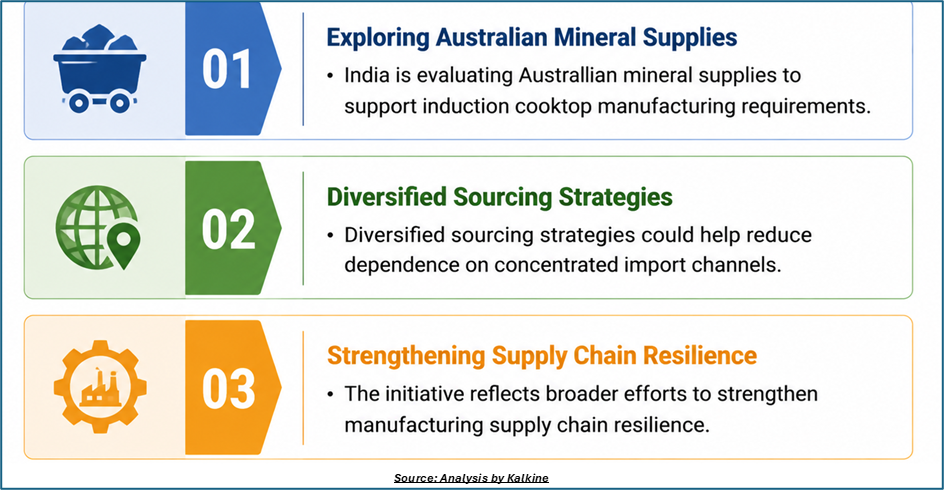
India is exploring opportunities to secure mineral supplies from Australia to support the manufacturing of induction cooktops, a move that could help reduce dependence on imports from China and strengthen domestic supply chains. The development comes as policymakers and industry participants seek greater resilience in critical manufacturing inputs amid evolving global trade dynamics.
Why Induction Cooktops Are In Focus
Induction cooktops have gained popularity in recent years due to their energy efficiency, ease of use, and compatibility with modern kitchens. Demand has been supported by urbanisation, rising household incomes, and increasing consumer preference for electric cooking appliances.
However, a significant portion of the components and raw materials used in the production of induction cooktops continues to be sourced from overseas markets. This dependence has exposed manufacturers to supply disruptions, price fluctuations, and geopolitical uncertainties.
The latest initiative seeks to address some of these challenges by expanding access to alternative sources of critical minerals and inputs.
The Australia Connection
Australia is among the world's major suppliers of several minerals used in industrial and manufacturing applications. Indian authorities are reportedly examining the possibility of sourcing key minerals from Australia that can be used in the production of induction cooktops and related components.
The move aligns with broader efforts to diversify import sources and reduce concentration risks in supply chains. By securing access to alternative mineral suppliers, manufacturers may be able to lower vulnerabilities associated with dependence on a single country or region.
Industry observers note that diversification has become an increasingly important consideration as global manufacturers reassess sourcing strategies in response to changing trade patterns.
Reducing Import Dependence
China remains a major supplier of components, electronics, and manufacturing inputs across several industries, including consumer appliances. While Chinese imports continue to play a significant role in global supply chains, many countries are exploring options to reduce concentration risk.
For India, expanding sourcing relationships with countries such as Australia could help improve supply chain flexibility. Access to a broader network of suppliers may support manufacturing continuity and provide additional procurement options during periods of disruption.
The initiative also reflects India's wider focus on developing domestic manufacturing capabilities across strategic sectors.
Potential Impact On Domestic Manufacturing
A stable supply of essential minerals can play an important role in supporting local manufacturing ecosystems. If Indian manufacturers gain reliable access to critical inputs, it may encourage greater investment in component production and assembly operations linked to induction cooktops and related appliances.
Increased domestic manufacturing activity could contribute to value addition within the country while supporting the development of local supplier networks. Industry participants may also benefit from reduced exposure to international supply bottlenecks.
The long-term impact will depend on factors such as commercial viability, logistics arrangements, processing capabilities, and the pace of industry adoption.
Broader Supply Chain Strategy
The effort to secure alternative mineral supplies forms part of a larger trend among governments and businesses seeking to strengthen supply chain resilience. Recent years have highlighted the importance of diversified sourcing strategies across industries ranging from electronics and renewable energy to automotive manufacturing and consumer goods.
As countries seek to balance cost efficiency with supply security, partnerships involving resource-rich nations and manufacturing-focused economies are becoming increasingly relevant.
For India, access to reliable mineral supplies could support ongoing initiatives aimed at enhancing manufacturing competitiveness and reducing external dependencies in selected sectors.
What Industry Will Watch Next
Stakeholders are likely to monitor how sourcing arrangements develop and whether they translate into greater domestic production capacity. Industry participants will also assess the economic feasibility of mineral imports, processing infrastructure requirements, and the impact on manufacturing costs.
Any progress in securing long-term mineral supply agreements could influence future investment decisions within the appliance manufacturing ecosystem. At the same time, developments in global commodity markets and trade relations will remain important factors.
Key Risks
- Mineral sourcing agreements may take time to operationalize.
- Global commodity price volatility could affect manufacturing costs.
- Logistics and transportation challenges may impact supply consistency.
- Domestic processing capacity may require additional investment.
Summary
India's exploration of Australian mineral supplies for induction cooktop manufacturing reflects a broader effort to diversify sourcing channels and reduce dependence on Chinese imports. The initiative could support supply chain resilience, encourage domestic manufacturing activity, and expand access to critical inputs. However, factors such as costs, infrastructure requirements, and implementation timelines will influence the long-term impact on the industry.
FAQs
Q: Why is India exploring mineral supplies from Australia?
A: India is seeking alternative sources of key minerals to support manufacturing and reduce supply chain concentration risks.
Q: How could this affect induction cooktop manufacturing?
A: Access to reliable mineral supplies may support domestic production and improve sourcing flexibility for manufacturers.
Q: What challenges could affect the initiative?
A: Commodity prices, logistics, infrastructure needs, and commercial viability may influence implementation and industry adoption.