

Highlights
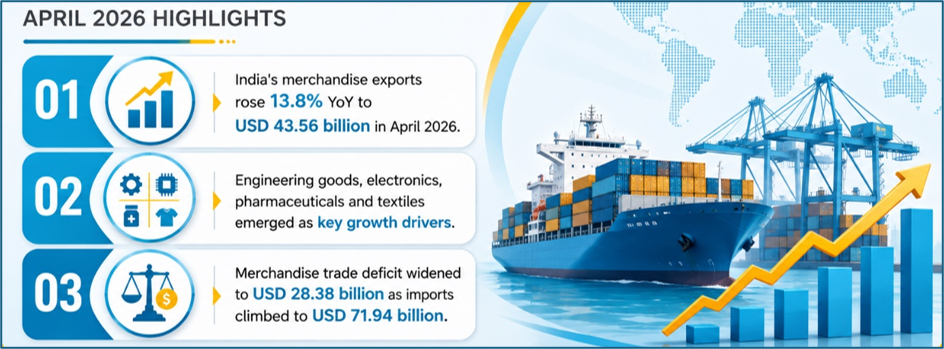
- India’s merchandise exports increased to USD 43.56 billion in April 2026.
- Engineering goods, electronics, pharmaceuticals and textiles supported export growth.
- Merchandise trade deficit widened to USD 28.38 billion during the month.
India’s export sector began FY2026-27 on a positive note, with merchandise exports recording year-on-year growth in April 2026 despite global economic uncertainties, geopolitical tensions and supply chain challenges. The latest trade data indicates that export-oriented sectors continued to contribute to overseas shipments, while rising imports led to a wider trade deficit.
According to data highlighted by the Federation of Indian Export Organisations (FIEO), India’s merchandise exports rose to USD 43.56 billion in April 2026 from USD 38.28 billion in April 2025. Imports increased to USD 71.94 billion from USD 65.38 billion during the corresponding period last year. India’s overall exports of goods and services are estimated at USD 80.80 billion during April 2026.
Source: Analysis by Kalkine
Export Growth Amid Global Challenges
Commenting on the trade performance, FIEO President S C Ralhan stated that the increase in merchandise exports reflects the resilience and adaptability of Indian exporters despite an uncertain global trade environment.
He noted that geopolitical tensions, supply chain disruptions and rising logistics costs have continued to impact international trade. However, exporters across several sectors maintained growth momentum during the month.
The latest figures suggest that Indian products continue to find demand in global markets despite external challenges affecting international commerce.
Key Sectors Driving Overseas Shipments
Several manufacturing and industrial sectors contributed significantly to export performance during April 2026.
Among the top export categories were engineering goods, petroleum products, electronic goods, drugs and pharmaceuticals, organic and inorganic chemicals, gems and jewellery, ready-made garments, rice, cotton yarn and plastic products.
Engineering goods, electronics, pharmaceuticals and textiles were identified by FIEO as major contributors to export growth, reflecting India's expanding manufacturing base and diversified export basket.
Trade Deficit Widens on Rising Imports
While exports registered growth, imports increased at a faster pace during the month. India’s merchandise trade deficit widened to USD 28.38 billion in April 2026.
According to FIEO, the widening gap was largely influenced by developments in the Middle East. The ongoing regional conflict affected global shipping routes, resulting in higher freight charges and elevated energy costs. The increase in imports was primarily driven by petroleum products and electronic goods, while higher energy prices contributed to a larger import bill.
Major Import Categories Remain Elevated
India’s leading import items during April 2026 included petroleum crude and petroleum products, electronic goods, gold, electrical and non-electrical machinery, transport equipment, non-ferrous metals, coal, chemicals, plastic materials and vegetable oils.
Higher imports of energy and technology-related products continued to influence overall trade dynamics. The increase in electronics imports also highlights India's growing demand for components, devices and industrial equipment used across manufacturing and consumer sectors.
Key Export Markets Continue to Support Growth
The United States remained India’s largest export destination during April 2026.
Other significant export markets included Singapore, the UAE, China, Bangladesh, the Netherlands, Tanzania, the United Kingdom, Australia and Sri Lanka.
On the import side, China emerged as the leading source of imports, followed by Russia, the United States, the UAE, Saudi Arabia, South Korea, Japan, Singapore, Germany and Indonesia. The broad geographic spread of export destinations reflects India's continued engagement with both developed and emerging markets.
Policy Support Remains Important
FIEO highlighted the importance of continued policy support, stable logistics networks and improved market access initiatives to maintain export momentum.
S C Ralhan said:
“Going forward, India must continue focusing on export diversification, value addition, trade facilitation and strengthening of strategic trade partnerships to achieve sustained export growth and improve global competitiveness.”
The comments underline the importance of enhancing competitiveness and expanding market reach as exporters navigate evolving global trade conditions.
What Investors May Watch
Export-oriented sectors such as engineering goods, electronics, pharmaceuticals, textiles and chemicals may remain in focus as investors assess the sustainability of export growth.
Future trade data, logistics costs, energy prices, geopolitical developments and demand trends across key export markets could influence sector performance in the coming months.
Key Risks to Watch
- Higher energy prices may increase import costs further.
- Geopolitical tensions could disrupt global shipping routes.
- Weak global demand may affect export growth momentum.
- Currency volatility may impact exporter profitability.
Summary
India’s merchandise exports rose to USD 43.56 billion in April 2026, reflecting continued export activity despite global uncertainties. Engineering goods, electronics, pharmaceuticals and textiles contributed significantly to growth. However, imports climbed to USD 71.94 billion, resulting in a merchandise trade deficit of USD 28.38 billion. Market participants may monitor trade trends, logistics conditions and global demand indicators going forward.
FAQs
Q: How much did India’s merchandise exports increase in April 2026?
A: Merchandise exports increased to USD 43.56 billion from USD 38.28 billion in April 2025.
Q: Which sectors contributed most to export growth?
A: Engineering goods, electronics, pharmaceuticals and textiles were among the key contributors to export expansion.
Q: Why did India’s trade deficit widen in April 2026?
A: Higher petroleum and electronics imports alongside elevated energy costs increased the merchandise trade deficit.