

Highlights
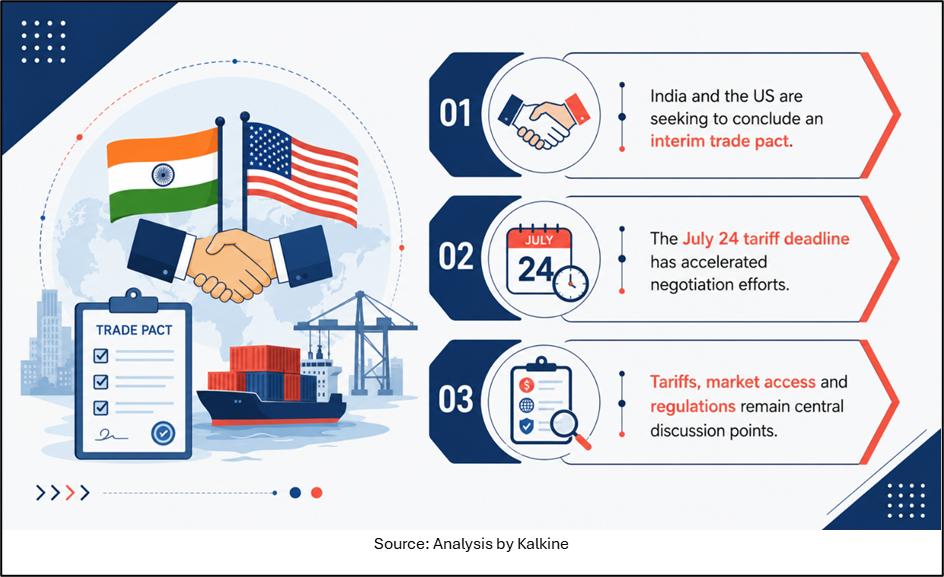
- India and the US are working to finalise an interim trade agreement.
- The July 24 tariff deadline has increased pressure on negotiators.
- Market access, tariffs and trade barriers remain key discussion areas.
India and the United States have entered a critical phase in negotiations for an interim trade agreement, with both countries attempting to conclude a deal before a key tariff deadline on July 24. The talks are part of a broader effort to establish a Bilateral Trade Agreement (BTA) aimed at expanding economic cooperation and addressing longstanding trade concerns.
Recent ministerial-level discussions between Indian Commerce Minister Piyush Goyal and US Trade Representative Jamieson Greer have been described as constructive, with both sides reviewing progress and exploring pathways to conclude an initial agreement. Officials from both countries have indicated that substantial progress has been made in recent months.
Why The July 24 Deadline Matters
The urgency surrounding the negotiations stems from the expiry of a temporary US tariff framework scheduled for July 24. Both countries are seeking clarity on tariff arrangements before the deadline, making the coming weeks crucial for trade discussions.
India is aiming to secure favourable trading terms that would help its exporters remain competitive in the US market. The government is also seeking assurances regarding future tariff treatment to reduce uncertainty for businesses engaged in bilateral trade.
The deadline has effectively become a focal point for negotiators as both sides attempt to resolve outstanding issues while preserving broader economic ties.
Progress Made In Recent Negotiations
Interim Pact Takes Shape
Trade negotiations have accelerated following high-level political engagement between the two countries. Officials have repeatedly indicated that discussions are moving toward an interim agreement that could serve as the first phase of a larger trade framework.
Both governments have reaffirmed their commitment to achieving an agreement that is commercially meaningful and balanced for businesses on both sides.
Focus On Bilateral Trade Expansion
The proposed arrangement is expected to address tariff structures, market access and other trade barriers affecting goods and services moving between the two economies. Negotiators are also examining ways to strengthen overall economic engagement and improve trade competitiveness.
India and the US have increasingly emphasised the importance of expanding bilateral trade as both economies seek deeper commercial cooperation.
Key Issues Still Under Discussion
Despite progress, several areas continue to require negotiation.
Market Access Concerns
Market access remains one of the most sensitive issues. Discussions include trade barriers, import regulations and opportunities for businesses from both countries to access each other's markets.
Agricultural products, industrial goods and certain service sectors are among the areas where negotiators continue to seek common ground.
Tariff And Regulatory Questions
The impact of US tariff policies and ongoing trade investigations has added complexity to negotiations. Certain regulatory and tariff-related matters remain unresolved, making the final stages of discussions particularly important.
Experts note that while significant progress has been reported, the outcome will depend on how effectively both sides address the remaining differences.
Potential Impact On Businesses
A successful interim agreement could provide greater visibility regarding tariff treatment and market access conditions for exporters and importers. Businesses involved in sectors with significant India-US trade exposure are closely monitoring developments.
The agreement could also serve as a foundation for broader negotiations aimed at expanding bilateral trade volumes and strengthening economic relations over the longer term.
However, the final structure of the agreement and its economic implications will depend on the details eventually negotiated by both governments.
Key Risks
- Failure to meet the July 24 deadline could prolong uncertainty.
- Unresolved tariff issues may affect trade competitiveness.
- Regulatory differences could delay final agreement execution.
- Market access disputes may remain contentious.
Summary
India and the United States are moving closer to an interim trade agreement as the July 24 tariff deadline approaches. Ministerial-level talks have reported substantial progress, with both countries seeking a balanced and commercially meaningful arrangement. While tariffs, market access and regulatory issues remain under discussion, negotiators are working to finalise a first-phase agreement that could lay the groundwork for a broader bilateral trade partnership.
FAQs
Q: Why is the July 24 deadline important for India-US trade talks?
A: The deadline is linked to tariff arrangements, increasing urgency for both countries to conclude an interim agreement.
Q: What is the proposed India-US Bilateral Trade Agreement?
A: It is a trade framework aimed at improving market access, reducing barriers and expanding economic cooperation.
Q: Have India and the US finalised the trade deal yet?
A: No. Negotiations are ongoing, although both sides report substantial progress toward an interim agreement.