

Highlights
- India and the US are accelerating trade negotiations ahead of a key tariff deadline.
- Both sides are working toward an interim agreement covering market access and tariffs.
- The outcome could influence exports, investment flows and bilateral trade relations.
India and the United States have intensified efforts to conclude an interim trade agreement as a key tariff deadline approaches. Senior officials from both countries are engaged in negotiations aimed at resolving outstanding trade issues before Washington's temporary tariff measures expire on July 24.
The discussions reflect growing urgency on both sides to secure a framework that supports trade growth while addressing concerns related to tariffs, market access and broader economic cooperation. Commerce and Industry Minister Piyush Goyal and US Trade Representative Jamieson Greer have been leading the latest round of high-level discussions.
Why The July Deadline Matters
The current negotiations are taking place against the backdrop of temporary US import tariffs that are scheduled to expire on July 24. Both countries are seeking clarity on the future tariff framework and potential concessions that could emerge through a trade agreement.
Officials have indicated that an interim pact could help provide greater certainty for businesses and exporters while creating a foundation for a broader bilateral trade agreement in the future. The approaching deadline has added momentum to discussions that have been ongoing for several months.
What Is Being Negotiated?
The trade talks cover several areas including tariff reductions, market access, customs facilitation, non-tariff barriers, investment promotion and economic cooperation.
India is seeking improved access to the US market and tariff terms that enhance the competitiveness of its exports relative to other manufacturing economies. Meanwhile, the United States is focused on expanding opportunities for its exporters and ensuring reciprocal market access.
Negotiators are also working to address issues that have delayed progress, including sector-specific concerns and the evolving tariff environment in the United States.
Potential Impact On Indian Exports
A trade agreement could have important implications for Indian exporters across multiple sectors. Lower tariffs or improved market access may support exports of manufactured goods, engineering products, pharmaceuticals, textiles and services.
The United States remains one of India's largest trading partners, making trade policy developments particularly significant for businesses with exposure to overseas markets. Industry participants are closely monitoring negotiations for indications of how tariff structures may change under any future agreement.
Recent government data has shown resilience in India's export performance despite global economic uncertainty, highlighting the importance of maintaining access to key international markets.
Why Businesses Are Watching Closely
Companies involved in international trade generally prefer stable and predictable policy environments. Uncertainty around tariffs can affect procurement decisions, pricing strategies and long-term investment planning.
An interim agreement could provide businesses with greater visibility regarding future trade conditions. It may also encourage additional investment activity by reducing uncertainty around market access and trade costs. However, the extent of these benefits will depend on the final terms agreed by both sides.
Challenges Still Remain
Despite progress in discussions, several issues continue to require negotiation. Reports suggest that market access, agricultural trade, intellectual property matters and digital trade policies remain areas where further discussions may be necessary.
Trade agreements involving major economies often require balancing domestic interests with international commitments, making negotiations complex and time-consuming. The coming weeks are expected to be crucial in determining whether both sides can bridge remaining differences before the deadline.
What Happens Next?
Market participants will closely watch the outcome of the ongoing ministerial-level discussions. Any announcement regarding tariff reductions, market access commitments or the framework of an interim agreement could influence trade expectations and business sentiment.
Even if an interim agreement is reached, broader negotiations on a comprehensive bilateral trade framework are expected to continue. The current discussions may therefore represent an important step in a longer process aimed at strengthening economic ties between the two countries.
Key Risks
- Negotiations may not conclude before the tariff deadline.
- Sector-specific disagreements could delay implementation.
- Future tariff policy changes may alter trade dynamics.
- Global economic uncertainty could affect trade growth.
Summary
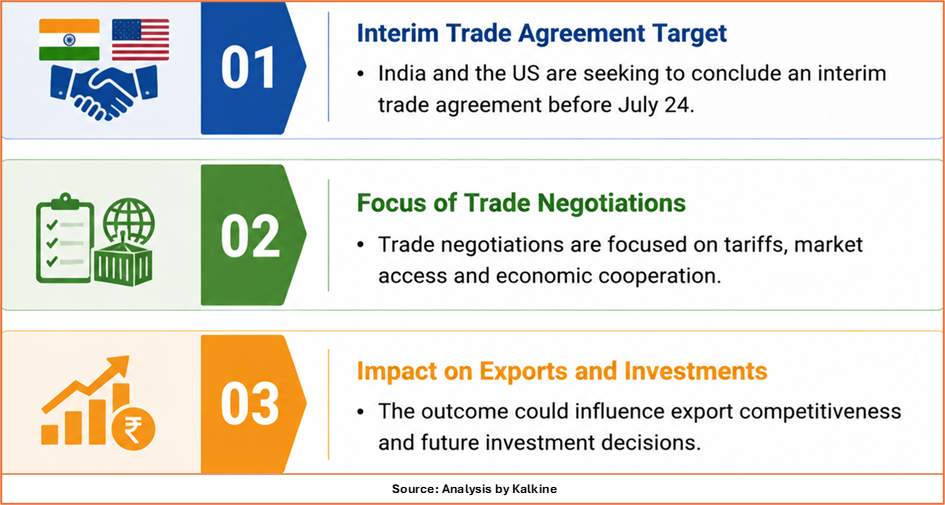
India and the United States are accelerating efforts to conclude an interim trade agreement before the July 24 tariff deadline. The negotiations focus on tariffs, market access and broader economic cooperation. A successful outcome could improve trade certainty, support exporters and strengthen bilateral economic ties. However, unresolved issues and policy uncertainties mean the final outcome remains dependent on ongoing negotiations.
FAQs
Q: Why are India and the US rushing to conclude a trade agreement?
A: Both countries are seeking progress before temporary US tariff measures expire on July 24.
Q: What are the main issues being discussed?
A: Tariffs, market access, customs procedures, investment promotion and trade-related regulatory barriers.
Q: How could the agreement affect Indian businesses?
A: It may improve export opportunities and provide greater certainty regarding future trade conditions.