

Highlights
- Gulf countries accounted for most reported Indian worker deaths overseas.
- Saudi Arabia and the UAE recorded the highest fatalities among destinations.
- Thousands of worker grievances were also reported during the period.
India's overseas workforce plays a significant role in supporting both domestic households and the national economy through remittances. However, recent government data has drawn attention to the human cost associated with overseas employment, particularly in Gulf countries, where a large share of Indian migrant workers are employed.
Data presented in Parliament showed that a substantial majority of Indian worker deaths reported abroad between 2021 and 2025 occurred in Gulf nations. The figures highlight the concentration of Indian migrant labour in the region and the challenges faced by workers employed overseas.
Saudi Arabia And UAE Report Highest Fatalities
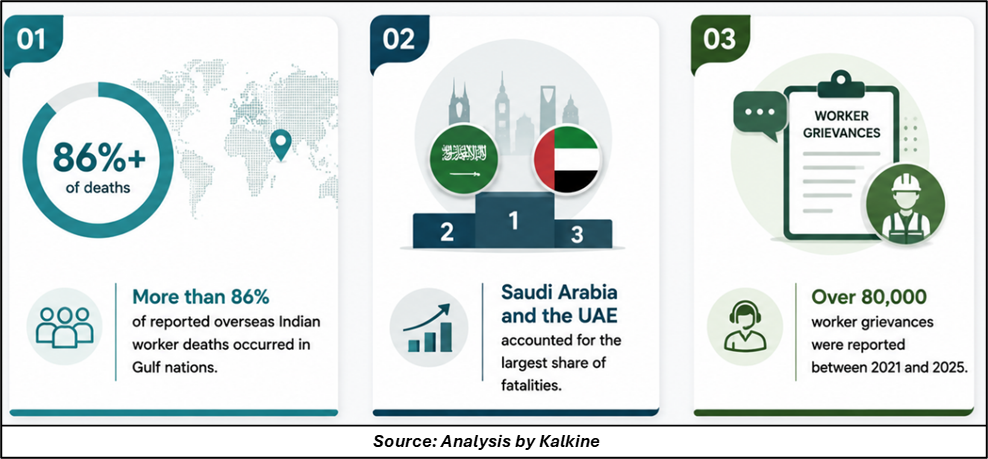
Government data showed that 37,740 Indian worker deaths were recorded abroad between 2021 and 2025. More than 86% of these fatalities occurred in Gulf countries, underscoring the region's significance as a destination for Indian migrant workers.
Among individual countries, the United Arab Emirates reported the highest number of fatalities, followed closely by Saudi Arabia. Together, the two nations accounted for a significant portion of total overseas deaths during the five-year period. Kuwait, Oman and Qatar also recorded notable numbers of fatalities.
The concentration of deaths in these countries largely reflects the scale of Indian migration to the Gulf, where millions of Indians are employed across sectors such as construction, transportation, hospitality, manufacturing, domestic services and oil-related industries.
Why Gulf Nations Dominate The Data
Large Migrant Workforce
The Gulf region remains one of the largest overseas employment destinations for Indian workers. Countries such as Saudi Arabia, the UAE, Kuwait, Oman, Qatar and Bahrain have long relied on migrant labour for infrastructure development and service-sector operations.
As a result, a higher concentration of workers naturally leads to higher absolute numbers of reported deaths compared with regions that employ fewer Indian nationals.
Diverse Causes Of Death
The government data does not provide a detailed cause-wise breakdown of fatalities. As a result, the reported figures include deaths arising from multiple causes, including natural causes, illnesses, accidents and other circumstances.
Without detailed categorisation, the data should not be interpreted solely as workplace-related fatalities. The figures represent overall deaths of Indian workers reported overseas during the period.
Rising Worker Welfare Concerns
Alongside fatalities, Indian diplomatic missions overseas received a large number of complaints related to worker welfare.
Between 2021 and 2025, overseas missions recorded 80,985 grievances involving issues such as labour disputes, exploitation, wage-related concerns and other workplace difficulties. The UAE and Kuwait accounted for a significant share of these complaints.
Separate parliamentary data has also highlighted continuing concerns involving recruitment practices, working conditions, documentation issues and assistance for distressed workers in several Gulf countries.
Government Measures To Support Workers
The Indian government has implemented several mechanisms to support citizens working overseas. These include bilateral labour agreements, grievance redressal systems, recruitment monitoring mechanisms and assistance provided through Indian embassies and consulates.
Authorities have also continued efforts to improve awareness regarding safe migration practices and worker rights before individuals take up overseas employment.
The government regularly engages with host countries to address worker welfare issues and strengthen protections available to Indian nationals employed abroad.
What The Data Suggests
The latest figures illustrate the extent to which Indian overseas employment remains concentrated in Gulf economies. While the region continues to provide employment opportunities for millions of workers, the data also highlights the importance of worker welfare, safety standards and effective grievance resolution mechanisms.
As migration to Gulf countries continues, policymakers are likely to remain focused on strengthening safeguards and improving support systems for Indian nationals working abroad.
Key Risks
- Worker welfare concerns may persist despite policy interventions.
- Recruitment-related disputes can affect overseas employment experiences.
- Lack of cause-wise data limits deeper analysis of fatalities.
- Dependence on a few labour markets increases vulnerability.
Summary
Government data shows that 37,740 Indian worker deaths were reported abroad between 2021 and 2025, with more than 86% occurring in Gulf countries. The UAE and Saudi Arabia recorded the highest fatalities, reflecting their status as major destinations for Indian migrant workers. Alongside these deaths, thousands of worker grievances were reported, highlighting the continuing importance of labour welfare, migration safeguards and support mechanisms for Indians employed overseas.
FAQs
Q: Which country reported the highest number of Indian worker deaths abroad?
A: The UAE reported the highest number of fatalities, followed by Saudi Arabia.
Q: Why are most Indian worker deaths reported from Gulf countries?
A: Gulf nations employ large numbers of Indian workers, resulting in higher reported fatalities.
Q: Do the reported deaths only include workplace accidents?
A: No. The figures include deaths from various causes and are not limited to workplace incidents.