

Highlights
- Economists increasingly expect RBI to keep interest rates unchanged for now.
- Any potential rate hike may be pushed to the second half of FY27.
- Inflation, monsoon performance and oil prices remain key policy factors.
The Reserve Bank of India (RBI) may not be in a hurry to raise interest rates despite concerns around inflation and global uncertainties. Economists are increasingly shifting their expectations for a potential rate hike to the second half of FY27, moving away from earlier forecasts that suggested action could come as early as the August monetary policy review. The changing outlook reflects a combination of easing inflation pressures, growth considerations and uncertainty surrounding external economic conditions.
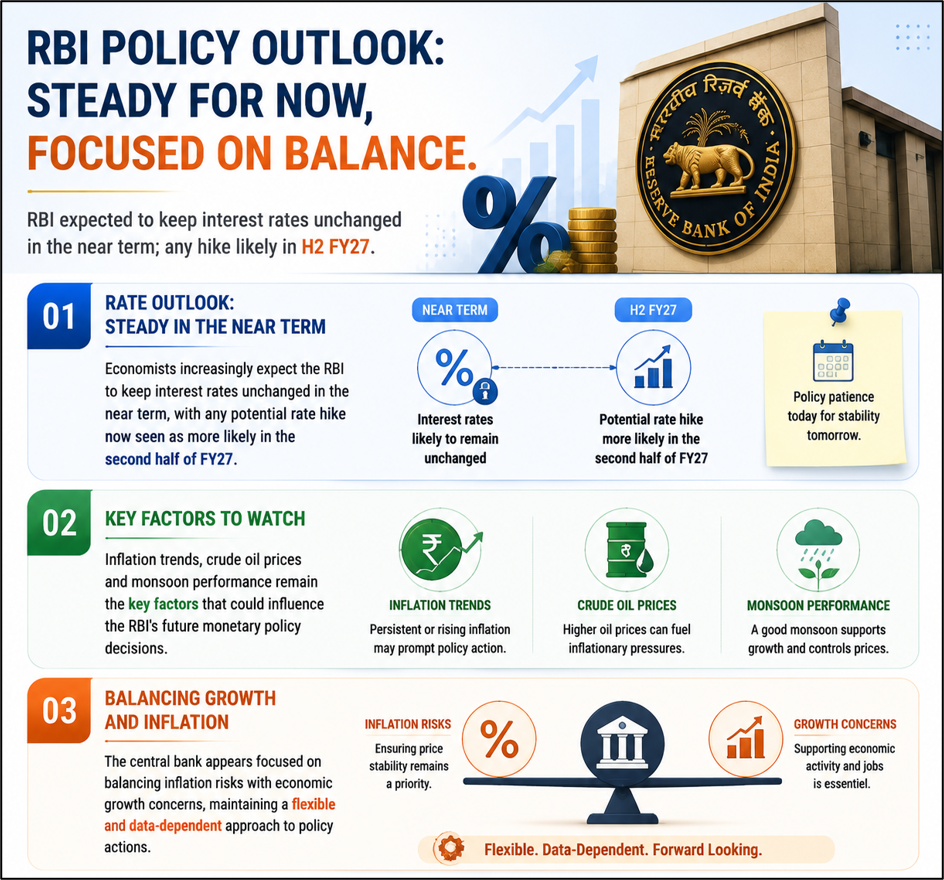
Source: Analysis by Kalkine
Why Expectations For A Rate Hike Are Shifting
Market participants had earlier anticipated that rising crude oil prices and geopolitical tensions could force the central bank to tighten monetary policy sooner. However, recent assessments suggest that the RBI is likely to maintain its wait-and-watch approach, allowing policymakers more time to evaluate inflation trends and economic conditions before considering any increase in borrowing costs.
The revised expectations come after the RBI's Monetary Policy Committee (MPC) opted to keep the repo rate unchanged at 5.25% during its June policy meeting. The committee also retained a neutral stance, indicating flexibility in responding to future economic developments rather than signalling an immediate policy tightening cycle.
Inflation Outlook Remains A Key Consideration
Inflation continues to be one of the most important factors influencing monetary policy decisions. While recent inflation readings have remained within the RBI's target range, policymakers remain cautious about potential risks from higher commodity prices, energy costs and weather-related disruptions.
Oil prices remain a significant concern because India is a major importer of crude oil. Any sustained increase in global energy prices could feed into domestic inflation through higher transportation and production costs. At the same time, uncertainty surrounding monsoon performance may influence food prices and agricultural output, adding another layer of complexity to policy decisions.
Growth Concerns Also Influence Policy Decisions
Alongside inflation management, the RBI continues to balance the need to support economic growth. Higher interest rates can help control inflation, but they can also increase borrowing costs for businesses and consumers.
Recent commentary from policymakers and economists suggests that the central bank is mindful of growth risks arising from global uncertainty and geopolitical developments. The RBI recently revised its FY27 GDP growth forecast to 6.6%, reflecting concerns about oil prices, external risks and weather-related factors. These considerations may reduce the urgency for immediate monetary tightening.
Monsoon And Oil Prices Under Close Watch
The progress of the monsoon season is expected to play an important role in shaping future policy decisions. A favourable monsoon could help contain food inflation, while weaker rainfall could place upward pressure on agricultural prices.
Similarly, developments in global oil markets remain critical. Any easing in geopolitical tensions that results in lower crude oil prices could reduce inflationary pressures and provide additional room for the RBI to maintain its current policy stance. Some policymakers have indicated that lower oil prices could also support stronger economic growth.
What Economists Expect Going Forward
Many economists now believe that the central bank may remain on hold for an extended period before considering any policy tightening. Forecasts increasingly point toward the latter half of FY27 as the most likely window for a rate increase, assuming inflation risks persist and economic conditions warrant such action.
The evolving outlook reflects the RBI's preference to avoid premature policy moves while monitoring developments in inflation, growth, commodity prices and financial markets. The central bank's future decisions are expected to remain data-dependent rather than guided by a predetermined path.
Key Risks
- Crude oil prices could rise sharply due to geopolitical tensions.
- Weak monsoon conditions may increase food inflation pressures.
- Currency volatility could complicate inflation management.
- Slower economic growth may limit policy tightening flexibility.
Summary
Economists are increasingly pushing back expectations for an RBI interest rate hike, with many now expecting any tightening to occur in the second half of FY27 rather than in the near term. The central bank's decision will depend largely on inflation trends, crude oil prices, monsoon performance and economic growth conditions. For now, the RBI appears focused on maintaining policy flexibility while monitoring domestic and global developments closely.
FAQs
Q: Why are economists delaying their expectations for an RBI rate hike?
A: Lower inflation concerns and growth considerations have reduced expectations of near-term policy tightening.
Q: What factors could influence the RBI's next rate decision?
A: Inflation, oil prices, monsoon performance, economic growth and global developments remain key considerations.
Q: What is the RBI's current repo rate?
A: The RBI maintained the repo rate at 5.25% during its June 2026 policy review.