

📌 Key Highlights
- Notification of Award (NOA) received from NTPC Renewable Energy Limited
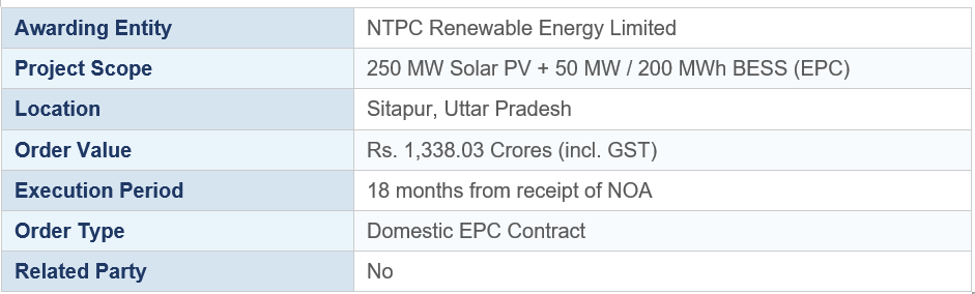
- Scope: EPC package for 250 MW Solar PV + 50 MW / 200 MWh Battery Energy Storage System (BESS)
- Location: Sitapur, Uttar Pradesh
- Order value: Rs. 1,338.03 Crores (inclusive of GST) — one of the largest single EPC orders in Indian solar
- Execution period: 18 months from receipt of NOA
- Cumulative Solar EPC order book now ~5.5 GWp; BESS order book ~1.1 GWh
- No related party or promoter interest in NTPC Renewable Energy Limited
📋 Order Details at a Glance
📰 News Insights
Bondada Engineering Limited, a Hyderabad-based renewable energy EPC contractor, announced on June 16, 2026 the receipt of a Notification of Award (NOA) from NTPC Renewable Energy Limited — the clean energy arm of India's largest power generation PSU, NTPC Limited — for an integrated EPC package at Sitapur, Uttar Pradesh.
The project combines a 250 MW Solar PV plant with a co-located 50 MW / 200 MWh Battery Energy Storage System (BESS), making it one of the most technically complex hybrid renewable energy projects currently being developed in India. The aggregate order value stands at Rs. 1,338.03 Crores (inclusive of GST), with a completion timeline of 18 months from the date of award. The disclosure was filed with BSE (Scrip Code: 543971) under Regulation 30 of SEBI LODR Regulations.
With this addition, Bondada's cumulative Solar EPC order book has grown to approximately 5.5 GWp and its BESS order book to approximately 1.1 GWh — metrics the company has highlighted as evidence of its expanding position in India's energy transition landscape.
🏢 Company Overview
Bondada Engineering Limited (CIN: L28910TG2012PLC080018), formerly known as Bondada Engineering Pvt Ltd, is a Hyderabad-based EPC company specialising in large-scale solar PV projects and Battery Energy Storage Systems. Listed on BSE (Scrip Code: 543971), the company operates from its corporate office at Kushaiguda Industrial Area, ECIL, Hyderabad, Telangana.
Bondada has built a significant presence in the Indian renewable energy EPC space, executing projects for utility-scale solar developers and PSU clients. Its capabilities span civil works, module mounting structures, electrical balance of plant (eBOP), grid integration, and increasingly, BESS integration — a segment that is still nascent in India but growing rapidly as storage mandates become more common in government-tendered solar projects.
The company's relationship with NTPC Renewable Energy Limited — one of the most active utility-scale solar developers in India — represents a strategic anchor customer that validates its EPC credentials at the highest institutional level.
📊 Business Analysis
At Rs. 1,338 crores, this is a landmark order for Bondada Engineering and one of the largest single EPC disclosures in the Indian solar sector. The integrated Solar + BESS structure of this project is particularly significant: BESS-enabled solar projects are substantially more complex than standalone solar EPC work, requiring deep expertise in battery chemistry, power electronics, grid compliance, and systems integration.
NTPC Renewable Energy Limited has been among the most aggressive procurers of solar capacity in India, with multi-GW pipelines across multiple states. Winning a Rs. 1,338 crore EPC package from NTPC effectively certifies Bondada as a Tier-1 EPC contractor capable of handling integrated hybrid renewable energy projects — a qualification that opens doors to similar large-ticket tenders from SECI, NHPC Renewable, and state utilities.
The 18-month execution window is aggressive for a 250 MW solar project with an associated 200 MWh BESS system, implying intensive execution mobilisation. However, it is consistent with NTPC's typical project timelines and reflects confidence in Bondada's delivery capabilities. The cumulative order book of 5.5 GWp solar and 1.1 GWh BESS signals multi-year revenue visibility and strong execution pipeline for investors.
💹 Investor Impact
This is the single most impactful order disclosure among the June 16 batch and potentially one of the most significant for any mid-cap renewable EPC company in recent quarters. At Rs. 1,338 crores, it likely represents a substantial multiple of Bondada's recent annual revenues and transforms the company's revenue visibility profile overnight.
For investors, the key value drivers are: (1) a marquee PSU client providing stable, bankable cash flows; (2) the entry into BESS EPC — the highest-growth sub-segment of India's energy storage ecosystem; and (3) the 5.5 GWp order book providing multi-year execution runway. Near-term catalysts to watch include project mobilisation updates, L1 wins in subsequent NTPC/SECI tenders, and any working capital financing announcements related to this order.
Frequently Asked Questions
- What is BESS and why is it important in this project?
- BESS stands for Battery Energy Storage System. In this project, a 50 MW / 200 MWh BESS is co-located with the 250 MW solar plant, enabling stored solar energy to be dispatched during non-sunlight hours. This 'dispatchable solar' capability is increasingly valued by grid operators and commands premium pricing in competitive bids.
- Who is NTPC Renewable Energy Limited?
- NTPC Renewable Energy Limited is a wholly owned subsidiary of NTPC Limited — India's largest power generation company and a Maharatna PSU. It was created to house NTPC's renewable energy portfolio and has been aggressively tendering solar, wind, and hybrid projects as India targets 500 GW of clean energy capacity by 2030.
What does '5.5 GWp order book' mean for Bondada?
It means Bondada has approximately 5.5 gigawatt-peak worth of solar EPC contracts in hand — representing multi-year revenue visibility. For context, India added approximately 20–25 GW of solar capacity annually in recent years, so a 5.5 GWp order book for a single EPC contractor reflects a significant market share.
What is the execution risk in this order?
Key execution risks include supply chain constraints for solar modules and BESS components, land availability and grid connectivity at the Sitapur site, and the 18-month tight timeline. Any delay in module supply, government approvals, or grid evacuation infrastructure could push timelines.