

Highlights
- WTI crude oil prices surged sharply after renewed U.S.-Iran hostilities revived concerns over global oil supply disruptions.
- Iran reportedly targeted a U.S. airbase following American strikes near Bandar Abbas, intensifying geopolitical tensions.
- Crude prices rebounded strongly as hopes of a near-term Iran peace deal weakened and concerns around the Strait of Hormuz resurfaced.
Overview
WTI crude oil prices rallied sharply in the latest session after renewed military escalation between the United States and Iran triggered fresh fears over supply disruptions in the Middle East. Oil prices rebounded after recent weakness as traders reassessed expectations surrounding a potential peace agreement and the reopening of commercial shipping routes through the Strait of Hormuz.
WTI crude futures climbed near the $91 zone after gaining more than 3%, while Brent crude futures also surged toward the $98 region during Asian trade. The rebound came after Iran’s Revolutionary Guard reportedly launched strikes targeting a U.S. airbase in Kuwait in retaliation for earlier American attacks near Bandar Abbas.
The renewed conflict increased concerns over the stability of oil flows through the Strait of Hormuz, a strategically critical route responsible for transporting nearly one-fifth of global crude oil supplies.
Why Are Oil Prices Rising Again?
Crude oil markets had witnessed heavy volatility earlier this week amid speculation that diplomatic negotiations between the U.S. and Iran could lead to easing tensions and improved shipping activity through Hormuz.
However, sentiment shifted sharply after U.S. President Donald Trump dismissed reports suggesting that Iran would reopen commercial shipping access through the Strait within a month. Trump also rejected proposals involving joint control of Hormuz by Iran and Oman, indicating that negotiations remained far from resolution.
Fresh military action between the two countries further weakened hopes of a near-term settlement and revived concerns over prolonged supply disruptions.
Reports also suggested that oil tanker traffic through Hormuz remains significantly below normal pre-conflict levels despite some limited improvement in recent days.
Strait of Hormuz Remains Key Market Trigger
The Strait of Hormuz continues to remain the central focus for global energy markets. Any disruption in the region can significantly impact global crude supply, shipping costs, and inflation expectations worldwide.
The latest attacks renewed fears that:
- oil exports from the Gulf region could face interruptions,
- shipping insurance and transportation costs may rise,
- and energy markets may remain volatile in the near term.
Higher oil prices also increase concerns around persistent inflation globally, especially as energy costs influence transportation, manufacturing, and industrial activity across economies.
Technical View
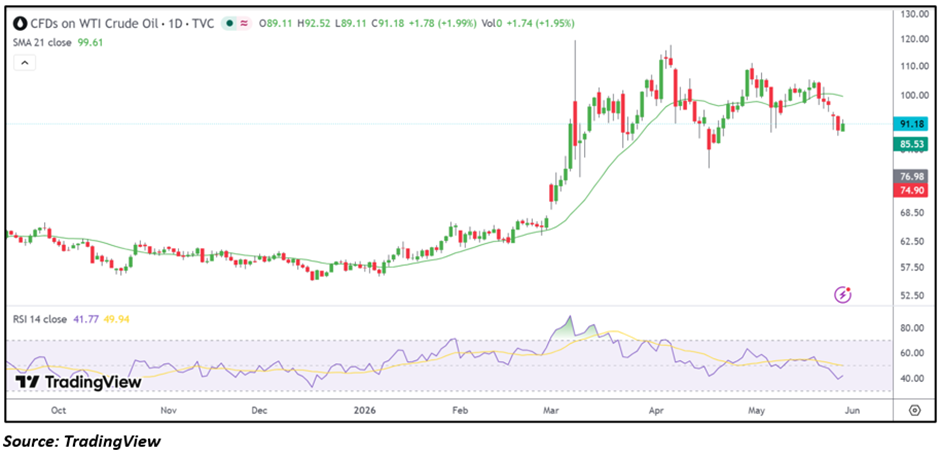
WTI crude oil futures traded near the $91.18 level while remaining below the 21-day SMA near $99.61, reflecting a mildly weak near-term structure despite the latest rebound attempt. Recent price action indicates volatility-driven consolidation after crude witnessed sharp swings over the past several sessions amid geopolitical developments.
The 14-day RSI eased toward 41.77 and remained below its moving average, reflecting softer momentum conditions despite the recent recovery from lower levels.
Key Technical Levels
WTI crude oil futures continued trading below the 21-day SMA, indicating that broader momentum remains cautious despite the sharp rebound triggered by geopolitical developments. Immediate support is placed around the $85–$86 zone, which may act as an important short-term demand region if volatility persists across energy markets. A deeper downside move could expose the $82 area, which remains a broader medium-term support zone for crude prices.
On the upside, immediate resistance is visible near the $96 zone, where previous recovery attempts witnessed selling pressure. A sustained move above this region could improve near-term sentiment and open the door toward the $100–$101 zone, which remains a key higher resistance area for the broader trend. Meanwhile, the 14-day RSI near 41.77 remained below its average line, indicating softer momentum conditions despite the recent rebound from lower levels.
Key Risks
- Further military escalation between the U.S. and Iran could trigger extreme commodity market volatility.
- Any disruption in Strait of Hormuz shipping activity may sharply tighten global crude supplies.
- Sudden diplomatic progress between both countries could reverse recent gains in oil prices.
- Weak global economic growth and slowing fuel demand could limit upside momentum in crude markets.
Broader Market Impact
The sharp rebound in oil prices also influenced inflation expectations, bond yields, currency markets, and precious metals sentiment globally. Higher energy prices may complicate the Federal Reserve’s interest-rate outlook as central banks remain cautious about inflation risks.
A prolonged rise in crude oil prices may also increase transportation and manufacturing costs globally, potentially affecting broader economic growth and consumer spending trends in major economies.
Summary
WTI crude oil prices rebounded strongly after renewed U.S.-Iran hostilities revived fears of prolonged supply disruptions and instability around the Strait of Hormuz. While geopolitical tensions remain the primary driver for oil markets, traders are also closely monitoring diplomatic developments, shipping activity, and broader inflation trends for further direction in crude prices.
FAQs
Why are crude oil prices rising?
Oil prices rose after renewed U.S.-Iran military escalation increased fears of supply disruptions around the Strait of Hormuz.
Why is the Strait of Hormuz important?
The Strait of Hormuz handles a major portion of global crude oil shipments, making it one of the world’s most critical energy trade routes.
What are the key resistance levels for WTI crude oil?
Immediate resistance is visible near the $96 zone, followed by the broader $100–$101 region.