

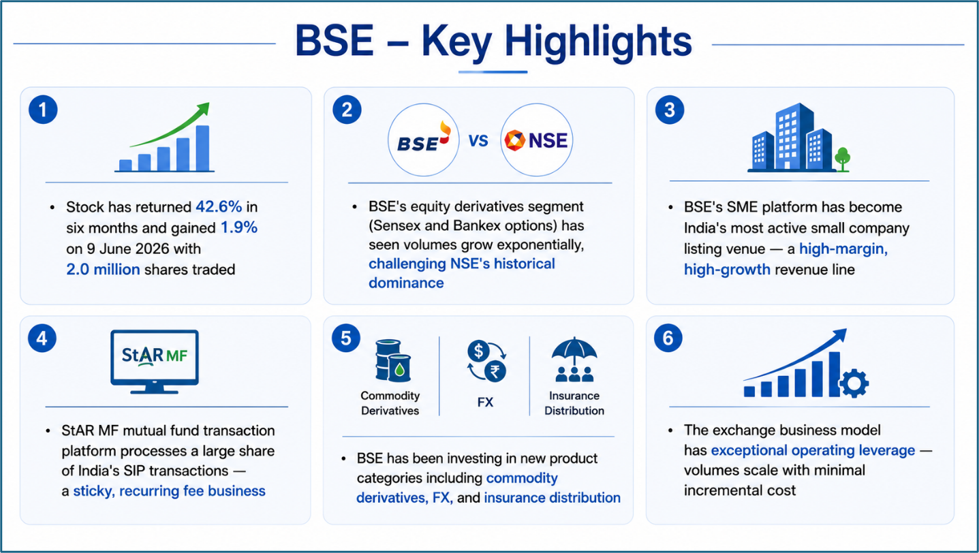
At Rs 3,992, BSE Ltd has re-rated from a sleepy exchange into a genuine high-growth financial infrastructure business on the back of derivatives volume explosion and SME IPO boom.
Why Has BSE Stock Surged?
The Derivatives Volume Explosion
BSE's equity derivatives segment was dormant for years as NSE dominated the Indian derivatives market. A regulatory intervention by SEBI in 2023-24 — which restricted weekly expiry options to one per exchange per week — created an unexpected windfall for BSE. BSE's Sensex and Bankex weekly options contracts, which had previously seen minimal trading, became SEBI-compliant alternatives to the NSE's dominant Nifty and Bank Nifty weekly contracts.
Derivatives trading volumes on BSE have gone from near-zero to hundreds of millions of contracts per month, generating transaction fees that have dramatically transformed the exchange's revenue and profit profile. This volume growth was not priced into the stock when it was languishing below Rs 2,000, and the re-rating since has been commensurate with the earnings step-change.
BSE's derivatives segment revenue grew from negligible levels to become a material contributor within twelve months — a revenue inflection that rivals any in the Indian financial sector recently and is still in its early innings.
StAR MF Platform — Recurring Revenue Annuity
BSE's StAR MF platform processes a significant proportion of India's mutual fund transactions, including SIP registrations and redemptions. As monthly SIP volumes have grown to Rs 25,000-26,000 crore, the transaction volumes through StAR MF have grown proportionately, generating recurring, largely fixed-cost revenue for BSE. This is arguably the most predictable and visible growth stream in the exchange's portfolio.
Sector Insights: Exchange Businesses as Financial Infrastructure
Stock exchanges globally are among the most profitable financial businesses because of their natural monopoly or duopoly structures, high barriers to entry, and purely transactional revenue models that scale with volume at near-zero marginal cost. In India, NSE has historically been the dominant exchange, but BSE's revival through derivatives volumes and the SME platform has demonstrated that the second-mover can also deliver exceptional returns under the right regulatory conditions.
SEBI's regulatory stance — which has been broadly supportive of competition between BSE and NSE in derivatives — has been a key enabler of BSE's recent growth. Any regulatory reversal would be a risk, but the current direction of travel favours a more competitive exchange market structure.
Technical View
BSE Ltd's chart shows a classic institutional accumulation pattern — a prolonged low-volume base followed by a volume-accompanied breakout that has sustained its move higher. The stock has made a series of higher highs and higher lows over twelve months. At Rs 3,992, it is approaching the psychologically important Rs 4,000 level, which if sustained on a weekly close basis would be technically bullish.
Support on pullbacks is at Rs 3,400-3,600. Resistance above current levels is in the Rs 4,200-4,500 range. Volume of 2.0 million shares on 9 June is healthy and suggests institutional participation alongside retail interest.
Bull, Base, and Bear Case
Bull Case — Rs 5,000-5,800
Derivatives volumes continue to grow as BSE's product ecosystem deepens, SME IPO pipeline remains robust, and StAR MF volumes scale with India's AUM growth. New product revenue (FX, commodities, insurance) begins to contribute materially. Target: Rs 5,000-5,800 at 45-50x forward FY27 earnings.
Base Case — Rs 3,500-4,200
Volume growth moderates after the initial ramp, but remains structurally elevated. Consistent earnings delivery with moderate upside from new products. Stock consolidates near current levels.
Bear Case — Rs 2,400-2,800
SEBI reverses the regulatory framework that benefited BSE's derivatives segment, or NSE recaptures dominant market share. Volumes fall sharply, earnings de-rate. Stock reverts toward pre-derivatives-boom valuation.
What Next?
Monthly derivatives volume data is the single most important metric to track. Any SEBI regulatory announcements affecting weekly options expiry schedules would move the stock materially. SME IPO pipeline activity and StAR MF transaction data are secondary but important indicators. BSE Ltd is a genuine high-growth financial infrastructure business at this stage of its evolution — one that most investors underestimated for years.
Disclaimer
This article is for informational purposes only and does not constitute financial advice or a recommendation to buy or sell any securities. All market data as at 9 June 2026. Past performance is not indicative of future results. Investors should conduct their own due diligence and seek independent financial advice before making any investment decisions.