

📌 Key Highlights
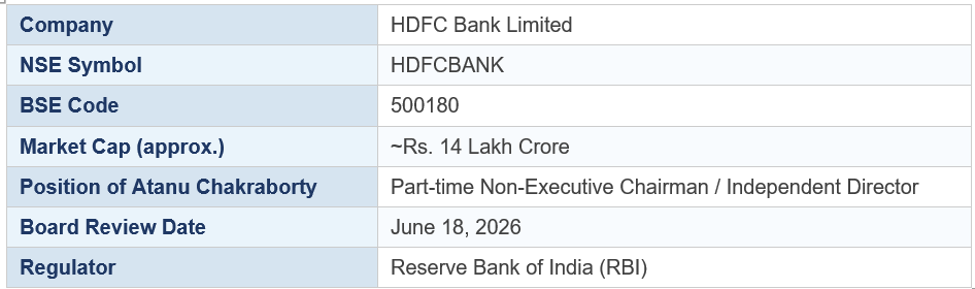
- HDFC Bank board to review findings related to independent director Atanu Chakraborty's exit on June 18, 2026
- Atanu Chakraborty is a former IAS officer and ex-Finance Secretary of India; was also HDFC Bank's Part-time Non-Executive Chairman
- His departure raises governance questions at India's largest private sector bank
- RBI closely monitors top management and board-level changes at systemically important banks
- HDFC Bank (NSE: HDFCBANK) is a component of Nifty 50 and part of multiple index funds
- Any governance concern at a 'too big to fail' institution carries systemic implications
📋 Quick Facts
📰 The Story
India's largest private sector bank, HDFC Bank, is set to convene a board meeting on June 18, 2026 to review findings related to the exit of Atanu Chakraborty — the bank's Part-time Non-Executive Chairman and an independent director of considerable institutional stature. The development, reported by the Economic Times, has drawn attention given Chakraborty's profile: a 1985-batch IAS officer of the Gujarat cadre, former Finance Secretary of India, and ex-Chairman of HDFC Limited (prior to the HDFC-HDFC Bank merger).
Chakraborty had been appointed as Part-time Chairman of HDFC Bank following the conclusion of the HDFC Ltd-HDFC Bank merger in July 2023 — one of the largest corporate consolidations in Indian financial history. His sudden exit and the subsequent board review of the circumstances of his departure has triggered heightened scrutiny from investors, analysts, and banking sector watchers.
While the specific findings being reviewed have not been publicly disclosed, the sequence of events — an abrupt departure followed by a formal board review — is unusual for a bank of HDFC Bank's stature and governance standards. Independent directors of a bank's standing are typically not subject to internal review post-departure; the very fact that such a review is being conducted suggests the circumstances of the exit may involve compliance, conflict-of-interest, or conduct-related concerns.
HDFC Bank's governance framework has historically been regarded as among the strongest in Indian banking. The bank has maintained a clean regulatory track record and has been consistent in its succession planning — the transition from Aditya Puri to Sashidhar Jagdishan as MD & CEO in 2020 was cited as a model for CEO succession in Indian banking. The post-merger period, however, has introduced new governance complexities given the significantly larger balance sheet, board composition changes, and the integration of HDFC Limited's legacy relationships.
The RBI has increasingly focused on governance at systemically important banks (D-SIBs) — of which HDFC Bank is one. Any board-level governance issue at HDFC Bank is therefore not just a corporate matter but a regulatory flashpoint. The June 18 board review will be closely watched for any disclosure to stock exchanges under SEBI LODR regulations.
📊 Financial Analysis
The immediate financial impact on HDFC Bank from this development is likely to be minimal — the bank's fundamentals remain strong with a loan book exceeding Rs. 25 lakh crore, robust CASA ratios, and improving net interest margins post-merger. However, governance concerns at large financial institutions tend to have a disproportionate impact on institutional investor sentiment, particularly for Foreign Portfolio Investors (FPIs) who hold significant stakes in HDFC Bank.
The timing is also sensitive: HDFC Bank is in the middle of a multi-year integration journey following the HDFC Ltd merger, and any boardroom turbulence creates uncertainty about strategic direction. If the board review findings result in a formal disclosure to stock exchanges — as would be required if the exit involved any regulatory reportable matter — the market reaction could be significant.
From a historical precedent standpoint, governance-related board exits at large Indian banks have tended to be transitory negatives — creating short-term volatility followed by reversion once clarity emerges. The critical variable is what the June 18 board review reveals and whether RBI is involved in the process.
💹 Investor Insights
For institutional and retail investors in HDFC Bank, the immediate advisory is to monitor the June 18 board meeting outcome and any subsequent stock exchange filing. If the review findings are benign (administrative rather than conduct-related), the stock impact should be contained. If regulatory or compliance dimensions surface, the stock could face meaningful selling pressure.
HDFC Bank remains a core holding in most large-cap Indian equity portfolios. Its valuation premium over PSU banks and most private sector peers is justified by its superior asset quality, return on assets, and franchise depth. A governance overhang, while disconcerting, does not structurally impair the bank's long-term earnings power — but it does warrant monitoring.
Frequently Asked Questions (FAQs)
- Who is Atanu Chakraborty and why does his exit matter?
- Atanu Chakraborty is a retired IAS officer who served as Finance Secretary of India and was the Part-time Non-Executive Chairman of HDFC Bank post the HDFC-HDFC Bank merger. His exit matters because board-level departures at systemically important banks are scrutinised by investors and regulators for governance signals.
- Is HDFC Bank required to disclose the board review findings?
- Under SEBI LODR Regulations (Regulation 30), material events including board-level decisions and findings with potential market-moving implications must be disclosed. If the June 18 review produces findings deemed material, HDFC Bank would be required to file a corporate announcement with the exchanges.
- What is a D-SIB and why is HDFC Bank classified as one?
- D-SIB stands for Domestic Systemically Important Bank — banks whose failure would have a significant impact on the financial system. RBI designates D-SIBs annually based on size, interconnectedness, and complexity. HDFC Bank, SBI, and ICICI Bank are currently designated D-SIBs, requiring higher regulatory capital and stricter governance standards.
- Should investors sell HDFC Bank on this news?
- Governance-related uncertainty is typically a reason for caution, not panic selling. Unless the review findings indicate regulatory action or a pattern of governance failures, the bank's fundamental strength supports holding positions. Investors should wait for the June 18 board outcome before making portfolio decisions.