

IDBI Bank Limited (NSE:IDBI) witnessed strong buying interest after the government reiterated its commitment to divest its stake in the lender, triggering a sharp rally in the stock price. Shares of the bank surged by nearly 8% intraday, reflecting renewed investor optimism surrounding the long-awaited privatization process.
The positive market reaction followed comments by Finance Minister Nirmala Sitharaman, who confirmed that the government intends to proceed with the divestment despite earlier challenges in receiving bids below the expected reserve price.
Government and LIC Plan to Sell Majority Stake
The divestment plan involves the sale of a combined 60.72% stake in IDBI Bank, including the Government of India’s 30.48% holding and Life Insurance Corporation of India’s (LIC) 30.24% stake. The strategic stake sale is expected to significantly reduce public sector ownership in the lender and potentially pave the way for private sector management.
Earlier financial bids reportedly fell below the reserve price set by the authorities, raising uncertainty around the timeline of the divestment. However, the government’s reaffirmation of its commitment indicates that the process remains a priority within India’s broader privatization agenda.
Market participants believe that clarity regarding the stake sale structure and revised pricing expectations could enhance investor confidence in the coming months.
Market Reaction Signals Investor Optimism
The announcement triggered strong momentum in IDBI Bank shares, reflecting expectations that privatization could unlock long-term value. Investors typically view privatization efforts as catalysts for improved operational efficiency, stronger governance standards, and better capital allocation.
The banking sector in India has been undergoing structural transformation, with policymakers focusing on strengthening balance sheets and improving asset quality across institutions. A successful divestment of IDBI Bank could serve as a landmark event in the government’s disinvestment roadmap.
Analysts note that investor sentiment toward the bank has improved in anticipation of strategic ownership changes that could enhance competitiveness and operational performance.
Strategic Importance of IDBI Bank Divestment
The divestment of IDBI Bank is seen as a significant milestone in India's privatization efforts, particularly within the banking sector. Successful execution of the transaction could encourage similar initiatives across other public sector entities.
Additionally, privatization is expected to bring operational flexibility, stronger risk management frameworks, and improved financial discipline. These factors could support sustainable long-term growth and help the bank align more closely with private sector peers.
From a broader perspective, the government’s renewed commitment underscores its focus on optimizing capital allocation and reducing fiscal burdens while encouraging private investment in the financial services sector.
Technical Summary
IDBI Bank remains in a short-term recovery after a sharp decline from recent highs near 110. Price trades below the 50-day SMA around 89, indicating a weak intermediate trend. RSI near 47 suggests neutral momentum. Immediate support lies at 70–72, while resistance is seen around 80–90 levels in near term.
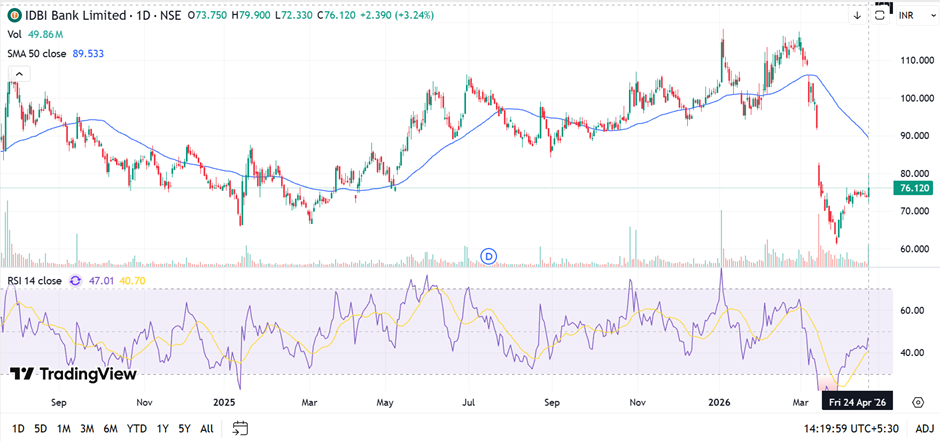
Chart by TradingView
Outlook
Looking ahead, investor focus will likely remain on updates related to bidder participation, revised valuation benchmarks, and timelines for the stake sale. Market participants may also monitor regulatory developments and potential interest from strategic investors.
If the divestment proceeds successfully, it could act as a key catalyst for long-term valuation re-rating. However, near-term price movement may remain sensitive to announcements regarding bid revisions and overall market sentiment.
Overall, the reaffirmation of the divestment plan has injected fresh optimism into the stock, positioning IDBI Bank (NSE:IDBI) as a closely watched counter within India’s banking and privatization landscape.
FAQs
- Why did IDBI Bank (NSE:IDBI) shares rise recently?
IDBI Bank shares increased after the government confirmed it will continue the divestment process despite earlier bids falling below reserve price. - How much stake is planned to be sold in IDBI Bank (NSE:IDBI)?
The government and LIC together plan to sell a combined 60.72 percent stake, transferring majority ownership to a private buyer. - What could privatization mean for IDBI Bank (NSE:IDBI) investors?
Privatization may improve governance, operational efficiency, and profitability, potentially supporting long-term valuation growth and stronger investor confidence in the bank.