

Highlights
- Investors increasingly use PEG, P/B, and P/S beyond P/E ratio.
- Each valuation tool reflects different financial and sector perspectives.
- No single ratio is sufficient for complete stock valuation analysis.
The Price-to-Earnings (P/E) ratio is widely used across NSE and BSE listed equities to assess valuation based on earnings. It shows how much investors are willing to pay for one unit of earnings. However, reliance only on P/E may not capture variations in growth expectations, leverage levels, or sector specific financial structures.
Companies with negative or unstable earnings also make P/E less meaningful. As a result, analysts often consider additional valuation tools to interpret market pricing more effectively across different business models and cycles.
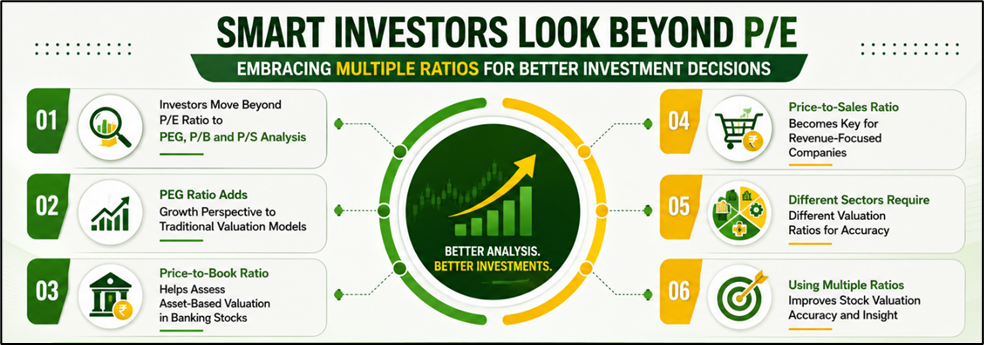 Source: Analysis by Kalkine
PEG Ratio: Growth Adjusted Valuation Lens
The Price-to-Earnings Growth (PEG) ratio adjusts the traditional P/E framework by incorporating expected earnings growth. It helps compare valuation against future expansion potential rather than current earnings alone.
A lower PEG may indicate that price levels are more aligned with projected growth, while a higher PEG may suggest elevated expectations already priced in. This ratio is frequently used in evaluating companies where earnings growth is a key driver of valuation. However, accuracy depends on realistic growth forecasts, which may vary across analysts and market conditions.
Price-to-Book Ratio: Asset Based Perspective
The Price-to-Book (P/B) ratio compares market price with a company’s book value derived from financial statements. It is often applied in sectors where asset value plays an important role, such as banking and financial services.
A lower P/B may indicate that a stock is trading near its asset base, while a higher P/B may reflect expectations of better capital efficiency. This ratio is commonly paired with return on equity to understand how effectively a company uses its assets to generate returns over time.
Price-to-Sales Ratio: Revenue Lens for Valuation
The Price-to-Sales (P/S) ratio evaluates market capitalization relative to total revenue generated. It is particularly useful for companies that may not yet report consistent profits. Since it is based on sales rather than earnings, it provides a broader view of how revenue streams are valued by the market.
However, it does not consider cost structures or profitability, which can limit its standalone usefulness. Investors generally combine this ratio with other financial metrics to gain a more balanced understanding of valuation.
Sector Wise Application of Ratios
Different sectors require different valuation approaches due to varying business structures and financial characteristics. Banking and financial companies often rely more on P/B ratios due to asset heavy balance sheets. Technology and early stage businesses may be better assessed using PEG or P/S ratios due to uncertain earnings profiles
. Stable and mature companies are often analyzed using P/E ratios for consistency. This variation highlights the importance of selecting valuation tools based on industry context rather than applying a single method across all companies.
Why Multiple Ratios Matter in Valuation
Using only one valuation metric may lead to incomplete interpretation of a company’s financial position. Multiple ratios allow investors to evaluate earnings, growth expectations, asset quality, and revenue efficiency together. This combined approach reduces dependence on a single assumption and provides a more structured analysis.
It also improves comparison between companies operating in similar sectors. By using several indicators, analysts can better understand how market pricing aligns with financial fundamentals across different stages of business development.
Evolving Equity Research Approach
Equity research has become more analytical as companies adopt diverse business models and revenue structures. Traditional valuation tools alone may not fully reflect underlying financial realities.
Investors increasingly combine P/E with PEG, P/B, and P/S ratios to build a broader assessment framework. This multi dimensional approach supports more structured analysis of market pricing behavior. It also reflects the growing need for sector specific evaluation methods rather than uniform valuation standards across all listed companies.
Key Risks
- Misinterpretation of valuation ratios may lead to incorrect investment decisions
• Growth assumptions in PEG may not align with actual future performance
• Sector mismatch can distort comparison between different companies
• Revenue based valuation ignores profitability and cost structure differences
Summary
Valuation of equities requires more than relying on P/E alone in current market conditions. Investors often use PEG, P/B, and P/S ratios to assess growth, assets, and revenue perspectives. Each ratio offers a different lens for analysis. Combining multiple valuation methods supports better understanding of financial positioning across sectors, improving interpretation of market pricing behavior and investment evaluation consistency overall.
FAQs
Q: Why is P/E ratio insufficient alone for valuation analysis?
A: It ignores growth expectations, debt levels, and sector differences, making valuation incomplete across diverse companies in financial markets analysis context
Q: How does PEG ratio improve stock valuation understanding?
A: It links price with expected earnings growth, helping evaluate whether valuation aligns with future performance expectations in comparison analysis framework
Q: Why is Price-to-Sales ratio used in valuation?
A: It evaluates company valuation based on revenue, especially useful for firms without consistent profitability or earnings stability measurement context tool