

Highlights
- Flexi cap funds invest across companies of different market capitalisations.
- Long-term SIP outcomes depend on market cycles and investment discipline.
- Investors should assess risk, consistency and fund strategy before investing.
Flexi cap funds have emerged as a preferred investment option for many equity investors because they offer diversification through a single mutual fund. Unlike investment categories that require fixed allocations to specific market-cap segments, these funds give fund managers the flexibility to distribute investments across large-, mid- and small-cap companies based on changing market conditions.
This adaptable investment approach allows portfolios to evolve with economic trends, company valuations and emerging opportunities. As a result, many investors include flexi cap funds in their long-term wealth creation strategy through Systematic Investment Plans (SIPs).
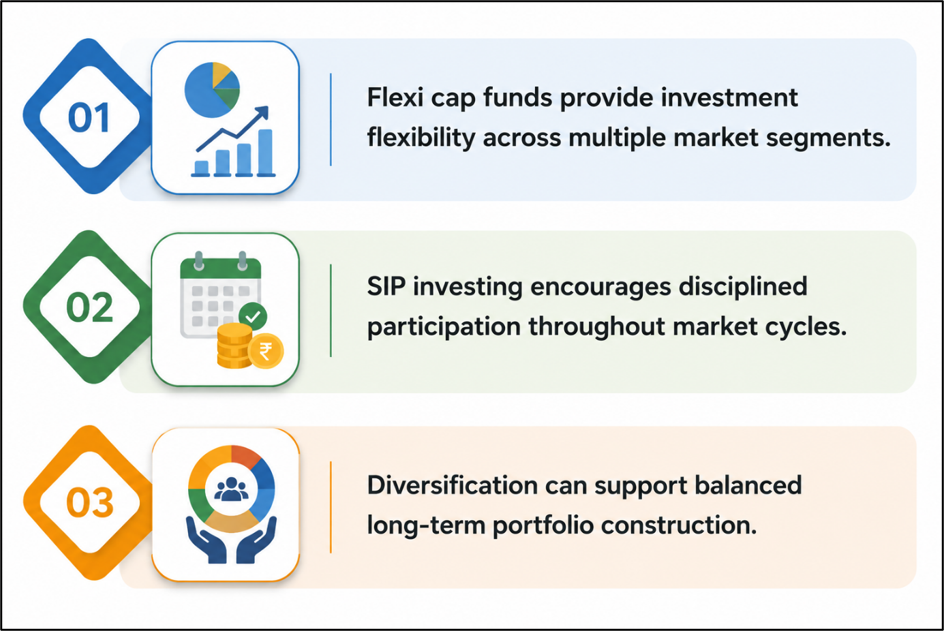
Source: Analysis by Kalkine
How Flexi Cap Funds Operate
A flexi cap fund is designed to invest predominantly in equities while allowing the fund manager to decide where capital should be allocated. Instead of maintaining a fixed proportion in large-cap or mid-cap stocks, the portfolio can be adjusted whenever market conditions change.
During periods when large companies appear attractively valued, the allocation may increase towards that segment. Similarly, if mid-cap or small-cap businesses present better growth opportunities, the portfolio can gradually shift in that direction. This flexibility aims to provide diversification while enabling the fund manager to respond to changing market dynamics.
Why SIPs Are Commonly Used for Equity Investing
A Systematic Investment Plan enables investors to contribute a fixed amount at regular intervals instead of investing a lump sum. This method spreads investments across different market levels, allowing investors to purchase more units when prices decline and fewer units when markets are trading at higher valuations.
Over an extended period, this disciplined investment approach may reduce the impact of short-term price fluctuations and encourage consistent participation in equity markets. However, investment returns remain linked to market performance and cannot be predicted in advance.
What Can Influence SIP Performance?
The long-term performance of any flexi cap fund depends on several interconnected factors rather than a single element. Market movements, corporate earnings, interest rate trends, economic growth and investor sentiment all influence equity valuations.
In addition, every fund manager follows a different investment philosophy, resulting in variations in sector allocation, stock selection and portfolio diversification. Consequently, funds operating within the same category may generate different outcomes over identical investment periods.
Factors Investors Should Evaluate Before Choosing a Flexi Cap Fund
Historical returns often receive considerable attention, but they represent only one aspect of a fund's overall profile. Investors may also benefit from reviewing the consistency of performance across different market cycles, the level of diversification within the portfolio, the investment process followed by the fund manager, expense ratios and the fund's ability to align with their own financial objectives.
Evaluating these broader factors may provide a more balanced perspective than relying solely on recent performance figures.
Why Long-Term Discipline Matters
Equity markets rarely move in a straight line. Periods of growth are often followed by corrections, and short-term volatility is a natural feature of equity investing. Investors who continue their SIPs during different market conditions may benefit from disciplined investing rather than attempting to predict market highs and lows.
Remaining invested over longer periods also provides more time for investments to potentially benefit from the effects of compounding, although future returns are never guaranteed.
Understanding the Role of Diversification
One of the distinguishing features of flexi cap funds is their ability to diversify investments across companies of different sizes and sectors. Diversification can help reduce dependence on a single segment of the market, allowing portfolios to adapt when leadership shifts between large-, mid- and small-cap stocks.
While diversification does not eliminate investment risk, it may help reduce the impact of concentration in any one area of the market.
Key Risks to Consider
- Equity markets can experience significant price volatility.
- Past performance does not indicate future returns.
- Portfolio allocation decisions may affect investment outcomes.
- Market downturns can temporarily reduce investment value.
Summary
Flexi cap funds offer investors a diversified approach to equity investing by allowing fund managers to allocate investments across companies of varying market capitalisations. Their flexible investment mandate enables portfolios to adapt to changing market conditions, making them a popular choice for long-term SIP investors.
Nevertheless, investment performance depends on multiple factors, including market conditions, portfolio management and investment duration. Investors should consider their financial goals, risk tolerance and investment horizon before selecting any mutual fund.
FAQs
Q: What distinguishes a flexi cap fund from other equity mutual funds?
A: A flexi cap fund can freely allocate investments across large-, mid- and small-cap stocks without predefined allocation limits.
Q: Can investing through a SIP eliminate market risk?
A: No. SIPs encourage disciplined investing but do not remove the risks associated with equity market fluctuations.
Q: Should historical returns be the only factor when selecting a flexi cap fund?
A: No. Investors should also evaluate diversification, investment strategy, consistency and suitability for their financial objectives.