

Highlights
- Debt mutual funds witnessed significant net outflows during May after strong inflows in April.
- Liquid, money market and overnight fund categories accounted for a large share of withdrawals.
- Equity mutual funds continued to receive net inflows despite the overall industry outflow.
The mutual fund industry experienced a noticeable shift in investor activity during May as debt-oriented schemes moved from strong inflows in the previous month to substantial net outflows. This reversal contributed significantly to the industry's overall net outflow for the month.
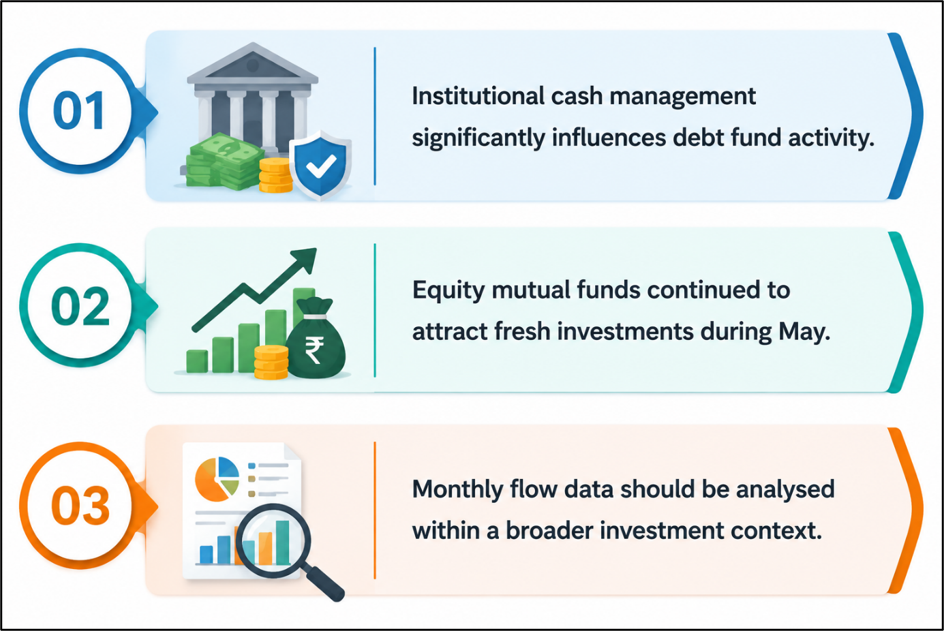
The change was largely linked to liquidity management by institutional investors rather than a broad change in long-term investment sentiment. Debt fund flows often fluctuate because many organisations use these schemes for short-term cash management instead of long-term investment.
Source: Analysis by Kalkine
Which Debt Fund Categories Experienced the Highest Outflows?
The largest withdrawals were concentrated in debt fund categories that are generally used for managing short-term surplus funds.
Liquid funds recorded the highest redemptions during the month, followed by money market funds and overnight funds. These schemes are commonly preferred by companies, banks and large institutions that temporarily invest surplus cash before deploying it elsewhere.
Because these investments are typically short-term in nature, inflows and outflows can vary considerably from one month to another.
Why Institutional Investors Influence Debt Fund Data
Institutional investors play an important role in the debt mutual fund segment. Large organisations frequently shift money between different financial instruments depending on operational cash requirements, quarter-end adjustments or treasury strategies.
Since these transactions usually involve substantial amounts, even a limited number of institutional redemptions can have a significant impact on monthly industry data. As a result, short-term fluctuations in debt fund flows may not necessarily reflect changing sentiment among retail investors.
Equity Mutual Funds Continued to Attract Investors
While debt schemes experienced sizeable withdrawals, equity mutual funds continued to record positive net inflows during the same period.
Continued investments into equity-oriented schemes indicate that many retail investors maintained their long-term investment approach despite changes in debt fund activity. Regular contributions through Systematic Investment Plans (SIPs) also continued to support equity fund inflows.
This contrast highlights that movements in debt and equity fund categories are often influenced by different types of investors and investment objectives.
How Should Investors Interpret Monthly Fund Flow Data?
Monthly inflow and outflow figures provide useful information about market activity, but they should not be viewed in isolation.
Debt mutual funds often experience seasonal fluctuations because institutional investors regularly move funds to meet liquidity requirements. Therefore, a single month's outflow does not necessarily indicate a deterioration in the debt fund segment.
A broader assessment that considers interest rate conditions, portfolio quality, investment objectives and market environment generally provides a more meaningful understanding of the asset class.
Why Investment Objectives Remain Important
Debt mutual funds continue to serve different financial needs, including liquidity management, income generation and capital preservation. The suitability of these schemes depends on an investor's financial goals, investment horizon and risk appetite rather than monthly flow numbers.
Instead of reacting to short-term industry statistics, investors may benefit from evaluating whether a debt fund continues to align with their overall investment strategy.
Key Risks to Consider
- Institutional withdrawals can significantly affect monthly fund flows.
- Interest rate changes may influence debt fund performance.
- Short-term market movements may increase portfolio volatility.
- Historical fund flows do not predict future investment performance.
Summary
Debt mutual funds recorded sizeable net outflows during May after attracting strong inflows in April, with liquid, money market and overnight funds accounting for most of the withdrawals. The movement was largely driven by institutional liquidity management rather than a widespread change in investor confidence.
At the same time, equity mutual funds continued to receive fresh investments, indicating continued participation by long-term investors. Monthly fund flow data should therefore be interpreted alongside broader market conditions and individual investment objectives.
FAQs
Q: Why did debt mutual funds witness large outflows during May?
A: The decline was mainly driven by institutional investors withdrawing funds to meet short-term liquidity requirements.
Q: Do heavy debt fund outflows indicate poor investment performance?
A: Not necessarily. Such movements often reflect treasury management decisions rather than the performance of debt mutual funds.
Q: Should investors make investment decisions based only on monthly fund flows?
A: No. Financial goals, investment horizon, portfolio quality and risk tolerance should remain the primary considerations.