

The search for defence stocks under 100 rupees is one of the most popular queries among Indian retail investors who want to participate in the defence sector boom without committing large amounts of capital per share. It is a completely understandable impulse — India's defence sector is structurally well-positioned, backed by a record FY27 budget of Rs 7.85 lakh crore and record exports of Rs 38,424 crore in FY26. However, the reality of 2026 is that the sector's strongest companies now trade at significantly higher prices after years of re-rating.
This article provides a transparent and honest assessment of the 'defence stocks under 100' segment. It explains the current price landscape, identifies the category of stocks that genuinely trade below Rs 100 in the defence and defence-adjacent space, discusses the unique risks of this price band, and gives retail investors the tools to assess whether such stocks align with their investment goals. All prices mentioned are approximate as of June 2026 and must be verified on NSE/BSE.
Sector Overview
India's defence manufacturing sector has undergone dramatic re-rating over the past four years. The Nifty India Defence index, launched in recognition of the sector's growing investment importance, now includes heavyweights like BEL, HAL, BDL, Mazagon Dock, and GRSE. The FY27 Union Budget allocated Rs 7.85 lakh crore to defence — the highest-ever — with capital spending up ~21.8% YoY. Defence exports hit a record Rs 38,424 crore in FY26, up 62.66%.
This structural re-rating has pushed most quality defence names well above the Rs 100 threshold. A low share price does not imply a cheap company — and a high share price does not imply an expensive one. The relevant metric is market capitalisation and valuation ratios (P/E, EV/EBITDA, P/Book), not the nominal share price. Investors should be cautious about equating 'under Rs 100' with 'affordable' or 'low risk'.
Why Defence Stocks Matter in 2026
India's defence modernisation is a multi-decade programme. The government targets Rs 3 lakh crore in defence production and Rs 50,000 crore in exports by 2029. Five Positive Indigenisation Lists (PILs) covering 5,500+ items restrict imports and channel orders to domestic manufacturers. Seventy-five percent of the capital acquisition budget — approximately Rs 1.64 lakh crore in FY27 — is reserved for Indian industry.
This creates a long, durable order pipeline across the value chain: from large platform manufacturers (HAL, Mazagon Dock) all the way to component suppliers, sub-system integrators, and raw material providers. For investors willing to research carefully, the lower-price-point segment of this ecosystem — which includes some component and sub-system suppliers — can offer exposure, albeit with much higher risk and lower liquidity.
Key Defence Stocks to Watch
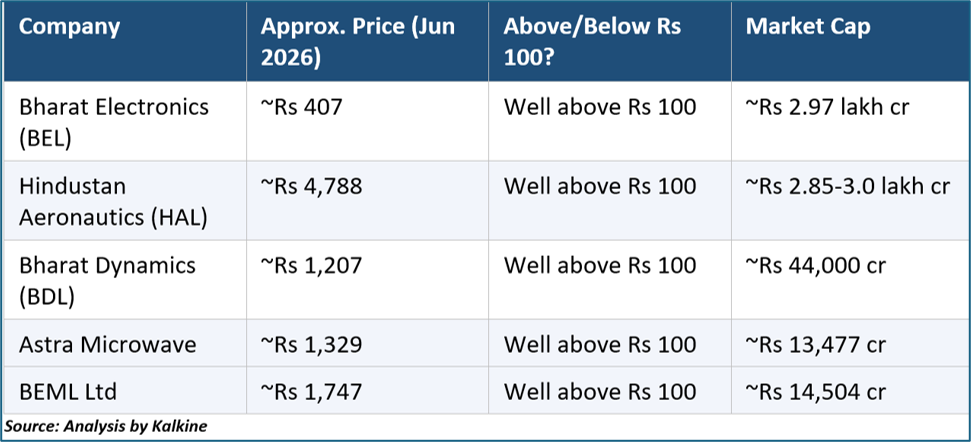
The table below lists the approximate prices of major listed defence companies as of June 2026 to illustrate the price landscape. Note that none of the well-known defence names currently trade below Rs 100. Always verify current prices on NSE/BSE before any transaction — prices change daily.
Company-by-Company Analysis
The Reality: Why Quality Defence Stocks Are Now Above Rs 100
The re-rating of Indian defence stocks has been dramatic. BEL, which traded below Rs 100 as recently as 2020, now trades around Rs 407. HAL was listed at IPO in March 2018 at Rs 1,215 and now trades above Rs 4,700. BDL, Mazagon Dock, and GRSE have all seen multi-fold increases. This re-rating reflects genuine fundamental improvement: record order books, strong revenue growth, rising profitability, and the structural tailwind of India's Atmanirbhar Bharat programme.
Investors searching for 'cheap' exposure by seeking stocks below Rs 100 may instead find themselves in micro-cap or penny-stock territory, where liquidity is thin, disclosures are limited, earnings are often loss-making or highly inconsistent, and the risk of permanent capital loss is significantly higher. The nominal share price is not a measure of value or affordability.
What Types of Stocks May Appear Below Rs 100 in the Defence Space
As of June 2026, defence stocks under Rs 100 — to the extent they exist — are primarily: (1) micro-cap component or sub-system suppliers with limited revenue visibility; (2) companies that have had recent stock splits or bonus issues pushing prices temporarily lower; (3) defence-adjacent industrials (e.g., certain metals or chemicals companies that have marginal defence exposure); and (4) penny stocks that claim defence exposure but may lack proven order books or contracts. The author cannot confirm specific names below Rs 100 as of this writing — prices change daily. Readers must verify current prices on NSE/BSE using a screener or broker platform.
Stock Splits: A Key Factor to Understand
Several defence stocks have undergone stock splits in recent years. A stock split increases the number of shares outstanding while reducing the price proportionally — the company's total market capitalisation remains unchanged. For example, if a stock trading at Rs 500 undergoes a 5:1 split, it will trade at approximately Rs 100 afterwards, but each investor's holding value remains the same. BEL, HAL, and BDL have each conducted splits historically. Always check the post-split adjusted price and the current price — do not confuse a split-adjusted low historical price with the current price.
Defence-Adjacent Stocks That May Trade Below Rs 100
Certain smaller NSE/BSE-listed companies operate in defence supply chains — providing raw materials such as speciality alloys, electronic components, cables, or sub-assemblies — and may trade below Rs 100. However, their revenue from defence contracts is often a small fraction of total revenue, making them poor proxies for the defence sector theme. Investors interested in this category should look at: verified order book from defence customers; proportion of defence revenue to total revenue; profitability track record; promoter integrity and corporate governance; and liquidity (daily trading volumes).
How to Screen for Defence Stocks Under Rs 100 Responsibly
If you want to screen for defence or defence-adjacent stocks below Rs 100, use screener tools on NSE/BSE or platforms like Screener.in, Tickertape, Trendlyne, or Dhan. Filter by: sector (Aerospace & Defence or Capital Goods — Defence); price range (< Rs 100); market cap (be very cautious below Rs 500 crore); and ensure positive net profit for at least 2-3 years. Cross-check the company's annual report for actual defence order book disclosures. Avoid companies that merely claim 'defence exposure' without documented contracts.
Recent News & Market Triggers
- India's defence exports hit a record Rs 38,424 crore in FY26, up 62.66% — creating downstream demand for components and sub-systems across the supply chain.
- FY27 defence budget of Rs 7.85 lakh crore, with capital spending at Rs 2.19 lakh crore, sustains long-term order pipelines.
- Doubling of financial powers for indigenisation and R&D was reported as particularly positive for smaller domestic players in the supply chain.
- DRDO transferred 12 technologies to private firms under SAMANVAY-2025, potentially opening opportunities for newer, smaller listed entities.
- Nifty India Defence index declined ~11% from its peak post-Budget 2026, bringing some mid and small caps closer to support levels.
- Choice Broking initiated coverage on Mazagon Dock, GRSE, Cochin Shipyard in June 2026, highlighting the breadth of the sector.
- Astra Microwave board approved demerger of space subsidiary — a sign of increasing sophistication in the listed defence ecosystem.
- Paras Defence and Data Patterns surged up to 12% on June 5, 2026 amid positive sector news, highlighting volatility in smaller defence names.
Growth Drivers
- Positive Indigenisation Lists: 5,500+ items restricted from import create order flow opportunities for domestic component and sub-system makers, including smaller players.
- SRIJAN portal: Allows MSMEs and smaller firms to express interest in indigenising imported defence items — potential catalyst for micro-cap defence suppliers.
- 700+ defence licences: Issued to 436+ private firms, many of which are unlisted or micro-cap, with some expected to list over time.
- Defence corridors: UP and Tamil Nadu corridors provide infrastructure support to smaller defence manufacturers, potentially benefiting listed companies in those geographies.
- Technology transfer: DRDO and ISRO technology transfers to private firms create new revenue streams for smaller listed companies.
- Export opportunities: Even small component and sub-system makers can benefit from the export pipeline to 100+ countries.
- Emergency procurement: Fast-track and emergency orders from the armed forces can provide sudden revenue visibility for smaller suppliers.
Risks Investors Should Know
- Liquidity risk: Penny and micro-cap stocks have very low daily trading volumes — you may not be able to sell your position at a fair price when needed.
- Information risk: Smaller companies have fewer analyst coverages, fewer disclosures, and less media scrutiny, making due diligence much harder.
- Corporate governance risk: Promoter integrity, related-party transactions, and accounting quality may be harder to assess in micro-caps.
- Revenue concentration and volatility: A small company may depend on one or two defence contracts; losing or delaying one contract can devastate earnings.
- Dilution risk: Smaller companies may raise capital through preferential allotments or QIPs at unfavourable terms, diluting existing shareholders.
- Pump-and-dump risk: The defence theme attracts speculative interest; some low-priced stocks may be promoted without genuine business substance.
- **No 'safe' just because it's cheap': A Rs 50 stock with poor fundamentals is far riskier than a Rs 500 stock with strong fundamentals.
- Sector volatility: Even quality defence stocks corrected up to 19% post-Budget 2026; smaller, illiquid names can fall much more sharply.
Valuation Considerations
For stocks below Rs 100, valuation metrics must be scrutinised even more carefully than for large-caps. Key questions include: Is the company profitable, or does it have a history of losses? What is the P/E ratio and how does it compare to sector peers? What is the book value per share — is the stock trading at a significant premium to book? What is the revenue trend over the past three to five years — steady growth, or erratic? Does the company have tangible defence contracts on its books, or is the defence exposure aspirational?
Low-priced stocks can be optically cheap but fundamentally expensive (high P/E, negative net worth) or genuinely undervalued. The difference is only apparent through careful financial analysis. Use Screener.in, Trendlyne, or BSE/NSE annual reports to access balance sheets and income statements. If you cannot assess these metrics confidently, consult a SEBI-registered investment adviser before investing.
Long-Term Outlook
The honest long-term outlook for the 'defence stocks under Rs 100' category is nuanced. India's defence production and export boom will benefit the entire supply chain — including smaller, lower-priced stocks — but separating genuine beneficiaries from speculative plays is difficult. Over the next five years, some genuinely capable smaller defence suppliers may scale their revenues significantly and see substantial share price appreciation; others may remain stagnant or decline.
Investors with a genuine interest in lower-priced defence exposure may find it more prudent to invest in diversified defence mutual funds or ETFs tracking the Nifty India Defence index rather than individual penny stocks. This provides sector exposure with built-in diversification and the oversight of professional fund managers. Mutual fund investments are subject to market risk.
Frequently Asked Questions
Q: Are there any good defence stocks under Rs 100 in India in 2026?
A: As of June 2026, the well-known and high-quality defence stocks — BEL, HAL, BDL, Mazagon Dock, Data Patterns, Astra Microwave, BEML — all trade well above Rs 100. Any defence or defence-adjacent stock trading below Rs 100 would typically be a micro-cap or penny stock with significantly higher risk. Always verify current prices on NSE/BSE and research the company's actual defence order book before investing.
Q: Why have defence stocks moved above Rs 100 so quickly?
A: The re-rating of Indian defence stocks reflects genuine fundamental improvement: record order books, rising revenues and profits, strong government policy support (Atmanirbhar Bharat, PILs, rising defence budget), and increasing institutional interest. Stocks like BEL, which once traded below Rs 100, have risen multi-fold as the investment case became clearer. This re-rating may or may not continue at the same pace.
Q: Is a low share price a sign of a cheap or affordable stock?
A: No. A share price of Rs 50 is not inherently 'cheaper' than a share price of Rs 500. What matters is the market capitalisation (number of shares times price), earnings per share, and valuation multiples. A Rs 50 stock can be overvalued if its P/E is very high or if its business fundamentals are weak. Always assess fundamentals, not just the share price.
Q: How do stock splits affect the 'under Rs 100' category?
A: If a high-priced defence stock undergoes a stock split — for example, a 10:1 split on a Rs 1,000 stock — the price drops to approximately Rs 100 per share, but the investor's total holding value is unchanged and the company's market capitalisation is unchanged. Buying a stock purely because a split brought it below Rs 100 does not create any investment value. The fundamentals before and after the split are the same.
Q: What are defence penny stocks and should I invest in them?
A: Defence penny stocks are very low-priced shares (typically below Rs 10-50) of small or micro-cap companies claiming defence sector exposure. These are extremely high-risk investments: they often have thin liquidity, poor disclosures, limited institutional coverage, and may not have verifiable defence order books. Retail investors should exercise extreme caution and consult a SEBI-registered adviser before considering penny stocks.
Q: Where can I find a current list of NSE/BSE defence stocks with prices?
A: Current lists with live prices are available on NSE India (nseindia.com), BSE India (bseindia.com), and platforms like Screener.in, Tickertape, Dhan, Groww, and Trendlyne. Filter by sector 'Aerospace & Defence' and set your price range filter to find any stocks currently below Rs 100. Always cross-check multiple sources and read the company's annual report.
Q: Are defence mutual funds a better option than trying to find under-Rs 100 stocks?
A: For many retail investors, investing in a SEBI-registered mutual fund or ETF that tracks the Nifty India Defence index provides diversified, professionally managed exposure to India's defence sector without the risks of concentrated micro-cap investing. This may be a more prudent approach for investors who cannot dedicate significant time to individual stock research. Mutual fund investments are subject to market risk; read scheme-related documents carefully.
Conclusion
The search for defence stocks under 100 rupees reflects a natural desire to participate in India's defence sector boom at a lower per-share price point. However, the honest reality in June 2026 is that quality defence stocks — BEL, HAL, BDL, Astra Microwave, Paras Defence, and others — have already re-rated significantly above Rs 100, driven by genuine fundamental improvement. The 'under Rs 100' space, to the extent it exists in this sector, carries substantially higher risk, lower liquidity, and less reliable disclosures. Investors should focus on fundamentals over share price optics, consider defence mutual funds for diversified exposure, and always consult a SEBI-registered investment adviser before making investment decisions.