
Gold prices declined to a two-month low on Thursday as geopolitical developments involving renewed US military strikes in Iran influenced currency and commodity markets. Spot gold fell 1.76% to USD 4,377.595 per ounce, its lowest level since March 27. The decline came as the dollar strengthened to a near one-week high, reducing demand for gold priced in US currency for international investors.
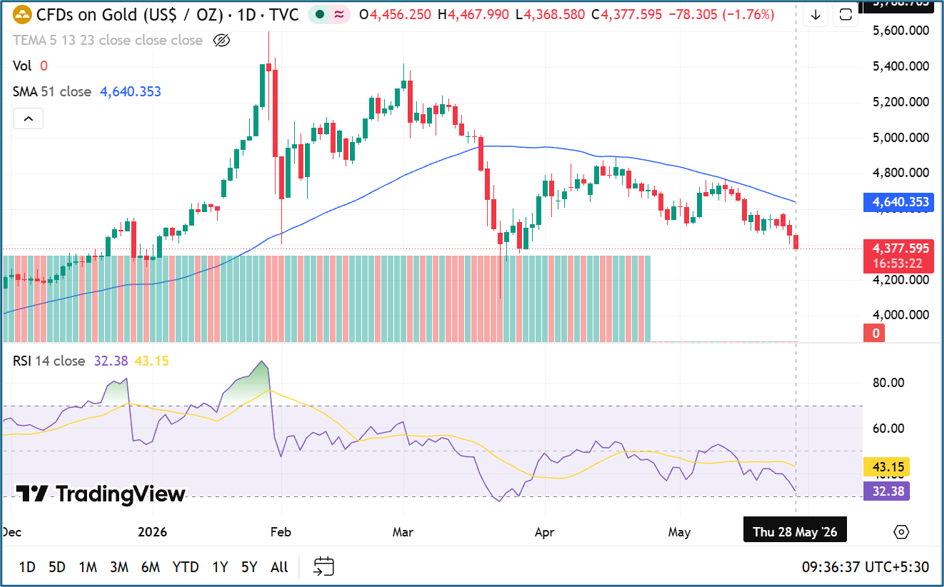
Source: Trading View
Geopolitical Developments and Market Reaction
US military operations reportedly targeted a military site in Iran, which officials believed could pose risks to US forces and commercial shipping routes in the Strait of Hormuz. The escalation in tensions led to increased volatility in global commodity markets, particularly crude oil and precious metals.
Oil prices rose around 2% in early Asian trade, as concerns over supply routes intensified. Higher crude prices may contribute to inflationary pressure globally, influencing expectations around monetary policy.
Dollar Strength and Inflation Impact
The US dollar’s rise weighed on gold prices by increasing the cost of bullion for holders of other currencies. Market participants noted that geopolitical uncertainty has supported dollar demand in recent sessions.
At the same time, rising oil prices are viewed as potentially inflationary, which may complicate interest rate expectations. While gold is traditionally seen as an inflation hedge, higher interest rates reduce the appeal of non-yielding assets.
Federal Reserve Policy Outlook
Federal Reserve Governor Lisa Cook stated that interest rates may need to remain steady in the near term. However, she indicated that tariff pressures, geopolitical tensions, and investment-driven price increases could lead to rate hikes if inflation accelerates.
Investors are now focused on upcoming US Personal Consumption Expenditures (PCE) data, which is considered an important indicator for the Federal Reserve’s policy direction.
Source: Analysis by Kalkine
Other Precious Metals Performance
Silver declined 1.6% to USD 73.44 per ounce, while platinum fell 0.8% to USD 1,902.66. Palladium also slipped 1% to USD 1,376.66 during the same trading session.
The broader precious metals complex followed gold’s downward movement amid a stronger dollar environment.
Market Sentiment Overview
Gold markets remain influenced by competing forces including geopolitical risk, inflation expectations, and interest rate outlook. While conflict-driven uncertainty typically supports safe-haven demand, dollar strength and potential policy tightening continue to pressure prices.
Analysts noted that inconsistent geopolitical signals and shifting monetary policy expectations are contributing to short-term volatility in bullion prices.
Key Risk
- Escalation or easing of US–Iran tensions may cause sharp volatility in gold prices.
- Stronger US dollar trends may continue to pressure bullion demand globally.
- Higher-than-expected inflation could lead to tighter Federal Reserve policy.
- Liquidity shifts in commodity markets may amplify short-term price swings.
Summary
Gold fell to a two-month low at USD 4,377.595 per ounce as US–Iran tensions boosted the dollar and influenced inflation expectations. Oil prices rose amid geopolitical concerns, while investors awaited US PCE data for Federal Reserve signals. Silver, platinum, and palladium also declined. Market sentiment remained driven by currency strength, inflation outlook, and geopolitical risk dynamics.
FAQs
Q1: Why did gold prices fall to a two-month low?
A: Stronger US dollar and geopolitical developments reduced demand for gold in global markets.
Q2: How did US–Iran tensions affect commodities?
A: Tensions lifted oil prices while increasing volatility in gold and currency markets.
Q3: What key data are investors waiting for?
A: Investors are focused on US PCE inflation data for Federal Reserve policy guidance.