

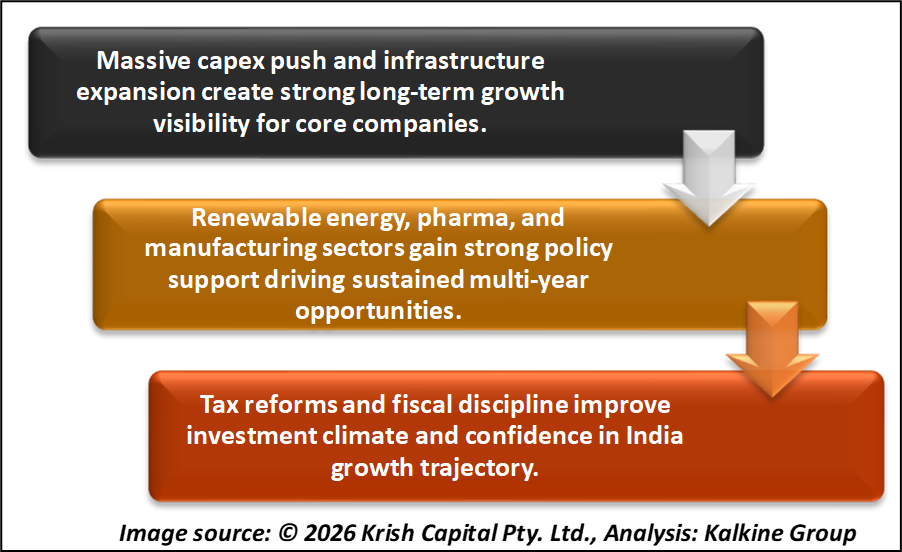
The Union Budget 2026–27 marks a decisive step toward shaping India’s long-term growth story. With a strong emphasis on infrastructure, manufacturing, renewable energy, and healthcare, the budget is not just a fiscal document—it is a strategic blueprint for the next phase of economic expansion. For investors looking at a 3–5 year horizon, this policy push creates meaningful opportunities in select sectors that are directly aligned with government priorities.
Infrastructure Boom: The Backbone of Growth
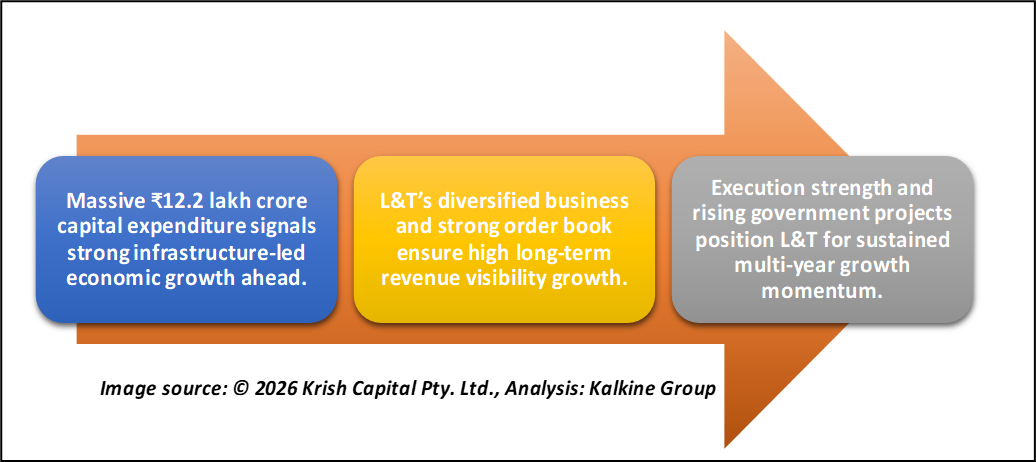
A standout feature of the budget is the sharp rise in capital expenditure to ₹12.2 lakh crore. This massive allocation underscores the government’s commitment to building world-class infrastructure, including high-speed rail corridors and advanced logistics networks.
Larsen & Toubro (L&T): Execution Power Meets Policy Support
Larsen & Toubro (L&T) is a clear frontrunner in benefiting from this infrastructure push. With a diversified business model spanning infrastructure, energy, hi-tech manufacturing, and IT services, L&T is uniquely positioned to capture opportunities across multiple verticals.
The company’s strong order book (₹7,332 bn) and rising order inflow (up 17% YoY) indicate robust future revenue visibility. Its execution-led model, improving return ratios, and efficient working capital management further strengthen its investment case. Over the next 3–5 years, as large-scale government projects gain momentum, L&T is likely to remain a key beneficiary of India’s infrastructure-led growth.
Renewable Energy: Powering India’s Green Transition
The budget’s indirect support for clean energy, along with global sustainability trends, continues to drive strong tailwinds for the renewable energy sector. Policies supporting domestic manufacturing of key components and critical imports like lithium-ion batteries are particularly significant.
Adani Green Energy Limited (AGEL): A Renewable Powerhouse
Adani Green Energy Limited (AGEL) stands at the forefront of India’s renewable energy transformation. With a rapidly expanding operational capacity of 17.2 GW and a strong pipeline of solar, wind, and hybrid projects, the company is scaling aggressively.
AGEL’s business model—built on long-term 25-year power purchase agreements (PPAs)—ensures predictable and stable cash flows. Its high EBITDA margins (above 90%) and efficient capacity utilization reflect operational strength. As India continues to push toward energy independence and clean energy targets, AGEL is well-placed for sustained growth over the next decade.
Pharma & Biotech: A Policy-Driven Growth Engine
Healthcare and pharmaceuticals have received strong indirect support through policy measures focused on domestic manufacturing and innovation. Initiatives like Biopharma Shakti highlight the government’s intent to strengthen India’s position in global drug production.
Sun Pharmaceutical Industries: Innovation Meets Scale
Sun Pharmaceutical Industries remains one of India’s largest and most globally diversified pharma companies. With a presence in the US, India, and emerging markets, the company benefits from both scale and innovation.
Its R&D-driven approach, coupled with a strong pipeline of complex and specialty products, supports long-term growth. With consistent revenue growth, improving margins, and robust profitability, Sun Pharma is well-positioned to benefit from rising healthcare demand and favorable policy support over the next 3–5 years.
Textiles & Manufacturing: Export-Led Opportunities
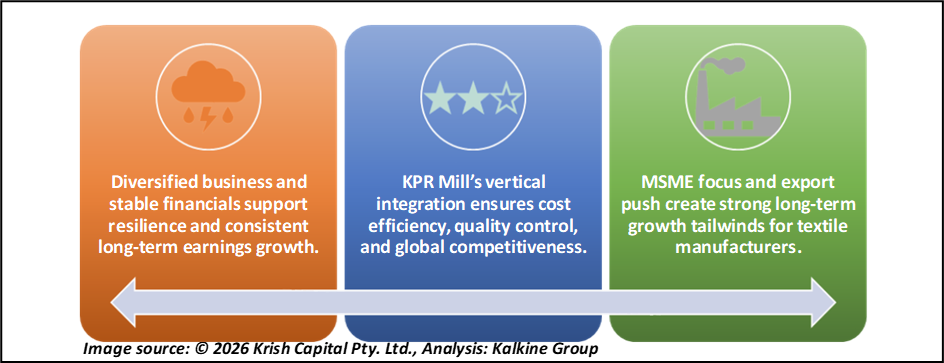
The government’s focus on MSMEs, export promotion, and domestic manufacturing provides a solid tailwind for the textile sector. This aligns with India’s ambition to become a global manufacturing hub.
K.P.R. Mill Limited: Integrated Strength Driving Growth
K.P.R. Mill Limited is a vertically integrated textile company operating across the entire value chain—from fibre to fashion. This integration gives the company a strong cost advantage and quality control, making it highly competitive in global markets.
Despite some near-term volume softness, the company has demonstrated stable financial performance with strong EBITDA and PAT figures. Its diversified presence in textiles, sugar, ethanol, and green energy further strengthens its resilience. With steady export demand and policy support for manufacturing, KPR Mill offers a compelling long-term investment opportunity.
Tax Reforms & Investment-Friendly Policies
The introduction of a new Income Tax Act from April 2026 simplifies the tax structure and improves compliance. Measures like reduced TCS on overseas travel and rationalized securities transaction tax (STT) aim to encourage investment activity.
Additionally, incentives such as tax holidays for foreign cloud service providers and safe harbour norms for IT services are expected to attract global investment and strengthen India’s position as a technology and innovation hub.
Fiscal Discipline: Stability Builds Confidence
The government’s commitment to fiscal prudence—with a fiscal deficit target of 4.3% and a declining debt-to-GDP ratio—adds credibility to the macroeconomic outlook. This disciplined approach ensures stability while allowing room for continued growth investments.
Final Takeaway: Aligning with India’s Growth Story
The Union Budget 2026–27 is clearly structured to drive long-term growth across infrastructure, energy, healthcare, and manufacturing. For investors with a 3–5 year horizon, this creates a powerful opportunity to participate in India’s evolving economic story.
Stocks like L&T, Adani Green Energy, Sun Pharmaceutical Industries, and K.P.R. Mill stand out as strong candidates to benefit from these structural tailwinds. Backed by policy support, strong fundamentals, and sectoral growth, these companies are well-positioned to deliver sustainable value in the years ahead.