

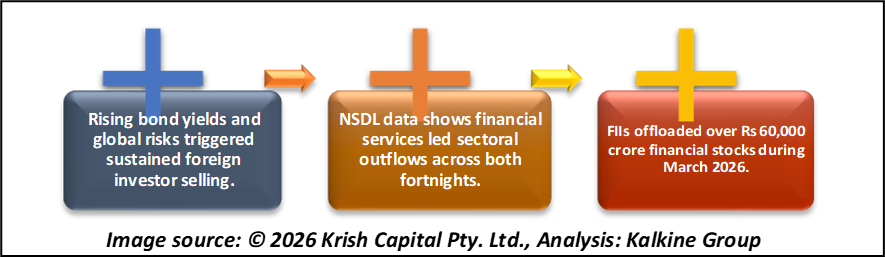
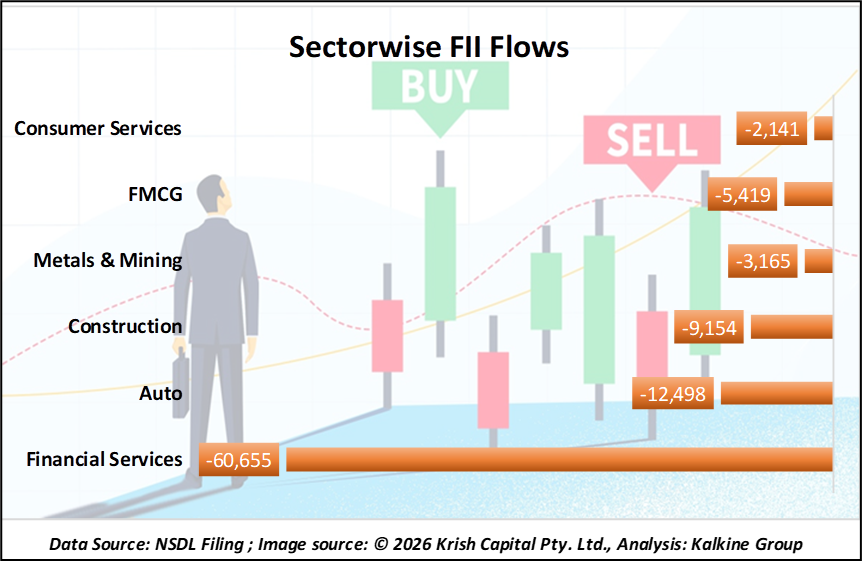
Foreign Institutional Investors (FIIs) continued aggressive selling in March 2026, with financial stocks witnessing cumulative outflows exceeding Rs 60,000 crore. The trend was visible across major banking and NBFC stocks listed on NSE and BSE, reflecting a broad-based reduction in exposure.
Data from NSDL’s fortnightly sector-wise report highlights that financial services remained the most impacted segment, with consistent selling across both halves of the month.
NSDL Data Shows Record Sectoral Pressure
According to NSDL data, the first half of March alone saw financial services stocks account for a major share of FII outflows. FIIs pulled out nearly Rs 31,831 crore from the sector during this period, representing around 60% of total sectoral outflows.
This was followed by continued selling in the second half, indicating that the pressure was not event-driven but part of a sustained portfolio adjustment. Broader equity outflows in early March also crossed Rs 60,000 crore within the first few trading sessions, reflecting strong selling momentum.
Yield Spike Drives Portfolio Reallocation
The primary trigger behind the selling trend was the rise in bond yields, both globally and domestically. Higher yields tend to reduce the relative attractiveness of equities, especially rate-sensitive sectors like financials.
FIIs typically rebalance portfolios toward fixed-income instruments in such environments. This shift was further influenced by global uncertainties, inflation concerns, and tightening liquidity conditions.
Broad-Based Selling Across Financial Ecosystem
NSDL’s sectoral data indicates that the selling was not limited to select stocks but spread across private banks, PSU banks, and NBFCs.
The phased outflows across two fortnights suggest a systematic reduction in exposure rather than short-term profit booking. Historical trends also indicate that financial services often bear the brunt during periods of FII risk aversion.
Market Impact and Institutional Dynamics
The heavy weight of financial stocks in benchmark indices meant that sustained FII selling impacted overall market performance. Indices experienced intermittent volatility during March, with downward pressure linked to banking stocks.
However, domestic institutional investors (DIIs) provided partial support, helping absorb some of the selling pressure and stabilizing broader market movements.
Outlook Depends on Rate Cycle and Liquidity
Future FII flows into financial stocks will largely depend on the trajectory of interest rates and bond yields. Stabilization in yields could moderate selling, while continued upward pressure may sustain cautious positioning.
Global macro factors, currency trends, and central bank actions will remain key variables influencing foreign investor sentiment in the near term.
FAQs
- What does NSDL data indicate about FII activity in March 2026?
NSDL data shows financial services faced the highest FII outflows, with sustained selling across both fortnights of March. - Why are financial stocks more affected by FII selling?
Financial stocks are highly sensitive to interest rates, making them vulnerable when bond yields rise and liquidity tightens. - Can markets remain stable despite FII outflows?
Yes, strong domestic institutional buying can offset foreign selling and provide stability to equity markets.