

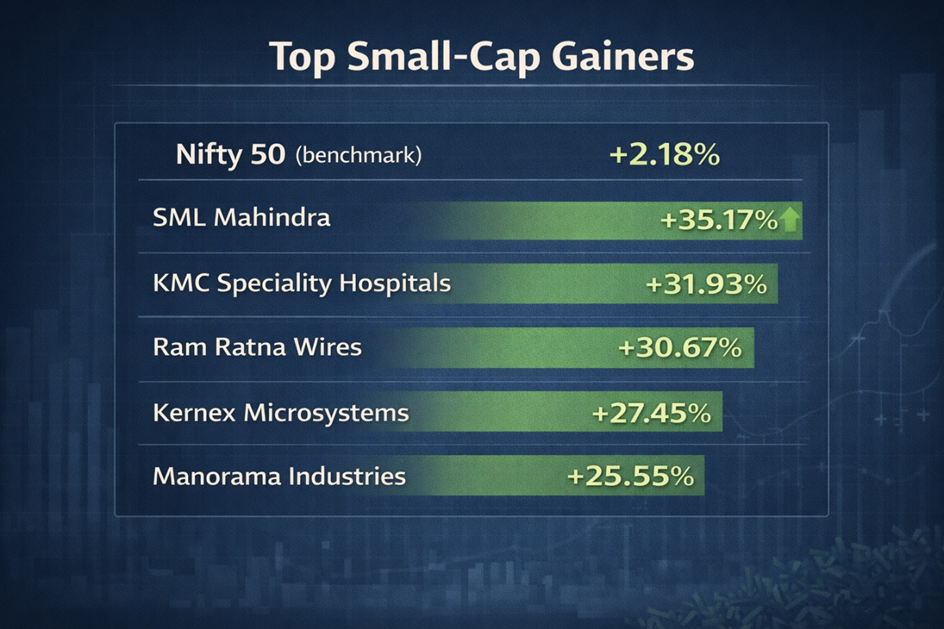
While the Nifty 50 eked out a 2.18 per cent gain over the past twelve months, five under-followed Indian companies delivered returns of between 25 and 35 per cent — a divergence that rewards the diligent and punishes the passive.
India's benchmark equity index has had a bruising twelve months. The Nifty 50, which ended the period at 23,837 — up a modest 508 points, or 2.18 per cent — spent much of early 2026 in retreat, touching a 52-week low of 22,182 before recovering. For the investor content to hold an index fund and wait, the past year has been a lesson in patience rather than reward.
Yet beneath the surface of a sluggish benchmark, a different story was playing out. Five small-cap companies — each operating in a niche with compelling structural tailwinds — delivered returns that ranged from 25 to 35 per cent over the same period. SML Mahindra, a commercial vehicle manufacturer, led the group with a 35.17 per cent gain. KMC Speciality Hospitals returned 31.93 per cent. Ram Ratna Wires added 30.67 per cent. Kernex Microsystems — a railway safety technology company with an almost unique position in India's Kavach rollout — rose 27.45 per cent. Manorama Industries, a specialty fats exporter riding a global cocoa price shock, gained 25.55 per cent.
The gap between these names and the headline index — in each case exceeding 23 percentage points — is not noise. It reflects the kind of asymmetric return profile that active small-cap investing, at its best, is supposed to deliver.
Key highlights · One-year returns vs benchmark
Source: REFINITIV, Analysis of Kalkine Group
Source: REFINITIV, Analysis of Kalkine Group
A commercial vehicle maker with remarkable returns on capital
Source: REFINITIV, Analysis of Kalkine Group
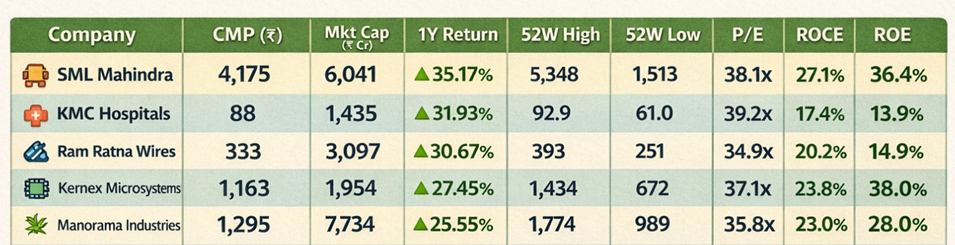
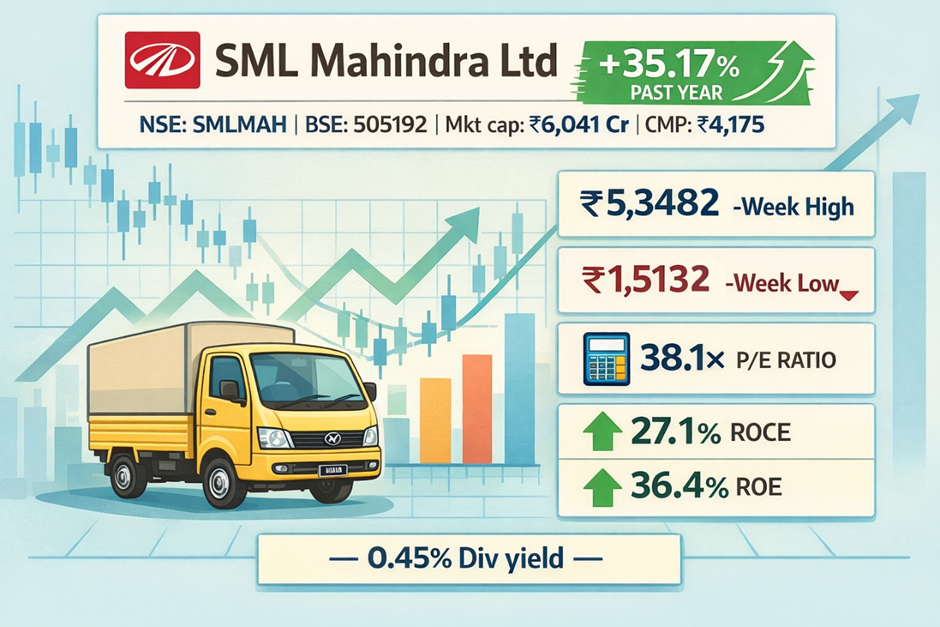
No company in this group illustrates the relationship between capital discipline and stock market performance more clearly than SML Mahindra. An ROE of 36.4 per cent and ROCE of 27.1 per cent — sustained over recent quarters — represent a quality of capital allocation that most Indian mid-cap companies would envy, let alone small-caps.
The stock's journey over the past year has been dramatic. From a 52-week low of ₹1,513, SML Mahindra surged to a peak of ₹5,348 — a near-3.5x move at the top — before consolidating to ₹4,175. The primary driver has been India's commercial vehicle upcycle: government procurement programmes for buses, fleet modernisation demand, and the infrastructure spending push have translated into order momentum that consistently exceeded market expectations. The company is investing in CNG and alternative-fuel variants, aligning its product range with India's clean mobility policy direction and extending its addressable market.
Source: REFINITIV, Analysis of Kalkine Group
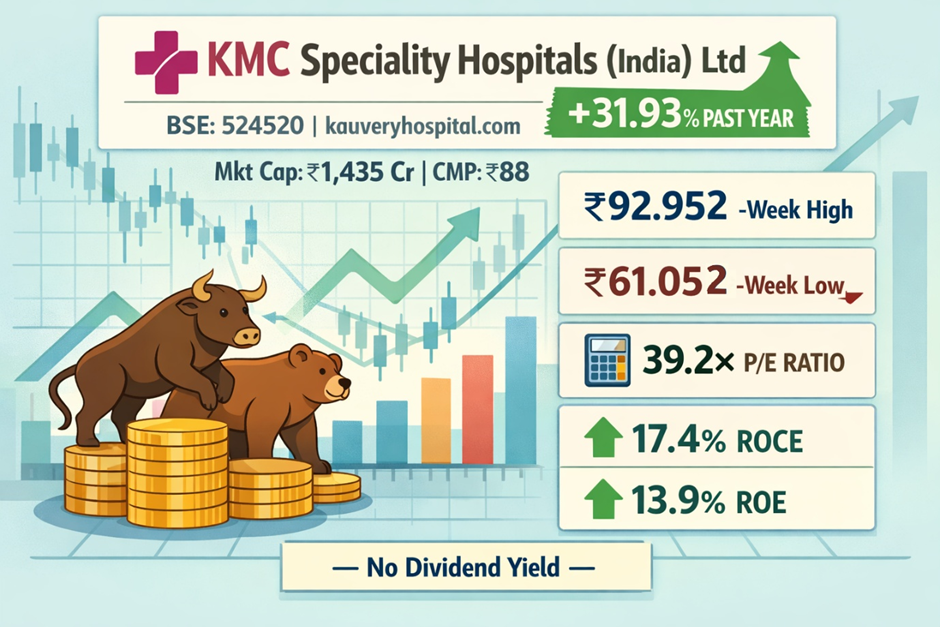
India's private healthcare sector has undergone a quiet but significant re-rating over the past two years, and KMC Speciality Hospitals — the Kauvery Hospital group — has been a direct beneficiary. The Trichy-based multi-speciality chain, which dominates a Tier-2 Tamil Nadu market where competition from large corporate hospital chains remains limited, has seen its stock move from ₹61 to a 52-week high of ₹92.9.
The investment thesis rests on structural demand rather than a cyclical upturn. Rising insurance penetration, an ageing population demanding speciality care outside major metros, and improving payer mix have all contributed to better occupancy and margin expansion. At a P/E of 39.2× the market is pricing in further earnings growth, but the company's ROCE of 17.4 per cent suggests the returns on incremental capital deployed in expansion are respectable. Management has outlined brownfield capacity additions targeting higher-revenue speciality disciplines — oncology, cardiology, neurology — where KMC's clinical reputation is already established.
Source: REFINITIV, Analysis of Kalkine Group
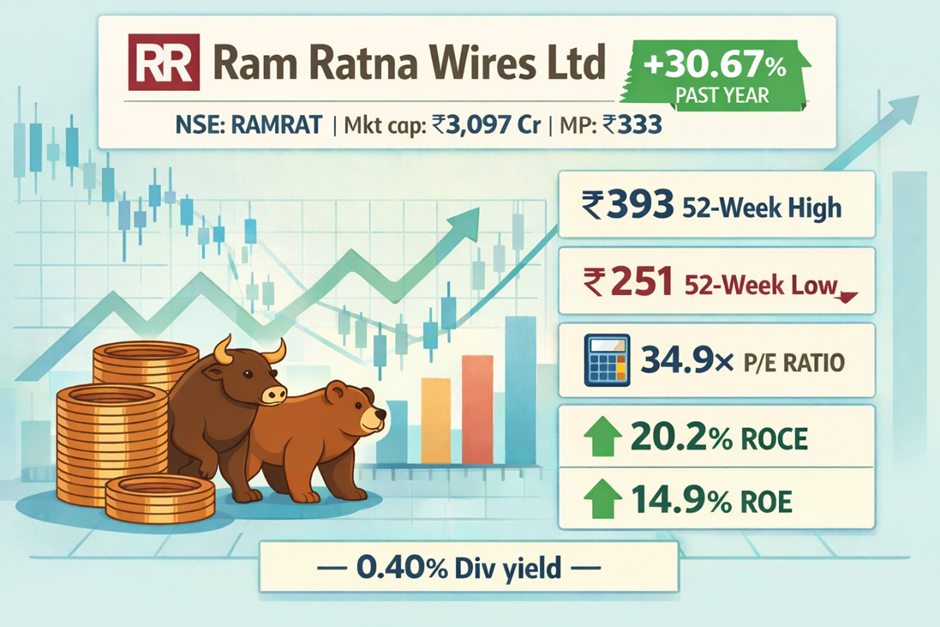
Ram Ratna Wires is the second-largest manufacturer of enamelled copper winding wires in India — a position that has become considerably more valuable as the country's power sector undergoes a sustained capital expenditure cycle. The company's core product, enamelled copper conductor, is an unglamorous but indispensable input to motors, transformers, compressors, and, increasingly, EV drivetrains.
The stock moved from ₹251 to a 52-week high of ₹393 before settling at ₹333 — a 57 per cent swing at peak, delivering a 30.67 per cent return over the year for holders. India's production-linked incentive schemes for white goods and electrical equipment, combined with the clean energy transition's structural copper intensity, have created a demand environment that appears durable rather than cyclical. ROCE of 20.2 per cent is creditable for a manufacturing business exposed to commodity input prices, and the company pays a regular quarterly dividend — a hallmark of consistent profitability.
Source: REFINITIV, Analysis of Kalkine Group
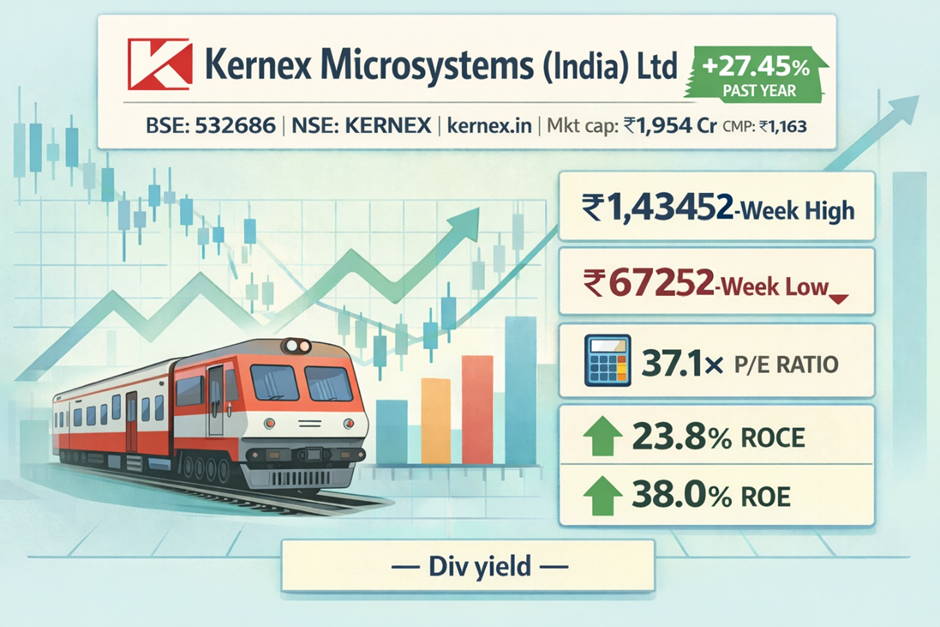
Kernex Microsystems occupies a position that most small-cap investors can only dream of: it is an approved vendor for a national infrastructure programme with no meaningful competition, a government mandate behind it, and a deployment timeline measured in years rather than quarters. The company manufactures safety systems and software for Indian Railways and is one of a tiny number of qualified suppliers for Kavach — India's indigenous automatic train protection system.
The stock's 1Y chart tells a story of high conviction and high volatility in equal measure: starting near ₹909 in April 2025, surging to ₹1,425 at its peak, correcting sharply, then recovering to ₹1,163. Yet the 27.45 per cent annual return understates the quality of the underlying business: an ROE of 38 per cent — the highest in this group — reflects the asset-light, software-intensive nature of railway safety systems. The key risk is execution pace: Kernex's fortunes are closely tied to the speed at which Indian Railways deploys Kavach across its network, which has historically been subject to budgetary and operational delays.
Source: REFINITIV, Analysis of Kalkine Group
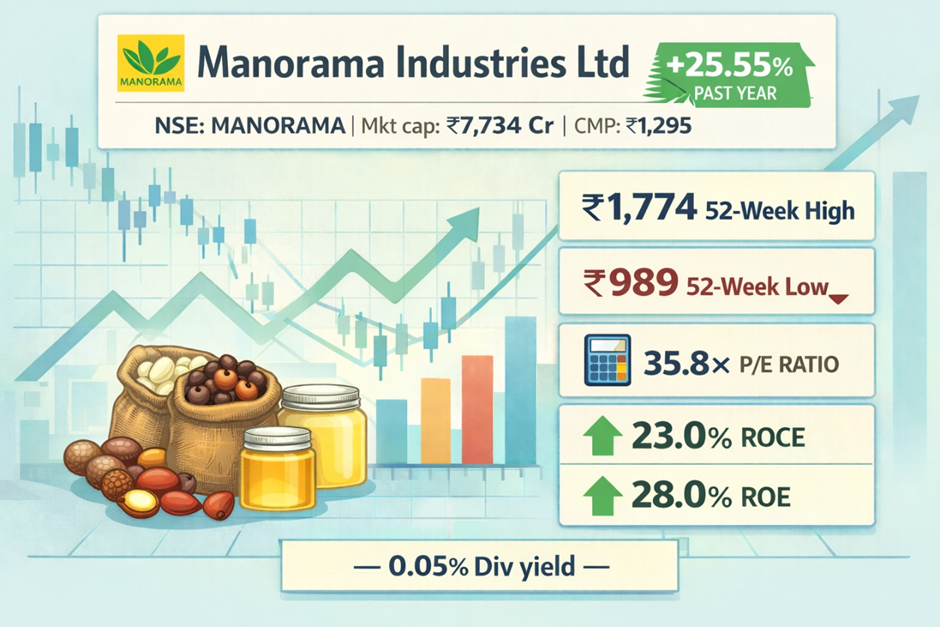
Manorama Industries is an Odisha-based company that processes non-wood forest produce — principally sal seeds and mahua — into cocoa butter equivalents consumed by global chocolate and confectionery manufacturers. It is the largest company by market capitalisation in this group at ₹7,734 crore, and its story over the past year has been shaped almost entirely by events in the global cocoa market.
Cocoa prices hit multi-decade highs over the review period, forcing the world's major chocolate producers to accelerate their use of plant-based cocoa butter substitutes. Manorama, as a niche and scalable supplier with an established forest produce sourcing network and food-grade processing capability, found itself with pricing power it had rarely exercised before. Export realisations and volumes rose simultaneously. The stock surged from ₹989 to a 52-week high of ₹1,774 — nearly an 80 per cent move at peak — before settling at ₹1,295, still a 25.55 per cent gain from twelve months prior. ROE of 28 per cent and ROCE of 23 per cent validate a business model that is less capital intensive than it appears from the outside.
"The gap between index returns and selective small-cap performance over this period is not a statistical anomaly — it is the market correctly pricing structural change in niche sectors that large-cap indices simply cannot capture."
What connects them?
Five different sectors, five different catalysts — yet several common threads run through these outperformers. Each operates in a niche with limited direct competition. Each has demonstrated capital efficiency metrics, with ROCE ranging from 17.4 per cent (KMC Hospitals) to 27.1 per cent (SML Mahindra), at a time when the cost of capital in India is not negligible. And each has a multi-year demand runway that is structural rather than cyclical: India's rail safety mandate, its power sector capex, its healthcare infrastructure gap, the global cocoa shortage, and the commercial vehicle modernisation programme are all medium-term themes, not one-quarter stories.
The common risk is valuation. All five stocks trade at P/E multiples of between 35× and 39×, implying that a significant portion of their future earnings growth is already in the price. For investors entering today, the margin of safety is narrow. The question is not whether these are good businesses — the return on capital data suggests they are — but whether the market has already recognised that fact fully.
Frequently asked questions
How much did the Nifty 50 return over the past year?
The Nifty 50 returned +2.18% over the past year, rising 508.45 points to close at 23,837 on April 13, 2026. The index ranged from a 52-week low of 22,182.55 to a high of 26,373.20 during this period.
Which stock delivered the best one-year return among the five?
SML Mahindra led with a +35.17% return (+₹1,083.80), bringing its price to ₹4,165. The stock moved from a 52-week low of ₹1,513 to a peak of ₹5,348 — a near 3.5× move at its highest point before consolidating.
Which company has the highest ROE among the five?
Kernex Microsystems has the highest ROE at 38.0%, reflecting the asset-light, software-intensive nature of its railway safety systems business. SML Mahindra is close behind at 36.4%.
What is Kavach and why does it matter for Kernex Microsystems?
Kavach is India's indigenous automatic train protection system, developed with RDSO to prevent train collisions. The Indian government has committed to deploying it across tens of thousands of route kilometres. Kernex is one of a small number of approved vendors, giving it a long, visible order pipeline that underpins its earnings outlook.
Why has Manorama Industries outperformed despite not being a technology company?
Manorama Industries benefited from global cocoa prices hitting multi-decade highs, which forced chocolate manufacturers worldwide to accelerate their use of cocoa butter equivalents — the specialty fats Manorama produces from sal seeds and mahua. This created a rare combination of rising volumes and improving realisations simultaneously.
What are the key risks for investors considering these stocks today?
All five stocks trade at P/E ratios of 35× to 39×, meaning significant future growth is already priced in. Small-cap stocks also carry lower liquidity and higher volatility than large-caps. Kernex is exposed to delays in government Kavach deployment; Manorama to cocoa price normalisation; SML Mahindra and Ram Ratna to any slowdown in India's infrastructure and manufacturing capex cycle.