

📌 Key Highlights
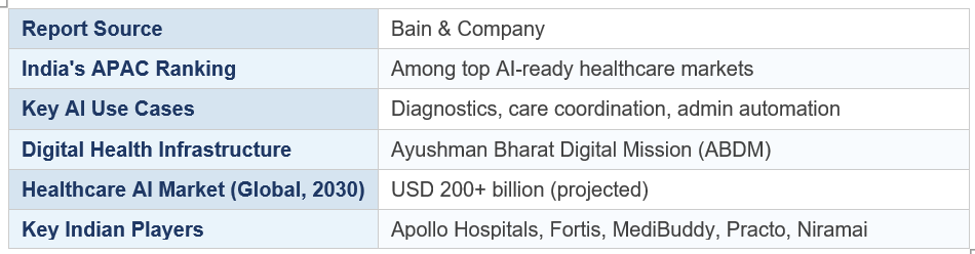
- India ranks among Asia-Pacific's most AI-ready healthcare markets, according to Bain & Company
- Rising demand for coordinated care is a primary driver of AI adoption in Indian healthcare
- Healthcare AI applications span diagnostics, clinical decision support, patient management, and administrative automation
- India's large patient population, digital health infrastructure (ABDM), and growing clinical data sets are AI enablers
- Global healthcare AI market projected to exceed USD 200 billion by 2030
- Indian healthtech companies attracting significant venture capital and strategic investment
📋 Quick Facts
📰 The Story
India has emerged as one of Asia-Pacific's most advanced markets for artificial intelligence adoption in healthcare, according to a new report by Bain & Company. The research firm cited India's rapidly expanding digital health infrastructure, large and diverse patient population, and rising demand for coordinated care as the primary factors positioning the country at the forefront of healthcare AI adoption in the region.
The Bain report highlights that AI applications in Indian healthcare are moving beyond early-stage diagnostics tools to encompass end-to-end care coordination — managing patient journeys across primary, secondary, and tertiary care settings. This is particularly relevant in India, where the fragmentation of the healthcare delivery system has historically resulted in poor care continuity and high out-of-pocket expenditure for patients.
The Ayushman Bharat Digital Mission (ABDM), which creates a unified digital health ID for every Indian citizen, is cited as a foundational enabler of healthcare AI. By standardising health records, ABDM creates structured data sets that AI models can leverage for predictive analytics, clinical decision support, and population health management. India now has over 600 million registered Ayushman Bharat Health Accounts (ABHAs), providing an unprecedented data substrate for AI-driven healthcare applications.
The report also notes that India's large network of ASHA workers, community health officers, and primary health centres — when equipped with AI-assisted diagnostic and triage tools — can significantly extend the reach of specialist care to underserved geographies. AI models trained on Indian patient cohorts (which differ epidemiologically from Western populations in disease prevalence, genetic markers, and comorbidity patterns) are increasingly demonstrating superior performance in the Indian clinical context.
Indian healthtech companies including diagnostics AI firms, telemedicine platforms, and hospital management software providers have collectively raised billions of dollars in venture funding over the past three years. Listed healthcare companies such as Apollo Hospitals, Fortis Healthcare, and Narayana Hrudayalaya have been investing significantly in AI-enabled clinical programs, while insurance companies are deploying AI for claims management and fraud detection.
The Bain report positions India alongside China, Australia, and Japan as APAC's leading healthcare AI adopters, but distinguishes India's trajectory as uniquely driven by public health priorities rather than premium-segment digitisation alone — reflecting the dual demands of a market that must simultaneously serve ultra-affluent urban patients and hundreds of millions of rural households with limited healthcare access.
📊 Financial Analysis
The strategic investment implications of India's healthcare AI leadership are significant. For listed healthcare companies, AI integration is transitioning from a competitive advantage to a competitive necessity — hospitals and diagnostic chains that fail to deploy AI in clinical workflows risk margin erosion as AI-enabled competitors achieve faster, cheaper, and more accurate diagnoses.
The B2B healthcare AI segment — companies selling AI tools to hospitals, insurers, and government health agencies — is particularly attractive from an investment perspective. These businesses benefit from institutional procurement, high switching costs once integrated into clinical workflows, and recurring software revenue models. Government healthcare programs (Ayushman Bharat, PMJAY) represent a large, structured procurement opportunity for AI-enabled health IT vendors.
For investors, the intersection of India's demographic dividend, digital infrastructure buildout, and increasing healthcare spending (projected to reach 3.5% of GDP by 2030 from ~2.5% currently) creates a multi-decade investment tailwind for healthtech.
💹 Investor Insights
Publicly listed Indian healthcare and technology companies with material AI exposure include Apollo Hospitals (AI-enabled diagnostic and care coordination programs), Thyrocare (AI in diagnostics), and various health IT software providers. The unlisted segment — dominated by startups — is accessible through AIFs and healthcare-focused venture funds.
International investors should also note that India's healthcare AI story is increasingly attracting global strategic interest, with multinational pharma and medtech companies establishing India-based AI centres to develop models trained on Indian patient data. This creates potential for technology export and global commercialisation of India-developed clinical AI solutions.
Frequently Asked Questions (FAQs)
- What is coordinated care and why is it a healthcare AI driver in India?
- Coordinated care refers to the organised management of patient care across multiple providers and settings, ensuring continuity, avoiding redundant tests, and improving outcomes. In India, where patients often navigate fragmented public and private health systems, AI-powered care coordination platforms can dramatically improve patient journeys and reduce costs.
- What is the Ayushman Bharat Digital Mission (ABDM)?
- ABDM is the Indian government's initiative to create a unified digital health ecosystem, including unique Health IDs (ABHA), digitised health records, and interoperable health data standards. It provides the data infrastructure that AI models need to deliver personalised, data-driven healthcare.
- Which Indian healthcare companies are leading in AI adoption?
- Apollo Hospitals has been among the most active, with AI programs in oncology, radiology, and cardiac care. Fortis Healthcare, Narayana Hrudayalaya, and diagnostic chains like Dr Lal PathLabs and SRL Diagnostics have also deployed AI in clinical and operational functions.
- Is India's healthcare AI leadership sustainable?
- India's advantages — large patient data volumes, strong IT talent pipeline, government digital health infrastructure, and cost-competitive AI development — are structural rather than cyclical. Sustainability depends on continued regulatory support, data privacy frameworks (DPDP Act compliance), and investment in AI model validation for Indian clinical contexts.