

Alok Industries Ltd (NSE:ALOKINDS) is one of India’s largest integrated textile manufacturers, operating across the complete textile value chain from raw materials to finished garments and home textiles. The company has undergone a significant transformation since its insolvency resolution in 2019, when it was acquired through the Insolvency and Bankruptcy Code (IBC) process by a consortium led by Reliance Industries. This acquisition reshaped the company’s capital structure and positioned it for long-term recovery, although consistent profitability remains a challenge.
Founded in 1986 and headquartered in Mumbai, Alok Industries Ltd operates large-scale textile manufacturing facilities located in Silvassa, Vapi, Navi Mumbai, and Bhiwandi. Its operations include spinning, weaving, processing, garment manufacturing, and polyester production. This integrated structure allows the company to maintain operational flexibility across multiple product categories and cater to domestic as well as export markets. Despite these advantages, the company has faced ongoing operational and financial hurdles, particularly in achieving sustainable profitability levels.
Integrated Textile Model Supports Diverse Revenue Streams
Alok Industries Ltd (NSE:ALOKINDS) operates through multiple business segments that contribute to its diversified revenue structure. These include cotton yarn and fabric manufacturing, polyester yarn production, home textile products, and garment manufacturing services.
Cotton yarn and fabric manufacturing forms an important part of the company’s operations, serving both domestic textile producers and export markets. Polyester yarn production, including partially oriented yarn (POY) and fully drawn yarn (FDY), provides backward integration benefits and aligns with Reliance Industries’ petrochemical ecosystem.
Home textile products such as bed sheets and terry towels contribute to export-driven revenue streams. The garment manufacturing division provides contract manufacturing services for domestic and international apparel companies. However, many of these segments operate in highly competitive and cyclical markets, resulting in fluctuating revenue and margin performance.
Financial Performance Reflects Continuing Turnaround Challenges
Alok Industries Ltd (NSE:ALOKINDS) has experienced fluctuating financial performance in recent years. While revenue improved following the post-pandemic demand recovery, profitability has remained inconsistent due to high operating costs and subdued demand in global textile markets.
The company has reported recurring losses in multiple financial years, primarily due to under-utilization of manufacturing capacity and pressure on margins. Capacity utilization levels have generally remained below optimal thresholds, limiting the company’s ability to benefit from economies of scale.
Financial support from the parent group has played a significant role in maintaining liquidity and supporting operational continuity. Inter-corporate deposits and financial assistance from group entities have enabled the company to continue operations despite persistent losses.
Industry Outlook Influenced by Global Demand Trends
The Indian textile industry remains a major contributor to exports and employment, but it continues to face global competition from countries such as Bangladesh, Vietnam, and China. Demand cycles in international markets significantly influence revenue growth for textile manufacturers.
Global demand volatility, fluctuating cotton prices, and changing consumer preferences have created operational challenges across the industry. Companies with strong brand presence and diversified product portfolios typically perform better in such environments.
Alok Industries Ltd (NSE:ALOKINDS) operates within a highly competitive segment where efficiency, product quality, and cost management play crucial roles in maintaining profitability. The company’s ability to strengthen customer relationships and improve capacity utilization remains essential for long-term growth.
Reliance Group Backing Offers Strategic Advantages
One of the notable strengths of Alok Industries Ltd (NSE:ALOKINDS) is its association with Reliance Industries. This relationship provides financial stability and access to raw materials through integrated supply chains.
Reliance’s broader textile and retail initiatives create potential opportunities for Alok Industries to expand production and integrate into retail-focused value chains. However, the pace and scale of such strategic integration remain uncertain, and long-term benefits depend on execution clarity.
The parent group’s financial support also enhances the company’s ability to sustain operations during challenging market conditions, reducing the risk of immediate liquidity constraints.
Key Growth Drivers Supporting Future Potential
Several factors could support the long-term growth prospects of Alok Industries Ltd (NSE:ALOKINDS). Improved capacity utilization remains one of the most important drivers. Increasing production efficiency could significantly enhance operating margins and revenue performance.
A cyclical recovery in global textile demand could also support revenue growth. As international markets stabilize, export demand for textile products may increase, benefiting integrated manufacturers.
Strategic alignment with retail and polyester value chains may create additional opportunities. Expansion into value-added textile products could improve profitability and strengthen the company’s competitive position.
Risks and Challenges Investors Should Monitor
Despite its integrated manufacturing capabilities, Alok Industries Ltd (NSE:ALOKINDS) faces several operational and financial risks. Sustained losses remain one of the most significant concerns, particularly if demand recovery remains slow.
Commodity price volatility, particularly in cotton and polyester, can impact production costs and margins. Additionally, strong competition from established textile companies with better brand positioning creates pressure on pricing and profitability.
Governance considerations, including related-party transactions with group entities, require continuous monitoring by investors. The possibility of dilution through additional funding rounds also remains a potential risk factor.
Technical Summary
Alok Industries is showing a mild recovery after a prolonged downtrend, with price attempting to sustain above the 50-day SMA, indicating early signs of trend reversal. RSI near 56 suggests improving momentum without overbought pressure. Immediate resistance is seen near 14.80–15.20, while support is positioned around 13.40–13.60 levels.
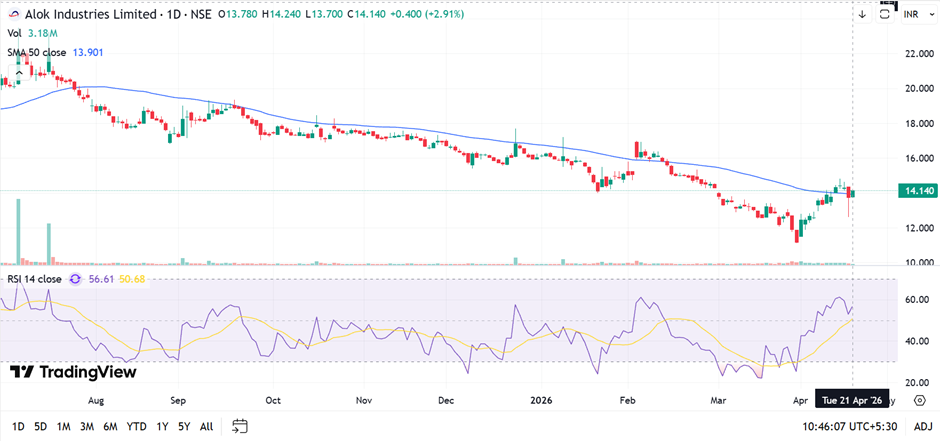
Chart by TradingView
Investment Outlook and Valuation Perspective
Alok Industries Ltd (NSE:ALOKINDS) represents a turnaround-oriented investment story supported by integrated textile infrastructure and strong promoter backing. However, the company’s financial performance has yet to demonstrate sustained improvement.
Traditional valuation methods are difficult to apply due to recurring losses and fluctuating profitability levels. Market valuation often reflects expectations of strategic support and operational recovery rather than consistent earnings growth.
Overall, the company remains a high-risk investment with uncertain profitability timelines. While long-term turnaround potential exists, investors typically evaluate this stock with caution due to its volatile financial performance and reliance on external support.
FAQs
- What does Alok Industries Ltd (NSE:ALOKINDS) manufacture?
Alok Industries manufactures cotton yarn, polyester yarn, fabrics, garments, and home textile products across an integrated textile manufacturing value chain. - What are the key challenges faced by Alok Industries Ltd (NSE:ALOKINDS)?
Major challenges include recurring financial losses, capacity underutilization, commodity price volatility, intense competition, and dependence on parent group financial support. - What factors could drive growth for Alok Industries Ltd (NSE:ALOKINDS)?
Growth may depend on capacity utilization improvements, global textile demand recovery, strategic support from promoters, and expansion into value-added products.