

Introduction
Central Bank of India (NSE:CENTRALBK) is one of India’s oldest public sector banks and represents a notable turnaround story within the PSU banking sector. The bank transitioned from a prolonged period of financial stress under regulatory restrictions to a stable operational phase supported by improving asset quality and profitability metrics. Over recent years, declining non-performing assets and gradual improvement in return ratios have strengthened investor confidence. However, despite operational progress, structural limitations such as modest profitability levels and potential government stake dilution continue to influence the long-term investment outlook.
Company Overview of Central Bank of India (NSE:CENTRALBK)
Central Bank of India was established in 1911 as the first Indian-owned and managed commercial bank and was later nationalized in 1969. Headquartered in Mumbai, the bank operates a wide branch network across India, serving millions of customers through both physical branches and digital banking platforms. The institution maintains a strong presence in central and western India, where it has historically built its customer base. The bank was placed under the Reserve Bank of India’s Prompt Corrective Action framework between 2017 and 2022 due to weak financial metrics but has since exited the framework after meeting regulatory thresholds related to capital adequacy and asset quality.
Business Model and Revenue Streams
Central Bank of India (NSE:CENTRALBK) follows a traditional public sector banking model that relies heavily on interest income generated from loans across retail, agriculture, and MSME segments. Non-interest income sources include treasury operations, government-related services, and transaction-based banking activities. The bank maintains a strong CASA ratio, reflecting a stable deposit base that supports funding efficiency. However, fee-based income remains relatively limited compared to larger peers due to modest penetration in advanced financial services and transaction banking segments. The bank’s lending portfolio has shifted over time toward safer retail and agricultural lending following earlier corporate loan stress.
Industry Overview and Market Position
India’s public sector banking industry has experienced favorable conditions in recent years, supported by strong credit growth and declining non-performing assets. Central Bank of India has benefited from this broader sector recovery, although it continues to rank below larger public sector banks in terms of operational scale and technological advancement. Competition from private banks has intensified, particularly in urban markets where customers seek advanced digital banking services. Despite these challenges, the bank retains a meaningful presence in semi-urban and rural regions where branch reach and government-linked services remain significant advantages.
Financial Performance and Profitability Trends
Central Bank of India (NSE:CENTRALBK) has demonstrated measurable improvement in financial performance over the past few years. Interest income growth has been supported by expanding loan portfolios and improved credit quality. Profitability has shifted from earlier losses to consistent positive earnings supported by lower credit costs and improved recovery from legacy accounts. Return on assets has gradually improved, reflecting better operational efficiency compared to previous years. However, cost-to-income ratios remain relatively elevated due to operational expenses and workforce-related obligations. Sustaining profitability growth will require continued focus on improving operational efficiency and maintaining credit discipline.
Balance Sheet Strength and Asset Quality
The balance sheet of Central Bank of India (NSE:CENTRALBK) has stabilized following years of provisioning and government-supported recapitalization. Gross non-performing assets have declined significantly from earlier crisis levels, while net non-performing assets have reduced to manageable levels. Provision coverage ratios have strengthened, indicating improved financial resilience against potential loan defaults. Capital adequacy remains above regulatory requirements, providing stability for future lending expansion. However, the bank’s dependence on government support for capital infusion in earlier years highlights the importance of maintaining strong internal capital generation going forward.
Competitive Strengths and Structural Challenges
Central Bank of India benefits from its extensive branch network and strong CASA deposit base, which provide funding stability and customer reach across multiple regions. Government-linked banking services also support consistent transaction volumes. However, the bank faces structural challenges including limited differentiation in product offerings, relatively weaker technology infrastructure compared to peers, and modest presence in high-margin financial services segments. These limitations place the bank at a competitive disadvantage when compared to leading public and private sector banks with advanced digital ecosystems.
Key Growth Drivers
Growth opportunities for Central Bank of India (NSE:CENTRALBK) are expected to emerge from continued credit expansion, improved recovery from legacy loans, and adoption of digital banking technologies. Enhancing customer engagement through mobile banking and digital services may improve customer retention and operational efficiency. Sustained low credit costs and stable deposit growth will remain essential factors supporting profitability. Additional diversification into higher-margin retail and secured lending segments may also contribute to long-term revenue growth.
Risks and Challenges
Central Bank of India (NSE:CENTRALBK) faces several risks that may influence its future performance. Asset quality risks remain linked to agricultural and MSME lending segments that are sensitive to economic cycles. Technology investment requirements remain ongoing, as insufficient upgrades may reduce competitiveness. Government stake dilution to meet regulatory minimum public shareholding requirements introduces potential supply pressure on stock prices. Interest rate movements may affect profitability through margin compression. Additionally, macroeconomic slowdown or renewed credit stress could reverse recent improvements in asset quality.
Technical Summary
Central Bank of India is consolidating near the 50-day SMA around 36.24, indicating neutral short-term trend. Price near 35.7 shows mild recovery after recent decline. RSI around 53 reflects balanced momentum. Immediate resistance is placed near 37.5–38, while support is seen around 34.5 and 33 levels in the near term.
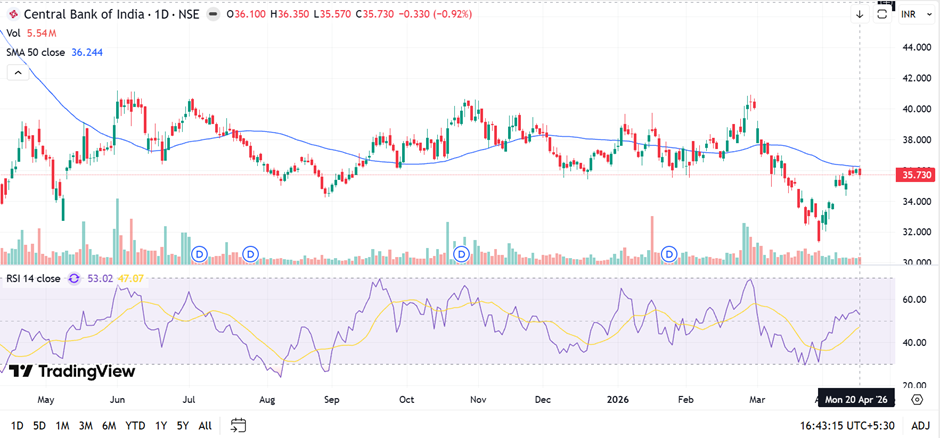
Chart by TradingView
Valuation Perspective and Investment Outlook
Valuation levels for Central Bank of India (NSE:CENTRALBK) have increased in line with the broader PSU banking sector rally. However, current valuation multiples appear relatively high when compared with the bank’s profitability metrics and return ratios. Future valuation trends will depend on sustained profitability improvement and successful management of dilution-related risks. Investors should closely monitor return ratios, asset quality indicators, and capital adequacy levels when assessing long-term investment potential.
Final Investment View
Central Bank of India (NSE:CENTRALBK) has successfully completed a meaningful operational turnaround supported by improved asset quality and profitability. However, structural limitations, valuation concerns, and potential dilution overhang create uncertainty regarding long-term upside potential. Investors evaluating this stock should remain cautious and focus on monitoring return metrics and regulatory developments before considering sustained exposure.
FAQs
Q1. What services does Central Bank of India (NSE:CENTRALBK) primarily offer?
The bank provides retail banking, MSME lending, agricultural finance, treasury services, and government-linked financial services across nationwide branch networks.
Q2. What helped Central Bank of India improve its financial performance?
Reduction in non-performing assets, improved credit recovery, government recapitalization support, and stronger loan growth contributed to profitability improvement.
Q3. What risks should investors monitor in Central Bank of India (NSE:CENTRALBK)?
Government stake dilution, asset quality risks, technology investment needs, and changing interest rate cycles remain key performance risk factors.