

Hindustan Motors Ltd (NSE:HINDMOTORS) is historically known as one of India’s pioneering automobile manufacturers, best remembered for producing the iconic Ambassador car. However, the company’s automotive operations have been inactive for several years, and its current business model largely revolves around residual assets rather than active manufacturing. Today, the company is categorized as a micro-cap entity with minimal operating revenue and significant reliance on potential asset monetization for future value creation.
Established in 1942, Hindustan Motors Ltd played a crucial role in shaping India’s early automobile industry. The Ambassador car, launched in 1958, dominated Indian roads for decades and became widely used by government institutions and taxi operators. Over time, increased competition from modern automobile manufacturers led to declining sales, eventually resulting in the shutdown of the company’s Uttarpara manufacturing plant in 2014. Since then, the company has transitioned into a non-operating structure focused primarily on managing legacy assets.
Dormant Manufacturing Operations Limit Revenue Growth
Hindustan Motors Ltd (NSE:HINDMOTORS) currently generates minimal revenue due to the absence of large-scale manufacturing operations. Historically, the company produced multiple vehicle models, including passenger cars and utility vehicles. However, operational shutdowns significantly reduced its revenue-generating capacity.
Present-day revenue sources are limited to minor activities such as spare parts sales, leasing arrangements, and miscellaneous service income. These revenue streams are insufficient to support sustained profitability, leading to recurring financial losses in recent years.
The absence of active production facilities places the company in a unique position compared to operating automobile manufacturers that continue to expand production capacity and technological innovation.
Land Assets Form the Core of Residual Value
One of the most significant assets associated with Hindustan Motors Ltd (NSE:HINDMOTORS) is its land holdings. The company owns land parcels at key locations, including the former manufacturing site at Uttarpara in West Bengal and additional property at Pithampur in Madhya Pradesh.
These land assets are often considered the primary source of potential future value. Market participants frequently speculate on the possibility of land monetization, redevelopment, or joint ventures involving these properties. However, monetization of industrial land typically involves regulatory approvals, zoning clearances, and long-term planning processes, which may delay potential realization.
As a result, while land assets represent theoretical value, converting that value into cash flow remains uncertain and subject to multiple external factors.
Financial Performance Reflects Ongoing Losses
Hindustan Motors Ltd (NSE:HINDMOTORS) has reported negligible revenue and recurring losses across multiple financial years. The company continues to incur administrative and statutory expenses despite the absence of operating income.
Negative operating cash flow and declining net worth further highlight the financial stress associated with maintaining dormant assets. Frequent audit qualifications and compliance challenges reflect ongoing operational uncertainty.
Given the limited revenue base, forecasting long-term financial performance remains difficult, making traditional financial analysis less effective for evaluating the company’s prospects.
Limited Industry Relevance in Modern Automotive Sector
Within India’s modern automobile industry, Hindustan Motors Ltd (NSE:HINDMOTORS) no longer holds a meaningful competitive position. The sector is currently dominated by companies that continue to invest in advanced technologies, electric vehicles, and large-scale manufacturing infrastructure.
Although the Ambassador brand once represented a major milestone in India’s automotive history, the brand was sold in 2017, reducing its relevance to the company’s future strategy. Without active production or research and development activities, the company’s role in the automobile ecosystem remains limited.
Industry growth trends now revolve around electric mobility, automation, and digital integration, areas where Hindustan Motors currently lacks direct involvement.
Speculative Catalysts Shape Market Sentiment
Investor interest in Hindustan Motors Ltd (NSE:HINDMOTORS) is often influenced by speculation regarding potential restructuring initiatives. These include possible land monetization projects, joint ventures, or reverse-merger opportunities involving new business entities.
Occasionally, rumors related to electric vehicle manufacturing or redevelopment initiatives have triggered temporary increases in trading volumes. However, such developments remain speculative and have not translated into confirmed operational changes.
Investors should recognize that reliance on speculative catalysts introduces significant uncertainty and volatility into the stock’s price movements.
Key Risks Investors Should Monitor
Hindustan Motors Ltd (NSE:HINDMOTORS) carries multiple risks due to its non-operational status. One major concern is the possibility of continued losses without meaningful revenue recovery.
Regulatory and legal challenges associated with land monetization represent another important risk. Changes in zoning policies or delays in approvals can significantly impact potential redevelopment timelines.
Liquidity risk also remains elevated due to low trading volumes and periodic market surveillance measures. Additionally, restructuring or merger activities could lead to shareholder dilution or changes in ownership structure.
Technical Summary
Hindustan Motors is showing a sharp recovery after a prolonged downtrend, with price sustaining above the 50-day SMA, indicating improving bullish momentum. RSI near 63 suggests strengthening momentum without extreme overbought pressure. Immediate resistance is seen around 17.20–17.50, while support is positioned near 15.80–16.00 levels in the short term.
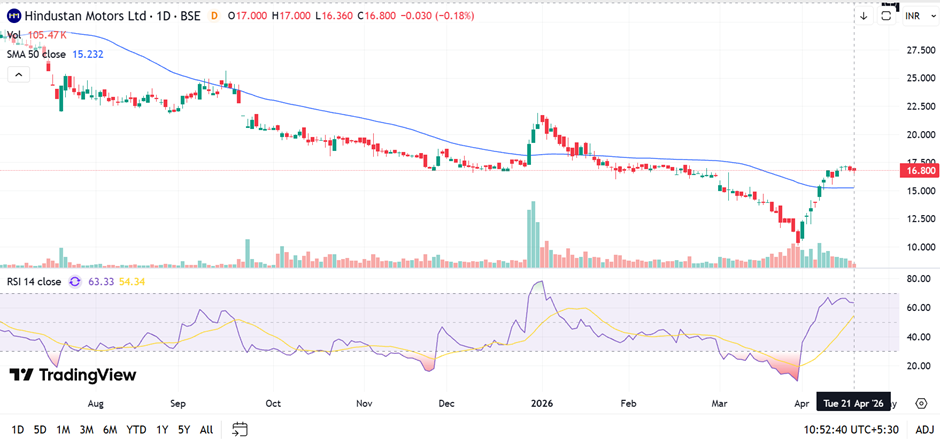
Chart by TradingView
Investment Outlook and Risk Perspective
Hindustan Motors Ltd (NSE:HINDMOTORS) represents a highly speculative investment scenario driven primarily by expectations of asset monetization rather than operational growth. Traditional valuation metrics such as earnings or price-to-earnings ratios are not meaningful due to minimal revenue and persistent losses.
The company’s long-term outlook depends on successful monetization of land assets or the emergence of new business opportunities. However, these developments remain uncertain and may take several years to materialize.
Overall, Hindustan Motors Ltd remains a high-risk investment suitable primarily for speculative market participants rather than long-term fundamental investors. Investors typically approach this stock cautiously due to its limited operational activity and uncertain growth prospects.
FAQs
- What is the current business model of Hindustan Motors Ltd (NSE:HINDMOTORS)?
The company primarily manages legacy land assets and minor service activities, with no active automobile manufacturing operations generating significant revenue. - Why is Hindustan Motors Ltd (NSE:HINDMOTORS) considered a speculative stock?
The stock depends on uncertain land monetization outcomes and restructuring possibilities rather than stable operating income or consistent earnings visibility. - What are the major risks associated with Hindustan Motors Ltd (NSE:HINDMOTORS)?
Key risks include ongoing financial losses, uncertain land monetization timelines, regulatory challenges, and absence of active operating business segments.