

Reliance Power Ltd (NSE:RPOWER) is a thermal and renewable power generation company that forms part of the Reliance Group led by Anil Ambani. Once among the most widely discussed companies in India following its landmark public listing in 2008, the company faced significant operational and financial challenges over the subsequent decade. In recent years, however, Reliance Power has taken steps toward stabilizing operations through debt restructuring and selective project execution, signaling gradual recovery in its operational profile.
Founded in 1995, Reliance Power Ltd initially set ambitious goals to develop large-scale power generation capacity across India. Although several major projects were delayed or canceled due to regulatory and financial challenges, the company continues to operate multiple power plants across thermal and renewable segments. Its core assets include the large-scale Sasan Ultra Mega Power Project, along with other thermal plants and smaller renewable installations. These facilities continue to contribute to the company’s revenue generation and operational continuity.
Operational Assets Continue to Support Core Revenue
Reliance Power Ltd (NSE:RPOWER) generates revenue primarily through long-term power purchase agreements (PPAs) with state distribution companies. These agreements provide predictable revenue streams, although margins may vary depending on fuel costs and contractual terms.
The Sasan Ultra Mega Power Project remains the company’s flagship asset and contributes a significant portion of total generation capacity. Additional operational plants support diversified power supply across multiple regions. Renewable energy installations, though limited in scale, represent the company’s initial steps toward expanding into cleaner energy generation.
Merchant power sales and short-term contracts also contribute to revenue during favorable market conditions. These supplementary income streams help improve utilization rates and enhance operational flexibility.
Financial Performance Reflects Stabilization Efforts
Reliance Power Ltd (NSE:RPOWER) has demonstrated gradual financial stabilization following years of restructuring and debt resolution. Revenue levels have remained relatively stable in recent years, reflecting consistent power generation output.
The company has significantly reduced its gross debt compared to earlier peak levels, achieved through asset monetization, settlements with lenders, and restructuring initiatives. Although leverage levels remain elevated compared to industry leaders, the reduction in debt represents an important step toward financial recovery.
Profitability has improved in certain periods, supported partly by non-recurring gains from asset sales and debt settlements. However, sustaining consistent profitability remains dependent on operational efficiency and further balance sheet strengthening.
Industry Dynamics Provide Opportunities for Improvement
India’s power sector continues to evolve, driven by increasing electricity demand and infrastructure expansion. Rising power consumption across industrial, commercial, and residential segments supports long-term demand for electricity generation.
Reliance Power Ltd (NSE:RPOWER) may benefit from improving market conditions, particularly during periods of strong electricity demand. Merchant power tariffs and favorable supply-demand balances can enhance profitability for certain operational assets.
However, the company operates in a competitive industry dominated by larger and financially stronger power producers. Maintaining competitiveness requires continuous operational efficiency and disciplined financial management.
Renewable Energy Expansion Offers Long-Term Potential
Reliance Power Ltd (NSE:RPOWER) has initiated steps toward expanding its renewable energy portfolio. Although current renewable capacity remains limited compared to industry peers, the transition toward cleaner energy presents long-term opportunities.
Renewable energy projects, including solar installations, represent potential avenues for diversification and future revenue growth. Strategic partnerships and capital investment will likely play important roles in scaling renewable capacity.
The transition toward renewable energy aligns with national energy policies and global sustainability initiatives, providing potential growth opportunities if executed effectively.
Balance Sheet Restructuring Remains a Key Focus Area
One of the most critical developments for Reliance Power Ltd (NSE:RPOWER) has been the gradual reduction in outstanding debt. This restructuring process has improved liquidity and reduced financial pressure compared to earlier years.
Despite progress, the company continues to carry significant financial obligations and contingent liabilities. Monitoring debt levels, refinancing strategies, and repayment schedules remains essential to evaluating long-term financial stability.
The company’s capital allocation strategy will play a crucial role in determining future growth potential and investor confidence.
Risks and Challenges Investors Should Monitor
Reliance Power Ltd (NSE:RPOWER) faces several operational and financial risks. One major concern relates to group-level exposures and inter-company relationships, which may affect financial performance and investor sentiment.
Fuel cost volatility and operational challenges at thermal power plants also represent potential risks. Additionally, delayed payments from distribution companies may impact cash flow cycles.
Governance concerns and market perception associated with historical financial stress remain relevant factors that investors should consider before evaluating long-term exposure.
Technical Summary
Reliance Power is showing a strong rebound with price sustaining above the 50-day SMA, indicating improving bullish momentum after a prolonged downtrend. RSI near 68 suggests strengthening momentum, approaching overbought territory. Immediate resistance is seen around 30.00–31.00, while support is positioned near 27.80–28.20 levels in the short term.
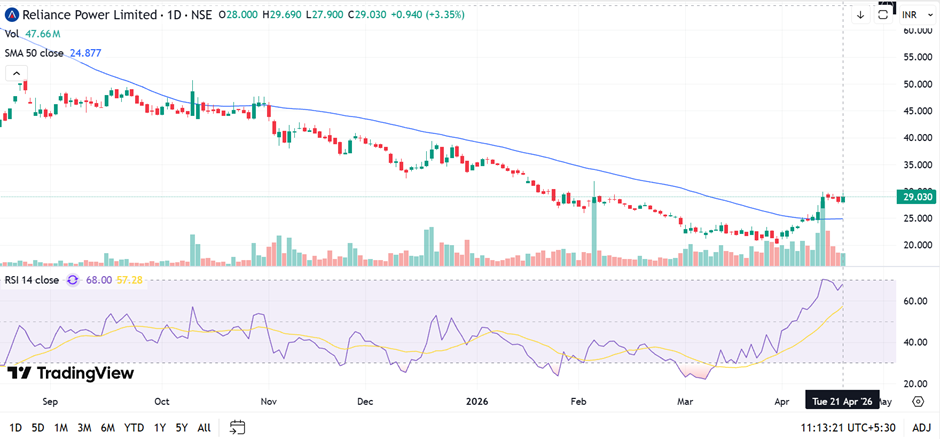
Chart by TradingView
Investment Outlook and Long-Term Perspective
Reliance Power Ltd (NSE:RPOWER) represents a recovery-driven investment profile rather than a high-growth opportunity. While debt reduction efforts and operational stabilization indicate gradual improvement, long-term growth prospects depend on disciplined execution and strategic investment decisions.
The company’s valuation has experienced significant movement driven by market sentiment and speculative activity. Investors typically view the stock as a high-risk opportunity influenced by operational recovery expectations rather than stable long-term growth fundamentals.
Overall, Reliance Power remains a transitional company navigating financial restructuring while maintaining operational continuity. Future performance will largely depend on sustained debt reduction, improved operational efficiency, and successful execution of renewable energy expansion strategies.
FAQs
- What are the primary operations of Reliance Power Ltd (NSE:RPOWER)?
Reliance Power operates thermal and renewable power plants, generating electricity primarily through long-term power purchase agreements with state utilities. - What are the major growth opportunities for Reliance Power Ltd (NSE:RPOWER)?
Potential growth opportunities include renewable energy expansion, improved electricity demand, operational efficiency improvements, and further debt reduction initiatives. - What risks are associated with Reliance Power Ltd (NSE:RPOWER)?
Key risks include financial leverage, fuel cost volatility, payment delays from utilities, governance concerns, and exposure to group-level financial risks.