

Vodafone Idea Ltd (NSE:IDEA) stands as one of the most financially stressed telecom operators in India despite maintaining a large subscriber base. Formed through the merger of Vodafone India and Idea Cellular, the company entered operations with significant scale but also inherited substantial debt and regulatory liabilities. Over recent years, the company has undertaken multiple fundraising initiatives and operational restructuring efforts to stabilize its financial position. However, persistent subscriber losses, high debt obligations, and limited capital investment in advanced network infrastructure continue to challenge long-term sustainability. These structural pressures place Vodafone Idea Ltd among the highest-risk companies in the Indian telecom sector.
Company Overview
Vodafone Idea Ltd was established in 2018 following the merger of Vodafone India Services and Idea Cellular. The company operates telecom services across India under a unified license, providing voice and data connectivity to millions of subscribers. Headquartered in Mumbai, the organization offers 2G, 4G, and limited 5G services across multiple telecom circles. Over time, the company has reduced operational costs through workforce rationalization, asset sales, and network optimization initiatives. The Government of India became the largest shareholder after converting deferred spectrum and AGR dues into equity, significantly altering the ownership structure.
Business Model and Revenue Streams
Vodafone Idea Ltd (NSE:IDEA) generates the majority of its revenue from mobile services, which include prepaid and postpaid voice and data offerings. Enterprise connectivity services contribute an additional share of revenue through fixed-line solutions, digital connectivity, and IoT-based services. The company has implemented tariff increases across multiple cycles, resulting in gradual improvement in average revenue per user levels. However, continuous subscriber losses have offset revenue gains, limiting overall financial growth. Network modernization remains a key priority, requiring substantial capital investment to maintain service quality and competitiveness.
Industry Overview and Market Position
India’s telecom industry has consolidated into a small number of major players, creating intense competition among operators. Vodafone Idea Ltd operates as the third-largest private telecom provider, positioned behind industry leaders with stronger financial resources and network infrastructure. The sector continues to experience rising data consumption and increasing demand for digital connectivity services. However, large-scale investments in network expansion remain essential to sustain market relevance. Compared to its competitors, Vodafone Idea Ltd continues to lag in advanced network deployment and customer acquisition strategies, limiting its ability to regain lost market share.
Financial Performance and Loss Trends
Vodafone Idea Ltd (NSE:IDEA) has reported persistent financial losses over multiple financial years despite improvements in operating metrics such as tariff realization and efficiency measures. Revenue levels have remained relatively stable, supported by pricing adjustments and operational improvements. However, large depreciation, amortization, and interest expenses continue to significantly exceed operating earnings. Free cash flow remains negative, indicating ongoing reliance on external financing to sustain operations. The company’s ability to generate sustainable profits remains dependent on improving revenue growth and controlling debt-related expenses.
Balance Sheet Strength and Debt Challenges
The balance sheet of Vodafone Idea Ltd (NSE:IDEA) remains heavily leveraged, representing one of the most significant financial challenges facing the company. Large debt obligations, including deferred spectrum liabilities and regulatory dues, have constrained the company’s financial flexibility. Fundraising through public offerings and promoter support has provided temporary liquidity relief, enabling network investments and operational continuity. However, ongoing reliance on external funding highlights the importance of continued financial restructuring and regulatory support. Without sustained improvement in operating cash flows, debt servicing obligations remain a major risk factor.
Competitive Strengths and Structural Limitations
Vodafone Idea Ltd maintains certain operational advantages, including spectrum holdings across multiple frequency bands and a large subscriber base across urban and rural markets. These assets provide the foundation for long-term recovery if financial conditions stabilize. However, structural limitations remain significant, including weaker network quality compared to competitors and limited financial capacity to fund rapid technological upgrades. The company’s market positioning reflects a defensive stance focused on retaining existing customers rather than expanding into premium segments. These limitations reduce its ability to compete effectively with financially stronger telecom operators.
Key Growth Drivers
Future growth prospects for Vodafone Idea Ltd (NSE:IDEA) depend heavily on external and internal factors. Industry-wide tariff increases could improve revenue generation and support profitability improvements. Continued investment in network expansion may reduce subscriber churn and improve service quality. Government policy decisions related to regulatory relief and spectrum dues restructuring remain critical drivers of financial stability. Strategic partnerships and monetization of non-core assets may also support liquidity improvement. However, achieving sustainable growth requires coordinated execution across multiple operational areas.
Risks and Challenges
Vodafone Idea Ltd (NSE:IDEA) faces a broad range of operational and financial risks. High leverage remains the primary concern, with large debt obligations creating long-term financial pressure. Subscriber churn continues to impact revenue stability and market share. Funding risks remain significant due to ongoing capital requirements for network upgrades. Regulatory decisions regarding dues restructuring and policy relief remain uncertain. Additional equity dilution may be required in future periods to support operations, potentially affecting shareholder value. These risks collectively position the company among the highest-risk telecom investments in India.
Technical Summary
Vodafone Idea is showing mild recovery but remains below the 50-day SMA near 10.05, indicating a weak broader trend. Price around 9.47 faces resistance near 10–10.2 levels. RSI near 51 suggests neutral momentum. Immediate support is seen near 9.0 and 8.6 levels, indicating range-bound movement in near term.
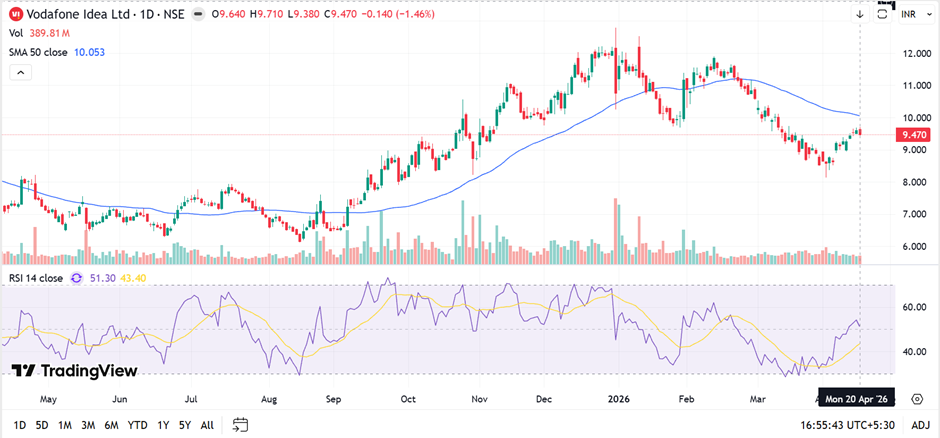
Chart by TradingView
Valuation Perspective and Investment Outlook
Valuation analysis for Vodafone Idea Ltd (NSE:IDEA) remains complex due to ongoing losses and uncertain cash flow projections. Traditional valuation methods may not accurately reflect the company’s financial risk profile. Future valuation movements will depend heavily on successful debt restructuring, subscriber stabilization, and continued tariff growth. Investors should carefully assess liquidity levels, capital expenditure commitments, and regulatory developments when evaluating investment potential.
Final Investment View
Vodafone Idea Ltd (NSE:IDEA) continues to operate under significant financial pressure despite ongoing restructuring initiatives. The company’s recovery path depends on multiple factors, including regulatory support, operational improvements, and sustained capital investment. While turnaround possibilities exist, the overall risk profile remains elevated. Investors should adopt a cautious approach and consider the long-term financial risks before making investment decisions involving this stock.
FAQs
Q1. What services does Vodafone Idea Ltd (NSE:IDEA) primarily provide?
Vodafone Idea offers mobile voice, data connectivity, enterprise communication services, and digital solutions across nationwide telecom infrastructure networks.
Q2. Why has Vodafone Idea Ltd faced continuous financial losses?
High debt levels, regulatory liabilities, heavy interest costs, and subscriber losses have contributed to persistent losses over multiple financial periods.
Q3. What factors could support Vodafone Idea Ltd’s future recovery?
Tariff increases, government relief measures, improved network investment, and subscriber stabilization remain critical drivers supporting long-term recovery potential.