

Yes Bank Ltd (NSE:YESBANK) represents one of the most significant turnaround stories in India’s private banking sector. After undergoing a major regulatory-led reconstruction in 2020, the bank has gradually rebuilt its balance sheet, improved asset quality, and restored profitability. Supported by institutional backing from a consortium of banks and the recent announcement of a strategic investment by Sumitomo Mitsui Banking Corporation, Yes Bank has entered a new phase of recovery. Despite operational progress, profitability metrics remain below those of leading private sector banks, and investors continue to monitor execution risks associated with its long-term turnaround.
Company Overview of Yes Bank Ltd (NSE:YESBANK)
Yes Bank Ltd was founded in 2004 and rapidly expanded into one of India’s major private banks before facing a severe credit quality crisis that led to regulatory intervention. The reconstruction scheme implemented in March 2020 involved capital infusion from multiple public and private banks, stabilizing the institution and restoring customer confidence. Headquartered in Mumbai, the bank operates an extensive branch and ATM network serving retail, corporate, and institutional customers. Over recent years, the bank has shifted its focus toward building a diversified loan portfolio emphasizing retail and SME lending while reducing exposure to high-risk corporate assets.
Business Model and Revenue Streams
Yes Bank Ltd (NSE:YESBANK) generates revenue through multiple sources typical of private sector banks. The largest component is net interest income derived from loans extended across retail, SME, and corporate segments. Additional revenue streams include fee-based services such as transaction banking, wealth management, foreign exchange services, and treasury operations. Over time, the bank has reshaped its loan mix to prioritize smaller-ticket retail and MSME loans, reducing reliance on large corporate borrowers. While the CASA ratio has improved steadily following the reconstruction phase, funding costs remain relatively higher compared to established private sector peers.
Industry Overview and Market Position
India’s private banking sector remains highly competitive, dominated by large institutions with strong deposit franchises and advanced digital ecosystems. Yes Bank operates within the second tier of private banks, competing in segments such as SME lending and retail banking. The bank’s recovery strategy focuses on expanding customer relationships through digital banking platforms and improving operational efficiency. The entry of a global banking partner is expected to enhance product capabilities and strengthen cross-border banking opportunities. However, competition from well-established private banks continues to limit rapid market share expansion.
Financial Performance and Profitability Trends
Financial performance at Yes Bank Ltd (NSE:YESBANK) has improved significantly since the restructuring period. Profitability has transitioned from earlier losses to steady earnings growth, supported by lower credit costs and improved loan quality. Net interest income has increased gradually, reflecting stable lending activity and controlled risk exposure. Return on assets has moved into positive territory, though it remains below the industry benchmark levels achieved by leading private banks. Operational costs remain relatively high due to investments in technology and branch expansion. Sustained profitability growth will depend on improving margins and enhancing operational efficiency.
Balance Sheet Strength and Asset Quality
The balance sheet of Yes Bank Ltd (NSE:YESBANK) has stabilized following capital infusions and restructuring initiatives. Asset quality indicators have improved considerably, with reductions in gross and net non-performing asset levels. Capital adequacy remains comfortably above regulatory thresholds, supporting lending expansion. However, legacy exposures related to stressed assets continue to require monitoring. Ongoing provisioning against legacy exposures remains a critical factor influencing future profitability trends. Liquidity levels remain strong, ensuring the bank’s ability to meet regulatory requirements and support customer deposit growth.
Competitive Strengths and Structural Challenges
Yes Bank Ltd benefits from its rebuilt deposit franchise and adoption of digital banking technologies aimed at improving customer engagement. The institution has invested significantly in strengthening its operational framework and rebuilding market confidence. However, structural challenges remain in the form of higher operating costs and relatively lower profitability compared to larger private sector banks. Brand perception among corporate customers continues to evolve gradually following earlier credit issues. Maintaining customer trust and improving profitability metrics remain essential priorities for sustaining competitive positioning.
Key Growth Drivers
Growth prospects for Yes Bank Ltd (NSE:YESBANK) are expected to be supported by expansion of retail and SME lending, growth in fee-based services, and enhanced digital banking capabilities. The strategic partnership with a global banking institution is expected to support product diversification and cross-border financial services. Improvement in operational efficiency and reduction in funding costs may also support long-term profitability growth. Successful execution of these initiatives could improve return ratios and strengthen investor confidence in the bank’s long-term prospects.
Risks and Challenges
Yes Bank Ltd (NSE:YESBANK) faces several risks that investors should consider. Residual exposure to legacy stressed assets remains a key concern, as additional provisioning could affect earnings. Competitive pressure from established private sector banks continues to influence pricing and profitability. Management transition risks and regulatory oversight remain important factors influencing operational stability. Additionally, macroeconomic fluctuations affecting retail and SME borrowers could lead to higher credit costs in future periods.
Technical Summary
Yes Bank is showing short-term recovery, trading slightly above the 50-day SMA near 19.78, indicating improving momentum. Price around 19.84 faces immediate resistance near 20.5–21 levels. RSI near 57 signals strengthening momentum. Immediate support is seen near 19 and 18.2 levels, suggesting cautious bullish bias near term.
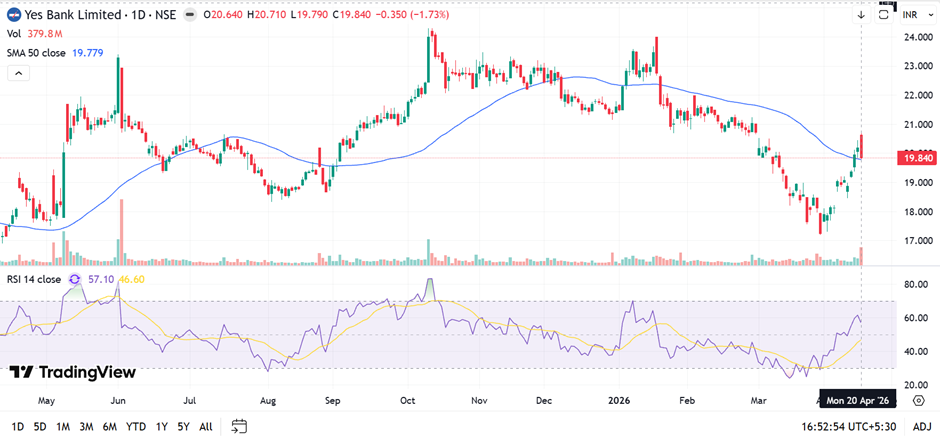
Chart by TradingView
Valuation Perspective and Investment Outlook
Valuation levels for Yes Bank Ltd (NSE:YESBANK) reflect market expectations of sustained turnaround progress and improved profitability. However, current valuation multiples appear elevated relative to the bank’s return ratios. Future stock performance will depend on achieving consistent improvement in margins, operational efficiency, and asset quality metrics. Investors should carefully evaluate long-term profitability trends and strategic execution before considering long-term allocation decisions.
Final Investment View
Yes Bank Ltd (NSE:YESBANK) has made substantial progress in rebuilding its financial strength following the restructuring period. The bank’s operational stability has improved, and growth prospects remain supported by retail lending expansion and digital transformation initiatives. However, the turnaround process remains ongoing, and sustained improvement in profitability metrics is required to justify higher valuations. Investors should adopt a cautious approach and monitor quarterly performance indicators to assess long-term sustainability.
FAQs
Q1. What led to the turnaround of Yes Bank Ltd (NSE:YESBANK)?
Regulatory intervention, capital infusion from consortium banks, asset quality cleanup, and improved deposit mobilization supported the bank’s recovery phase.
Q2. How does Yes Bank Ltd generate revenue across its operations?
Revenue is generated from interest income on loans, transaction fees, treasury operations, and wealth management services across multiple customer segments.
Q3. What risks should investors monitor in Yes Bank Ltd (NSE:YESBANK)?
Legacy asset exposures, competitive pressure, operational efficiency challenges, and macroeconomic risks affecting loan repayment remain important monitoring factors.